Portuguese
  Spanish


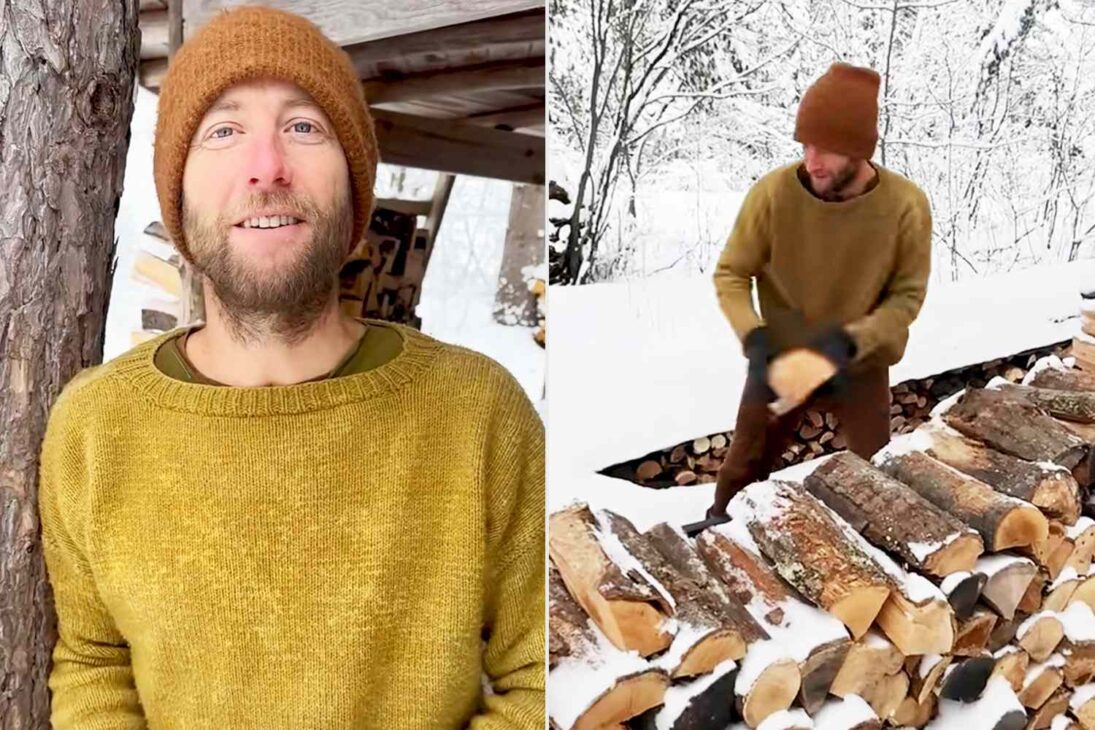
In a tiny house without conventional infrastructure, Robin Greenfield shows how he faces the intense cold of Wisconsin with simple resources, planned routine, and choices linked to sustainability, in an experience that went viral on social media.
Life in a tiny house without running water and electricity
Robin Greenfield lives in a tiny house in northern Wisconsin, United States, without thermal insulation, running water, or electricity.
During the winter, he resorts to layers of wool, blankets, and heated stones to keep the bed warm, in a routine that gained traction on social media by showing, in detail, how life functions with low dependence on conventional infrastructure.
The environmental activist, known for projects linked to sustainability and consumption reduction, recorded part of his daily life in a video published on TikTok.
-
Strawberry Moon to Be Visible in Brazil on Monday (29th); Here’s When and How to Watch

-
Driver Crosses 100-Year-Old Railway Bridge Over Uruguay River, Encounters Rural Couple Preserving Traditional Farming Methods
-
Rural Producer Returns to Brazilian Farmland, Builds Family Agricultural Business with Children’s Support and Industry Backing
-
Goiás Couple Boosts Artisan Cheese Production from 25 to 70 Kilos Daily with Technical Support, Transforming Family Life in Rural Brazil


The recording caught attention for showing basic tasks, such as keeping warm, storing food, and dealing with the lack of piped water, in a region marked by intense cold part of the year.
In an interview with People magazine, Greenfield stated that he was pleased to see the message reach so many people and offer “inspiration and education.”
According to him, the aim of the exposure is not to present his own routine as a mandatory model, but to encourage the public to reflect on consumption habits, comfort, and dependence on paid services.
The house where Greenfield lives does not have the systems associated with most urban dwellings.
There is no electric heating, indoor faucets, conventional shower, or switches.
As a result, activities that generally go unnoticed in daily life depend on planning, physical effort, and adaptation to the climate.
Heated stones help to face the cold of Wisconsin
Among the strategies he uses is the use of heated stones to retain heat in the bed.
The practice appears in the video as an alternative to electric heating or heating systems, but Greenfield does not claim that it replaces all necessary precautions to face low temperatures.
The routine also includes appropriate clothing, wool blankets, and constant organization of available resources.
Winter in Wisconsin often poses additional challenges for those living without thermal insulation.
In such a structure, the cold tends to enter through walls, floors, and gaps, which requires combined measures to reduce heat loss.
In Greenfield’s case, these measures are part of a personal choice related to how he organizes his own life.
Lifestyle Change Began in 2011
The journey that led him to this lifestyle began in 2011.
At the time, according to what he told People, Greenfield was 25 years old and intended to become a millionaire before turning 30.
Contact with books and documentaries about environmental impacts led him to reconsider the relationship between his habits and his beliefs.
The change occurred gradually.
For two years, he adopted a series of weekly adjustments focused on reducing consumption, environmental impact, and dependence on conventional structures.
Over time, these choices ceased to be isolated initiatives and began to guide his public actions.
In the tiny house, the routine involves tasks that require time.
Heating the space, preparing food, dealing with waste, obtaining water, and preserving supplies are part of the daily routine.
For Greenfield, this effort is linked to how he understands quality of life.
“The way I see it is that a quality existence takes time,” he told People.
The phrase helps explain one of the central points of his project: the attempt to make visible processes that, in cities, are usually resolved by infrastructure systems and outsourced services.
Instead of paying water, energy, and rent bills, Greenfield claims to seek to meet some of his own needs through skills, community relationships, and reduced material demand.
Foraging and Eating Outside the Supermarket
Another experience associated with his routine is the attempt to spend a year consuming only food and medicine obtained through gathering, spontaneous cultivation, or foraging.
More than five months after the start of the project, he told People that the process was occurring more naturally than he expected.
The main difficulty, according to Greenfield, is not just in finding food.
The challenge includes correctly identifying plants, collecting at the right time, preparing food, and balancing these tasks with other commitments.
He states that, with the advancement of experience, he started thinking less about supermarkets and more about the cycles of obtaining and preserving food.
The experience also involves waste management practices.
In another interview with People, Greenfield reported using a dry composting toilet.
The system he described includes a simple wooden structure, a seat, and a bucket, in which sawdust is added after use.
Then, the material is sent for decomposition.
Limited Technology and Less Dependence on Money
Despite living in a house without electricity, Greenfield does not claim to have completely eliminated the use of technology.
According to People, he uses energy from a nearby house when he needs to access a computer, attend meetings, or operate equipment related to food storage and preparation.
The difference, as he describes, is in the attempt to limit dependence on these resources.
This point avoids a misreading of the experience.
Greenfield does not present life in the tiny house as total isolation from society nor as complete abandonment of technology.
What he claims to seek is the reduction of the role of money and paid services in meeting basic needs.
“It’s basically looking at every way I’m spending money to meet my needs and building the skills or relationships to fulfill those goals,” he declared to People.
In practice, he associates this choice with less spending on housing, bills, recurring purchases, and ready-made services.
Repercussion on Social Media
The repercussion on social media generated different reactions.
Some viewers expressed curiosity about the methods he uses to live in the cold.
Others questioned the feasibility of the routine and raised doubts about the authenticity of the experience.
Greenfield acknowledges this skepticism and relates it to the distrust that many people have developed towards public figures and content published on the internet.


The messages he considers most relevant are those where viewers claim to have reconsidered their own routine.
“This is my job, to create critical thinking and self-reflection,” he stated.
According to Greenfield, the goal is not to convince everyone to live without running water or electricity, but to encourage changes compatible with each person’s reality.
Among the examples he cited are growing some of the food, composting, reducing the size of the dwelling, cutting down on purchases, or participating in community activities.
The proposal, as presented by Greenfield, is that simplicity can take different forms without requiring everyone to adopt the same level of restriction.
Sustainability, autonomy, and consumption
The interest in the tiny house is also related to frequent themes in debates about sustainability, autonomy, and consumption.
By showing how he organizes basic tasks without part of the modern infrastructure, Greenfield exposes the amount of work that is normally absorbed by public systems, private services, and household appliances.
His routine does not deny the importance of treated water, sanitation, electricity, or conventional heating.
The case shows, from an individual choice, how these resources reduce daily efforts and shape the way people use time, money, and energy.
In the field of scientific curiosity, the experience brings together issues related to climate, heat conservation, food, waste management, sanitary safety, and environmental adaptation.
Each of these areas requires practical knowledge so that a life with less infrastructure does not become a risk.
Between the interest in the lifestyle and the doubts about its viability, the story of Greenfield continues to circulate as an example of an extreme experience of voluntary simplicity.