






 Portuguese
  Spanish
  3 min of reading
  0 comments


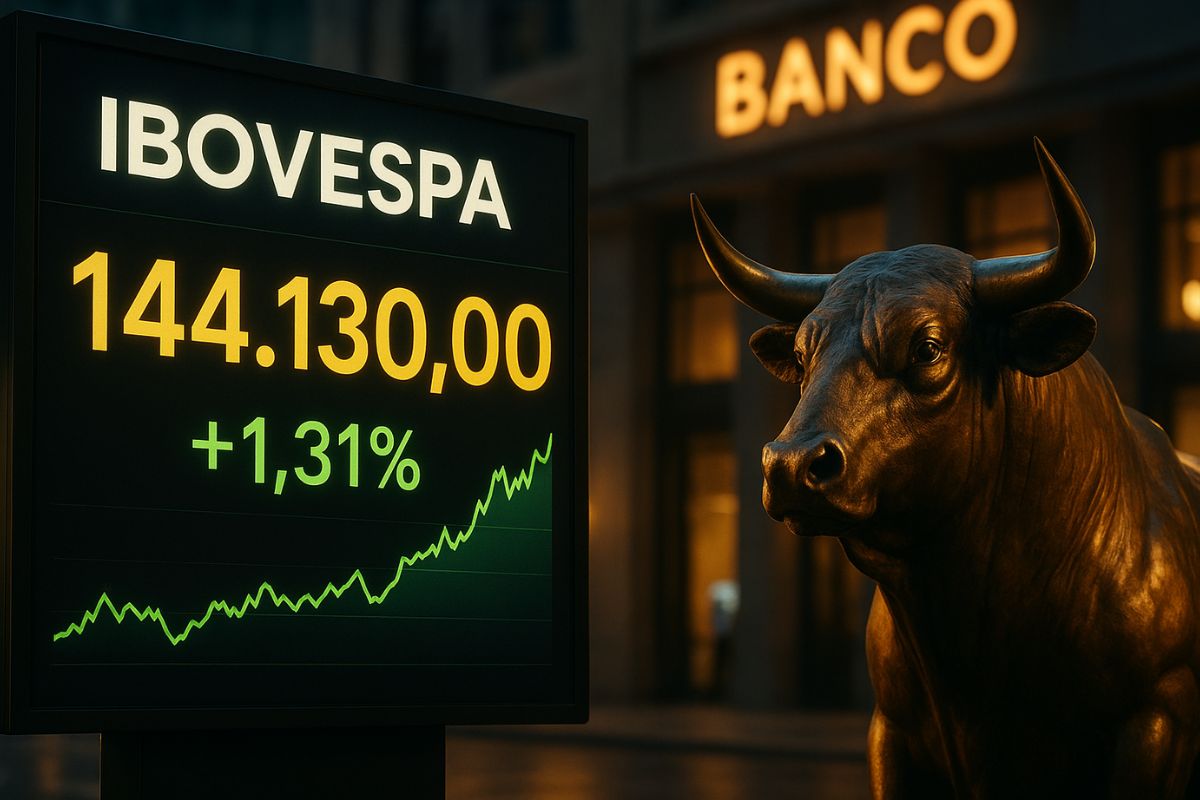
Brazilian Stock Market Hits 144,130 Points for the First Time in History. A 1.31% Increase Was Driven by Big Banks and Reinforces Investor Appetite for the Local Market
The Ibovespa, the main index of the Brazilian stock market, reached a historic level of 144,130 points on Monday (15), recording an intraday increase of 1.31%. This historic record was driven by the strength of big banks and the improvement in economic indicators, which eased pressure on future interest rates.
According to data from B3, the Brazilian stock market gained traction with a combination of controlled inflation and expectations of stable interest rates, a scenario that gave momentum to the shares of financial institutions and increased investor confidence in the local market.
Banks Lead Gains and Pull the Index
The banking sector was the main driver of the Brazilian stock market’s rise.
-
Brazilian Joins Homeownership Consortium, Faces Decade of Dual Payments Totaling $141,000, Surpassing Traditional Mortgage

-
Land Rover to Halt Production in July, Putting 371 Jobs at Risk, as Chinese Automaker Negotiates to Convert Factory to 100,000 Vehicles Annually by 2027

-
Mexican Pest Threatens U.S. Cattle Herds at Historic Lows, Potentially Boosting Brazilian Beef Exports as Burger Prices Soar

-
Brazilian Freight Bill Progresses in Congress with $5,000 Minimum Wage, 70% Advance Payment, and Fines Up to $1 Million, as Agriculture and Industry Warn of Rising Costs and Legal Uncertainty


Bradesco ON rose 2.01%, to R$ 14.70, while Bradesco PN increased 1.66%, to R$ 17.11, renewing recent highs.
Also seeing significant gains were BTG Pactual (+1.71%), Itaú PN (+1.47%), and Santander Unit (+1.08%), consolidating the strength of the sector.
Banco do Brasil diverged from the positive movement, falling 1.03%, amid fears of potential sanctions from the United States following the conviction of former President Jair Bolsonaro.
This decline brought caution and showed that political factors still weigh on the Brazilian stock market.
Iron Ore Recedes, But Vale Sustains Gains
Despite the decline in iron ore in Dalian (-0.31%) and Singapore (-0.25%), stocks linked to the mining sector also helped sustain the Brazilian stock market.
Vale rose 0.75%, followed by Bradespar PN (+0.71%) and CSN Mining (+0.59%).
In the steel sector, the gains were even stronger: Gerdau PN increased by 2.45%, Metalúrgica Gerdau PN gained 2.38%, while CSN ON (+0.89%) and Usiminas PNA (+0.22%) also traded higher.
These movements show that the Brazilian stock market finds support in strategic sectors, even amid international fluctuations.
Dollar Falls and Interest Rates on Global Radar
While the Brazilian stock market set a record, the spot dollar fell 0.78%, quoted at R$ 5.31 — the lowest since June 2024.
The future dollar for October was down 0.72%, to R$ 5.3320.
According to operators, the focus is on “super Wednesday”, when the market is expected to watch the interest rate decisions in the United States and Brazil.
The projection is for an interest rate cut by the Federal Reserve and a maintenance of the Selic at 15% per year by the Central Bank.
This differential favors carry trade operations, where international investors invest in higher return markets like the Brazilian stock market.
What Does This Record Mean for the Investor?
The historic mark of 144,000 points reinforces the attractiveness of the Brazilian stock market in the short term, but experts warn that risks remain.
Domestic political instability, dependency on foreign flow, and global uncertainties — such as the slowdown of the Chinese economy — may influence the direction of the index.
For individual investors, the record is symbolic, but it does not eliminate risks.
The moment favors those who already have positions in banks and companies linked to the domestic market, but analysts continue to recommend diversification and a focus on the long term.
The new record of the Brazilian stock market shows the strength of big banks and the optimism of investors, but it also exposes the need for caution in an uncertain global scenario.
Do you believe that this record of the Brazilian stock market marks a turning point in confidence in the market or do you think it is still too early to celebrate? How does this movement impact your investments? Leave your opinion in the comments — we want to hear from those who experience this firsthand.





-

1 person reacted to this.