






 Portuguese
  Spanish


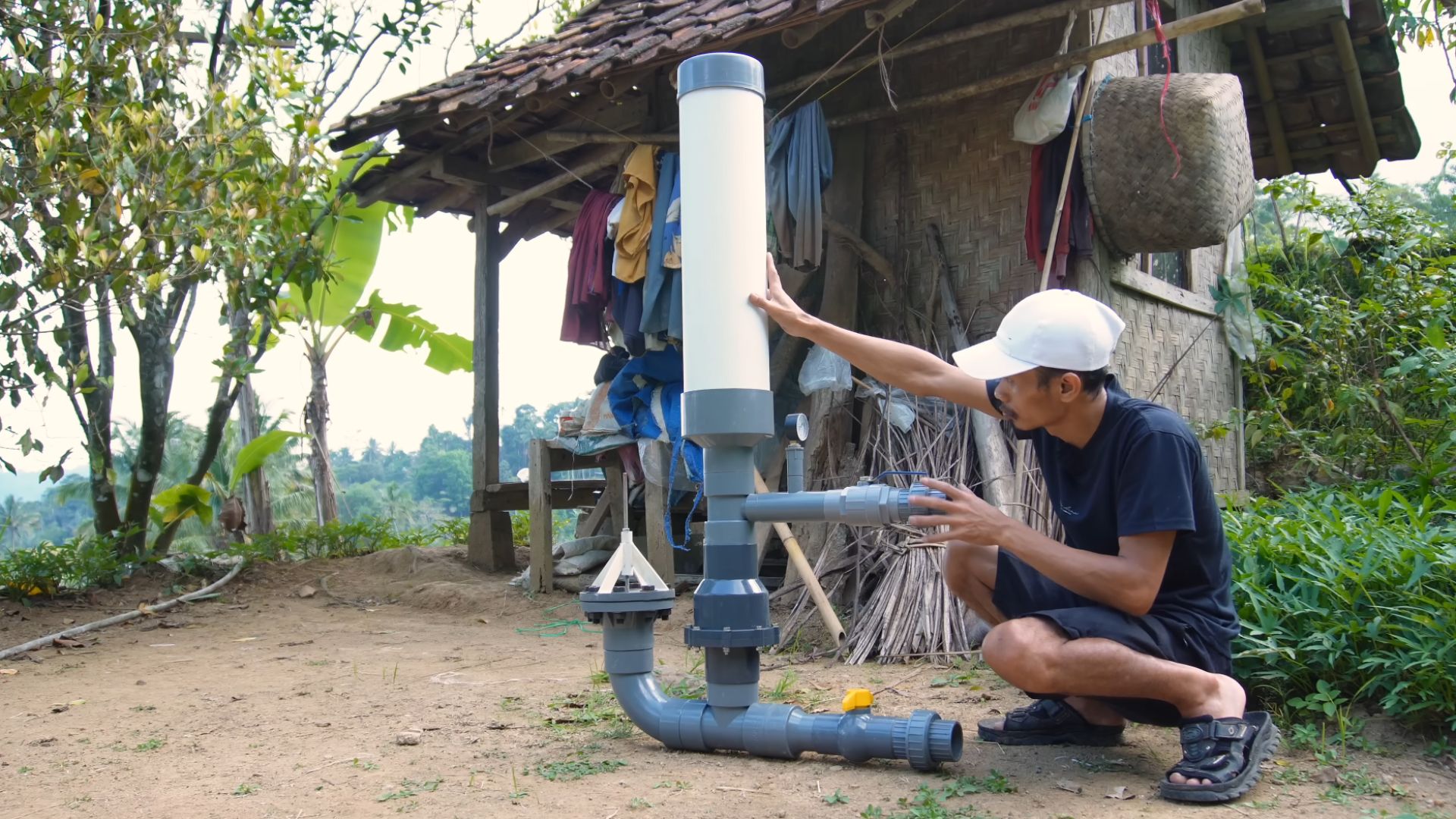


Simple Rural Technology That Utilizes Terrain Slope to Bring Water to Higher Areas Without Engine or Electric Network.
A water pump that dispenses with electric energy and can bring water uphill has been used on a rural property, with an estimated pumping capacity of 2.1 liters per minute, reaching up to 30 meters in height and 300 meters in distance from a slope of about 3 meters.
The installed equipment is known in the field as a hydraulic ram, a system that utilizes the force of falling water to push part of the collected volume to higher points on the terrain, without relying on an engine, fuel, or an electric network available in the area.
On the monitored property, the water collection is in a pond at a level well below the garden, which had been making regular water use for irrigation difficult, said the farmer who invented the idea, who had been looking for a way to “connect” to the planting area and had been considering this solution for some time.
-
Experts Reveal Which Water Bottle Material—Metal, Plastic, or Glass—Harbors the Most Bacteria and When Each is Best to Use

-
77-Year-Old Woman Earns Top Marks for Embroidered Children’s Book Thesis with Her 98-Year-Old Mother, Moves Audience After Returning to University Entrance Exams 30 Years Later with a Score of 980
-
Domestic Workers in Switzerland Earn Around $220 per Day, Compared to $24-$60 in Brazil

-
As Engineering Jobs Decline in Brazil, Professionals Eye the U.S. with 186,500 Annual Openings and Salaries Up to $170,000




Hydraulic Ram: How the System Pumps Water Without Electricity
The operation is based on the water hammer, a pressure spike generated when the flow is interrupted quickly within the piping, creating sufficient hydraulic energy to push part of the water to an exit that heads toward the final destination.
Those who monitored the setup explained that the system depends on a minimum drop between the collection point and where the ram is installed because it is this level difference that generates pressure to pump the water above the origin point.

In the observed case, about 18 meters of rigid piping were used in the feed line, with an approximate drop of 3 meters between the collection location and the equipment point, a condition considered sufficient to initiate pumping.
Installation of the Hydraulic Ram and Regulation of the Valves
The assembly of the ram was described as simple and quick, with the structure composed of connections, valves, and short segments of pipe, forming a set that allows the equipment to “strike” repeatedly while stabilizing the internal pressure.
The characteristic noise of the strikes, heard up close during the adjustment, is precisely the signal that the water hammer is occurring, and the rhythm serves as a practical reference to perceive whether the system is working steadily.
The regulation was done by gradually releasing the spring of the main valve until the strikes began, and then adjusting the stability point, aiming for a continuous operating interval that allows for small “gulps” of water with each stoppage.
During verification on-site, the count made next to the equipment recorded 12 strikes in 15 seconds, which corresponds to 48 strikes per minute, a number identified as adequate for the expected performance in that height and distance scenario.
Filter in Collection and Rigid Piping in the Same Diameter
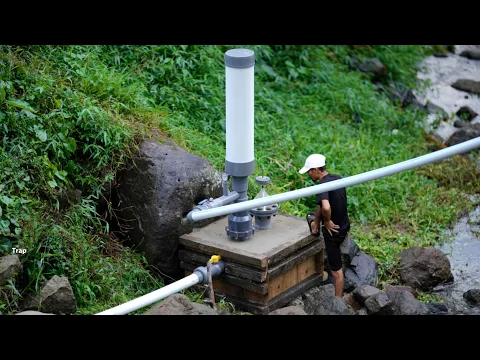

Since the water came from a pond with leaves and debris on the surface, the installation included a simple filter, assembled with a section of perforated pipe and covered with a screen, to reduce the risk of dirt reaching the valves.
The rationale is operational: if a leaf or larger particle enters the mechanism and prevents proper closure, the ram may jam and stop striking, interrupting the pumping until cleaning and resuming the cycle.
Another highlighted care was the use of rigid tubing with the same diameter as the equipment between the collection and the ram, because the feed line needs to withstand pressure and maintain the hydraulic conditions for the water hammer to occur.
In practice, the diameter of the inlet pipe must match the diameter of the ram used, while the outlet can vary depending on the need to lead the water to a more distant point, with losses and restrictions inherent to the hose or pipe chosen.
Fixation with Rubber to Absorb Impact of the Water Hammer
The equipment was installed leveled, both horizontally and vertically, to distribute the wear of the valves, reducing the tendency for concentrated effort on one side and extending the useful life of the set in continuous use.
Moreover, the fixation was not done rigidly, as the ram moves with each pressure strike, going back and forth, and the containment without flexibility can lead to ruptures, cracks, or breaks in the connections.
The guidance given on-site was to tie the system with rubber, allowing the slight movement that accompanies the strikes, keeping the equipment stable enough to operate without loosening, but with elasticity to absorb the repetitive impact.
Flow, Reach, and Time to Fill a 500-Liter Tank

With the hose connected and the system operating, a practical flow test was conducted to estimate how much the ram could deliver at the exit point under that set of conditions, without resorting to more complex measuring instruments.
The reported measurement indicated about 1.05 liters in 30 seconds, projecting 2.1 liters per minute, equivalent to approximately 120 liters per hour, a volume sufficient to fill a 500-liter tank in just over four hours.
Even without reaching the desired endpoint at that moment due to a lack of additional hose length, the on-site assessment was that by completing the course to the reservoir, the system would maintain delivery in pulses, “sip after sip,” at a steady pace.
In a video, the inventor summarized the expectation with the result by saying “I’m very happy,” stating that, with water reaching the garden, he could “water my vegetables” and maintain production, something he treated as a direct gain for the property’s routine.
Uses in the Rural Property: Irrigation, Water for Animals, and Fish Farms
The experience in Fraiburgo was not presented as an isolated case, and the equipment was described as useful for various purposes, including supply in small properties, aid in irrigation, provision of water for animals, and even oxygenation of fish ponds.
Subsequently, the team visited a farmer in a neighboring municipality, Gerson, described as a seed guardian, who reported having participated in one of the first experiences with hydraulic ram in the region, with tests and adjustments until achieving stable operation.
According to him, in the initial phase, there were many trips back and forth to the water tank, with interruptions and corrections, until the system began to operate regularly, which he described as an important change for a place far from the electric network.
The report also associated the equipment with lower operating costs, precisely by eliminating continuous electricity expenses and by depending on common parts and connections, used to assemble a low-complexity set aimed at meeting small demands.


