Portuguese
  Spanish


Brazil Advances in the Construction of the Giant Magellan Telescope and Presents Astronomical Technologies Developed by National Researchers!
Brazil took another important step in international astronomy with the release of a new episode of the series “Aiming for the Stars,” which showcases the technological advancements in the development of the Giant Magellan Telescope (GMT).
Produced by the GMT Brazil project, the series is in partnership with the University of São Paulo (USP), Fapesp, and TV Univap, with support from the National Laboratory of Astrophysics.
The latest episode details the first-generation instruments that will be part of the GMT, currently under construction in the Atacama Desert in Chile.
-
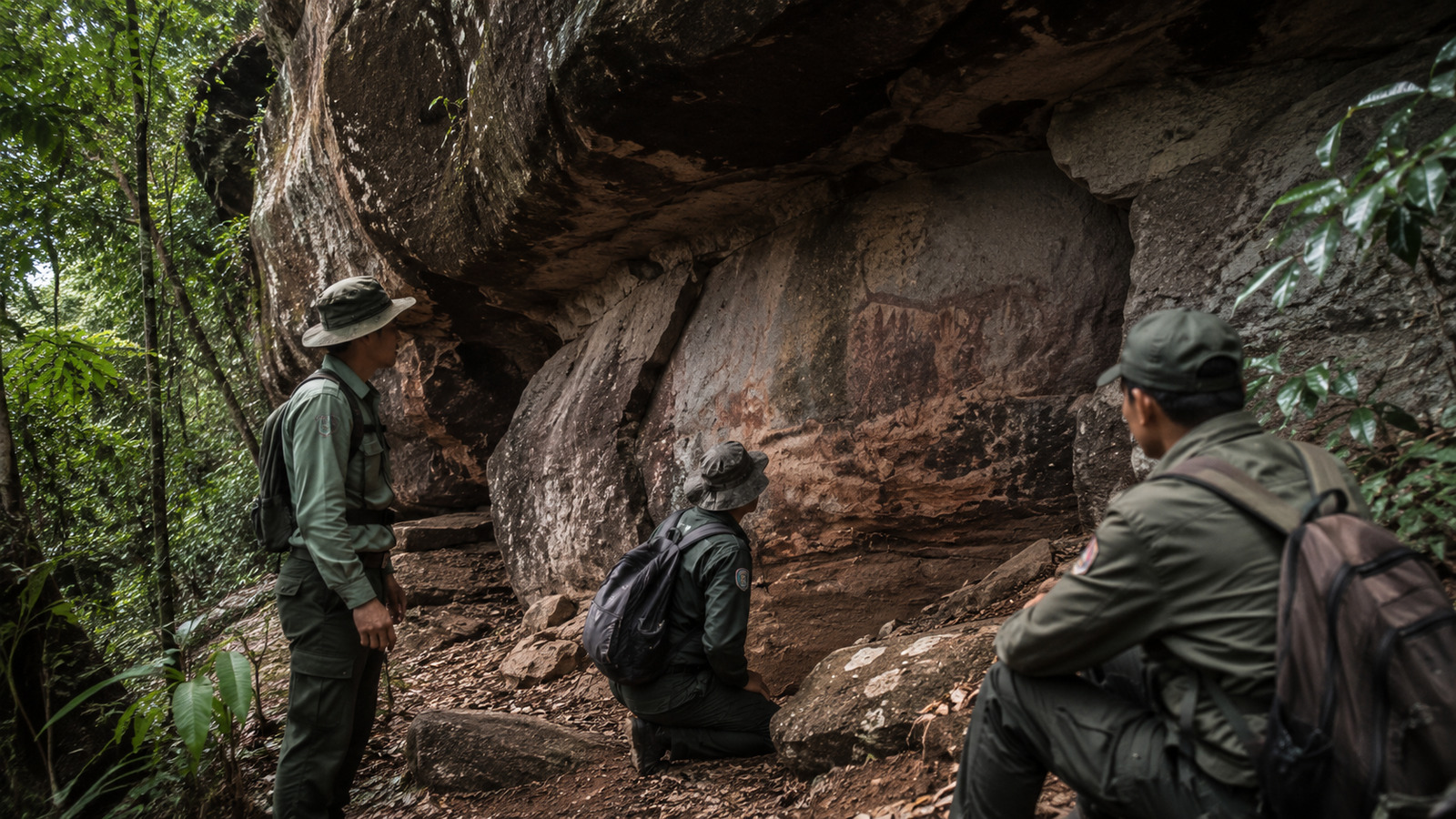
Anti-poaching patrol in Thailand accidentally discovers hidden cave with 2,000-year-old petroglyphs, geometric engravings, and mysterious three-finger patterns on sandstone walls.

-
Russia Deploys Largest Nuclear Icebreaker in Arctic Capable of Breaking Through Three-Meter-Thick Ice

-
TCL Launches Energy-Efficient Refrigerator in Brazil, Promising 70% Less Consumption Than Competitors

-
Project Daedalus: The 190-Meter Spacecraft Aiming to Reach Another Star with Nuclear Fusion and a 50-Year Fuel Supply




The telescope is expected to be operational by the early 2030s and to function for over half a century, capable of revealing details of the universe never seen before.
Brazilian Technology Aiming for the Stars
With technology 200 times more powerful than current leading telescopes and images up to ten times sharper than those from the James Webb Space Telescope, the GMT will be able to explore topics such as star formation, habitable exoplanets, dark matter, and dark energy.
A significant portion of this technology is being developed with strong participation from Brazilian scientists and engineers. According to Professor Laerte Sodré Jr., one of the project coordinators, Brazil’s involvement in the GMT “is a reflection of the competence and technical commitment of the Brazilian team.”
The episode presents several cutting-edge instruments:
- GMACS: visible multi-object spectrograph;
- G-CLEF: high-resolution echelle spectrograph;
- Exposure Meter: exposure measurement system;
- Manifest: optical fiber positioning robot;
- AOTC: set of cameras for atmospheric corrections;
- ComCam: commissioning camera for imaging tests.
These instruments, developed in partnership with Brazilian and international universities, promise to revolutionize the way we observe the cosmos.
National Leadership in the GMT
Brazil has been a founding member of the GMTO consortium, responsible for the GMT, since 2014. Fapesp’s investment of US$ 50 million ensures that 4% of the annual observation time is allocated to scientists from São Paulo. The Brazilian team consists of more than 70 professionals, including researchers, engineers, and scholarship holders, gathered at the GMT Brazil Office (GMTBrO).
Experts from USP, Unicamp, Mauá Institute of Technology, Univap, among other institutions, are participating in the project. Professor Claudia Mendes de Oliveira, co-coordinator of the project, and Professor Rafael Ribeiro from the Steiner Institute, also feature in the new episode.
A Future of Astronomical Discoveries Through the Giant Magellan Telescope
The telescope will have a primary mirror 25.4 meters in diameter, made up of seven segments of 8.4 meters in a flower shape. This structure will allow for extremely sharp images of distant galaxies and the search for signals of life on other planets.
With Brazil’s active participation, the GMT reinforces the country’s role in frontier science and the production of cutting-edge technological knowledge. The series “Aiming for the Stars” plays a crucial role in disseminating this work and valuing the Brazilian professionals involved.