






 Portuguese
  Spanish


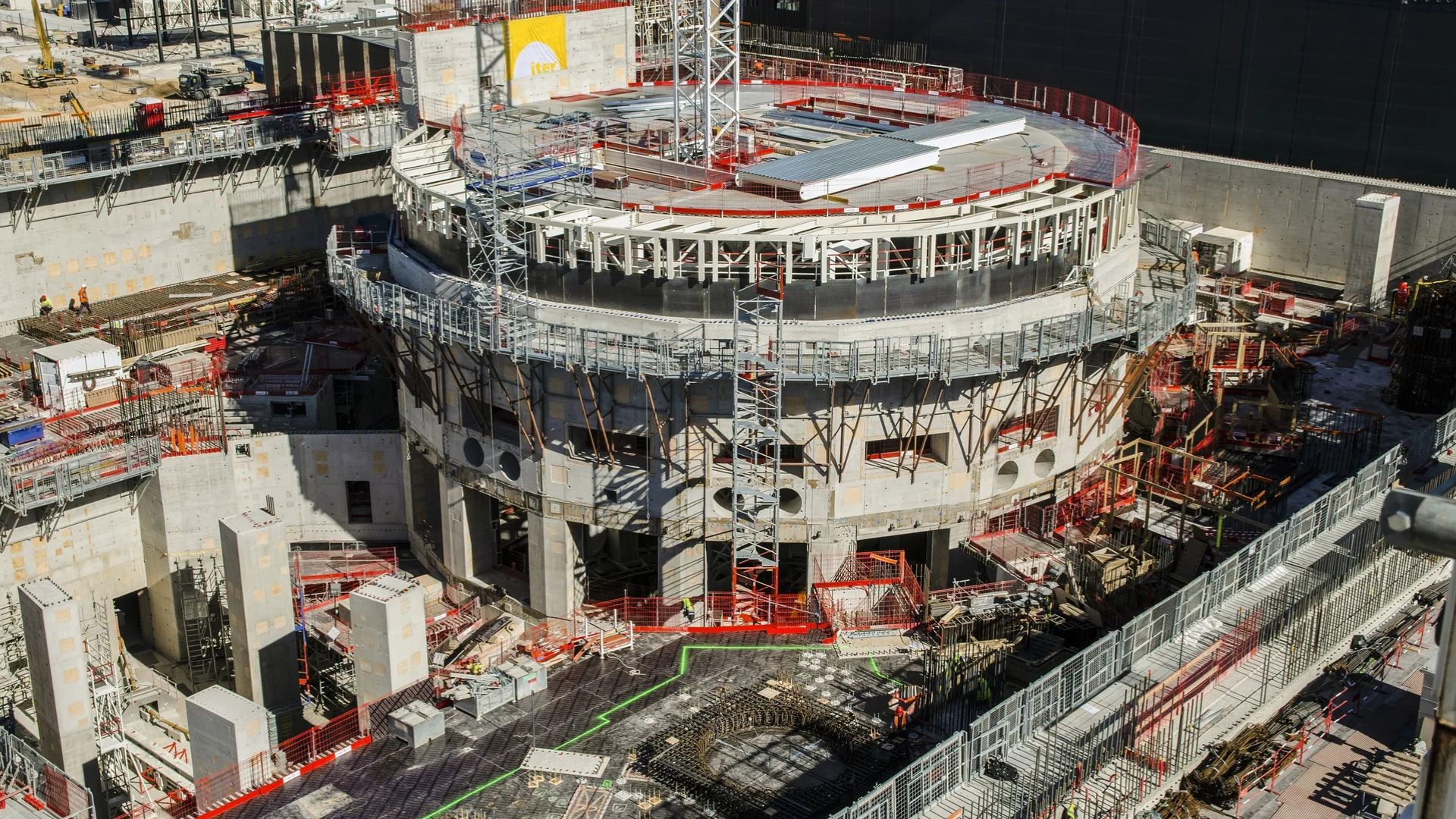
ITER will have plasma at 150 million degrees, will use superconducting magnets at -269°C and aims to prove nuclear fusion with Q=10 in France.
According to the ITER Organization, the International Thermonuclear Experimental Reactor, known as ITER, is the largest nuclear fusion scientific project in history, under construction in Saint-Paul-lez-Durance, in southern France. The initiative brings together seven partners representing more than half of the world’s population: China, European Union, India, Japan, South Korea, Russia, and the United States. The total estimated cost exceeds US$ 20 billion, making ITER one of the most expensive scientific projects ever undertaken outside the space program. The reactor is of the tokamak type, doughnut-shaped, with a vacuum chamber of 1,400 cubic meters where hydrogen plasma will be heated to 150 million degrees Celsius.
This temperature is about ten times higher than the core of the Sun, estimated at 15 million degrees. In this extreme condition, deuterium and tritium nuclei can fuse, form helium, and release energy, reproducing in the laboratory the process that powers the stars.
ITER is the largest nuclear fusion project ever built in the world
ITER was created to answer one of the biggest questions of modern energy: is it possible to produce controlled nuclear fusion on a scale large enough to pave the way for commercial plants? The proposal is not to generate electricity for the grid at this first moment, but to prove that the physical process can work sustainably.
-
Brazilians Earn Up to $120 an Hour Training AI Systems, Despite Lacking Programming Skills or Degrees

-
In Alaska’s -40°C Cold, a Scientist-Turned-Farmer Uses Vegetables’ Heat to Store Food Without Power
-
Oil Company Robots Discover 3,300-Year-Old Canaanite Shipwreck in the Mediterranean, Proving Ancient Mariners Navigated Open Seas Using Stars Long Before Historians Thought

-
Helicopter Drops 180 Tons of Sand and Gravel on Swedish River to Revive Ecosystem Damaged by Decades of Exploitation




Nuclear fusion unites light nuclei, such as deuterium and tritium, releasing energy far superior to that of conventional chemical reactions. Unlike fission, which splits heavy atoms, fusion attempts to reproduce the Sun’s energy mechanism in a machine built by humans.
The challenge is gigantic because atomic nuclei have positive charges and repel each other. For them to come close and fuse, the plasma needs to reach extreme temperatures, impossible to contain with any solid material.
ITER’s Tokamak uses a magnetic field to confine plasma at 150 million degrees
The tokamak solves this problem with magnetic confinement. Since the plasma is made up of charged particles, very intense magnetic fields can keep it trapped in a circular trajectory, without direct contact with the reactor walls.


In ITER, the toroidal magnets create the main field around the donut-shaped chamber. Poloidal magnets shape the plasma’s cross-section, while the central solenoid induces the electric current that helps initiate and sustain the reaction.
This arrangement creates a kind of invisible cage. The plasma reaches 150 million degrees, but it needs to remain magnetically suspended, without touching the tokamak’s internal structure.
The central solenoid of ITER functions as the electrical heart of the fusion reactor
In April 2025, General Atomics completed the sixth and final module of the central solenoid, the electromagnet considered the “beating heart” of ITER. The module arrived at the project site in France in September 2025.
The solenoid functions like a giant transformer. When its electric current changes, it induces a current in the plasma, initiating and sustaining an essential part of the tokamak’s operation.
Five of the six modules were already stacked in the assembly hall by May 2026, and the last will be added before the final installation in the tokamak pit. Without the central solenoid, the plasma does not start correctly, and the machine does not fulfill its experimental function.
ITER’s superconducting magnets operate at -269°C near absolute zero
ITER’s magnets need to be superconductors to generate powerful magnetic fields without unfeasible electrical consumption. To achieve this, they operate at around -269°C, just a few degrees above absolute zero.
Superconductivity allows enormous electric currents to circulate without significant resistance. Without this effect, the energy lost as heat would make it impossible to maintain the magnetic fields necessary for plasma confinement.

The thermal contrast inside ITER is one of the greatest ever created by humans. A few meters apart, the machine combines plasma at 150 million degrees and magnets cooled to temperatures close to the physical limit of cold.
ITER gathers 10 million components manufactured in 35 countries
The logistical scale of ITER is almost as complex as its physics. The reactor has about 10 million distinct components, manufactured in 35 countries with rigorous technical specifications.
The European Union supplies five of the nine sectors of the vacuum vessel, while South Korea provides the other four. The United States delivers the central solenoid, Japan participates with superconducting components, China supplies magnetic systems, and India contributes with cryogenics and heating.
Each piece needs to arrive at the site at the right time in the assembly sequence. A delay in a single critical component can halt entire installation stages in a structure that requires tolerances of tenths of a millimeter.
ITER’s vacuum vessel weighs much more than the International Space Station
The ITER vacuum vessel is formed by nine large sectors that need to be installed in a specific sequence. When complete, the assembly will weigh about 5,200 tons.

For comparison, the International Space Station weighs approximately 420 tons. This shows that ITER is not just a laboratory experiment, but a scientific infrastructure on an industrial scale.
The assembly needs to combine extreme weight, millimetric precision, and components coming from different continents. The machine is, at the same time, an experimental reactor, a diplomatic project, and a global logistical challenge.
ITER’s Q=10 goal aims to produce ten times more fusion energy than it consumes in the plasma
The central metric of ITER is the Q factor, which measures the ratio between energy produced by fusion and energy used to heat and confine the plasma. The goal is to achieve Q=10.
This means producing 500 megawatts of fusion power using 50 megawatts of external heating. No previous tokamak has achieved this level of sustained performance.
ITER will not convert this energy into electricity for the grid. Its function is to prove that controlled fusion can generate much more thermal energy than is needed to keep the plasma active.
First plasma of ITER is scheduled for 2036 after accumulated delays
The current schedule forecasts the first plasma in 2036, after accumulated delays totaling almost two decades compared to the initial targets. Full-energy deuterium-tritium operation is scheduled for 2039.
These dates reflect the technical complexity of the project. ITER is not a conventional plant, but an unprecedented machine, assembled by different countries with components that need to work together under extreme conditions.
Despite the delays, the assembly of the central solenoid marks a decisive stage. The project enters the phase where decades of engineering begin to materialize at the center of the tokamak.
Deuterium and tritium are the fuels of nuclear fusion tested in ITER
The fuel for ITER will be based on deuterium and tritium, two isotopes of hydrogen. Deuterium can be extracted from seawater in large quantities, making its availability one of the attractions of fusion.

Tritium is rarer and needs to be produced in reactors or dedicated systems. Future fusion reactors will need to use blanket modules with lithium to generate tritium from the neutrons released by the reaction.
This point is fundamental for commercial viability. Fusion will only be a complete energy solution if future reactors can produce a significant part of their own fuel.
ITER paves the way for DEMO and commercial nuclear fusion plants
ITER is not the final destination of nuclear fusion. It was planned as a step before DEMO, the demonstration reactor that should generate electricity for the grid on a commercial scale.

If ITER proves that Q=10 is possible and sustained, governments and companies will have a more solid technical basis to invest in subsequent reactors. The project will serve as scientific proof that magnetic fusion can move from the experimental field to energy application.
The historical comparison is clear. Just as Enrico Fermi’s CP-1 reactor proved in 1942 that controlled nuclear fission was possible, ITER aims to prove that controlled fusion can become a real source of clean energy in the 21st century.









-

-

4 people reacted to this.