Portuguese
  Spanish


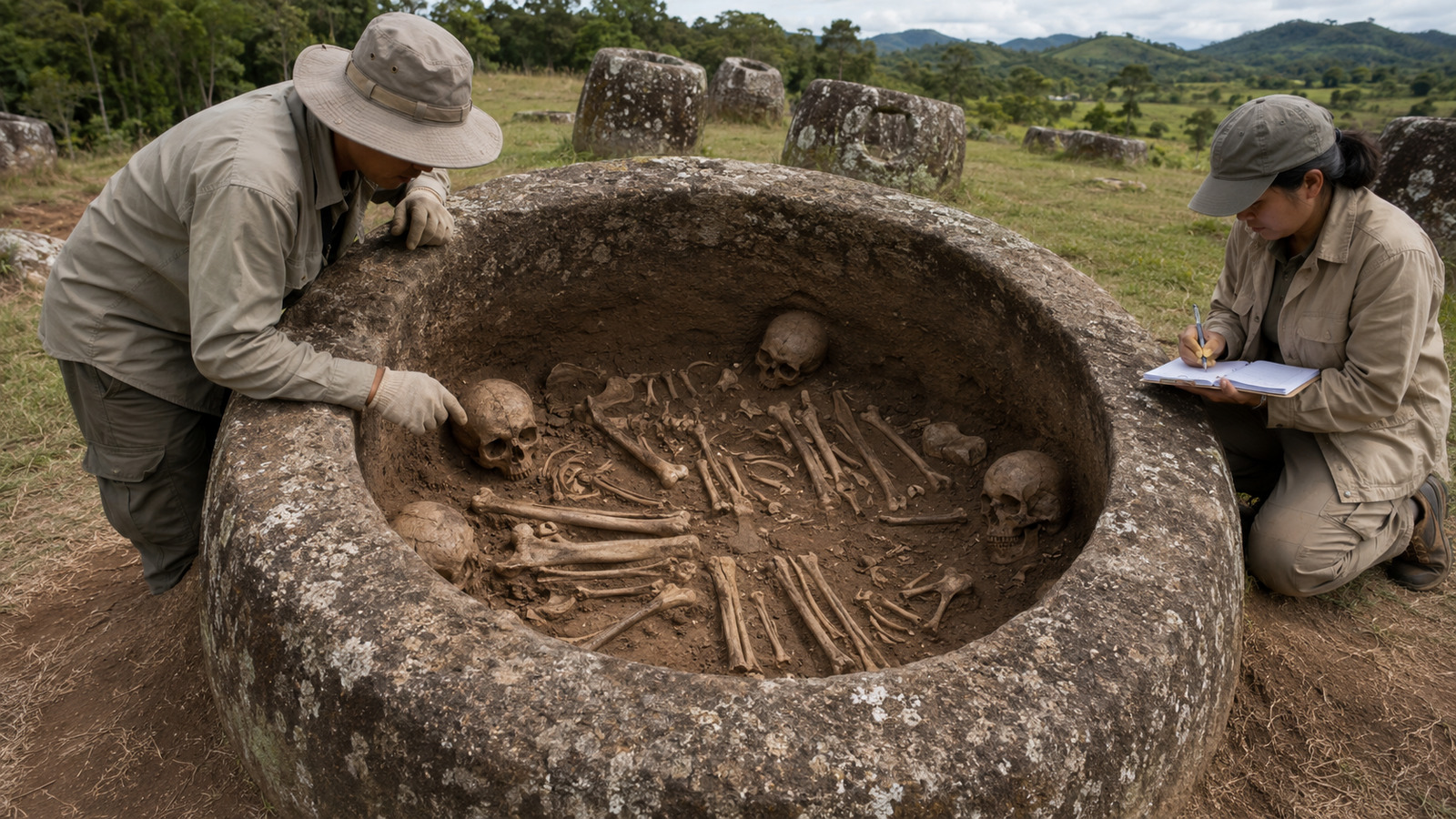

Discovery made by Australian archaeologists in northern Laos shows human bones organized inside Jar 1 and reinforces the funerary use of ancient vessels from the mysterious Plain of Jars
One of the largest vessels of the Plain of Jars in Laos held the remains of several generations that lived about 1,200 years ago, according to a discovery published this Tuesday, 19, in the journal Antiquity.
Discovery expands the enigma of the Plain of Jars
The container was named “Jar 1” and was located by Australian archaeologists at the large archaeological site in Xieng Khouang province, in northern Laos. The area is known for housing more than two thousand ancient vessels.
These vessels are periodically studied by researchers, but still provide few clues about their origin and the civilization that produced them. The new discovery draws attention due to the size of the container and the contents found inside it.
-
He has never read a line of code, but he already knows how to work: the French company UMA presented in Paris the Northstar, its first AI-powered humanoid robot designed for factories and warehouses, capable of copying tasks just by observing an employee in action.

-
A young Kenyan engineer collects plastic waste from the streets and transforms it into robots that translate physics lessons into sign language in real-time, a machine made with old bottles that teaches what was missing to deaf children left out of science.

-
What is the dark substance found in the sand of Ipanema Beach? Civil Police conduct an examination, collect samples of the material, and initiate an investigation to identify the composition, clarify the origin, and verify if there was an environmental crime.
-
The beer that was hidden for 3,000 years has returned to the world: scientists find yeast preserved in Ancient Egyptian vessels and recreate a pharaoh’s drink to discover the lost taste of an ancient civilization.




Human bones were organized inside Jar 1
Jar 1 was filled with human bones. Inside it, the remains appeared separated in a specific manner, with skulls in the corners and arm and leg bones grouped in another part.
For archaeologists, this organization indicates that the vessel was not the primary burial site for the bodies. The arrangement of the bones suggests a later stage of a more complex funerary rite, still poorly understood.
Research confirms the funerary use of the vessels
The scientific community had already suspected that the vessels of the Plain of Jars were linked to some type of funerary rite. The new research, cited by LiveScience, is considered the first to confirm this use.
The evidence suggests that the space may have functioned as a type of collective mortuary, used repeatedly by various generations.
This hypothesis helps to explain the presence of bones from different people inside the same container.

Jars were near ancient trade routes
According to scientists, the formations were used in funeral rites about a millennium ago. They were built near trade exchange routes, heavily used between 500 B.C. and 500 A.D.
The location reinforces the archaeological value of the region, which remains surrounded by questions about its burial practices and social organization.
It is still unknown which population used this burial method or the reason for the choice.
Despite the progress, researchers state that further investigations will be necessary to understand the order of the funeral rites and the civilization linked to the jars. Jar 1 thus becomes an important piece in this archaeological mystery.
With information from Veja.