Portuguese
  Spanish


With Federal Investment, Brazilian Ports Reach The Highest Volume Of Cargo Ever Registered In March, Highlighting Corn, Fuels And Solid Bulk Among The Main Increases
Brazilian ports registered, in March 2025, the highest volume of cargo ever handled for the month. In total, there were 113.7 million tons, an increase of 5.49% compared to the same period last year. The data comes from the Aquatic Statistics of Antaq (National Agency of Waterway Transportation).
According to the Minister of Ports and Airports, Silvio Costa Filho, the progress is the result of significant federal investments in infrastructure. “These are investments amounting to billions of reais to strengthen the port sector, focusing mainly on long-term actions that make our ports competitive and boost the Brazilian economy,” he stated.
According to the minister, the contributions aim to increase the logistical capacity of the terminals. He highlighted that this is the largest investment portfolio in the history of the sector. “It will ensure growth in the medium and long term,” he declared.
-
North Korean Fiasco: Launch of the Largest Warship Ends in Sinking

-
While giant ships still burn heavy fuel and the maritime sector races against climate targets, Maersk and Vale are starting to bet on ethanol as a new route to reduce emissions at sea.

-
China begins construction of the world’s largest LNG ship, a 344-meter giant capable of supplying 4.7 million homes for a month, carrying 271,000 m³ of gas, and placing QatarEnergy in the largest naval order ever recorded in world history.
-
China is designing a container ship with a thorium nuclear reactor that will operate for 40 years without refueling, and the 25,000-container giant from Jiangnan Shipyard will cross oceans without emitting carbon in an industry that burns 300 million tons of fuel per year.


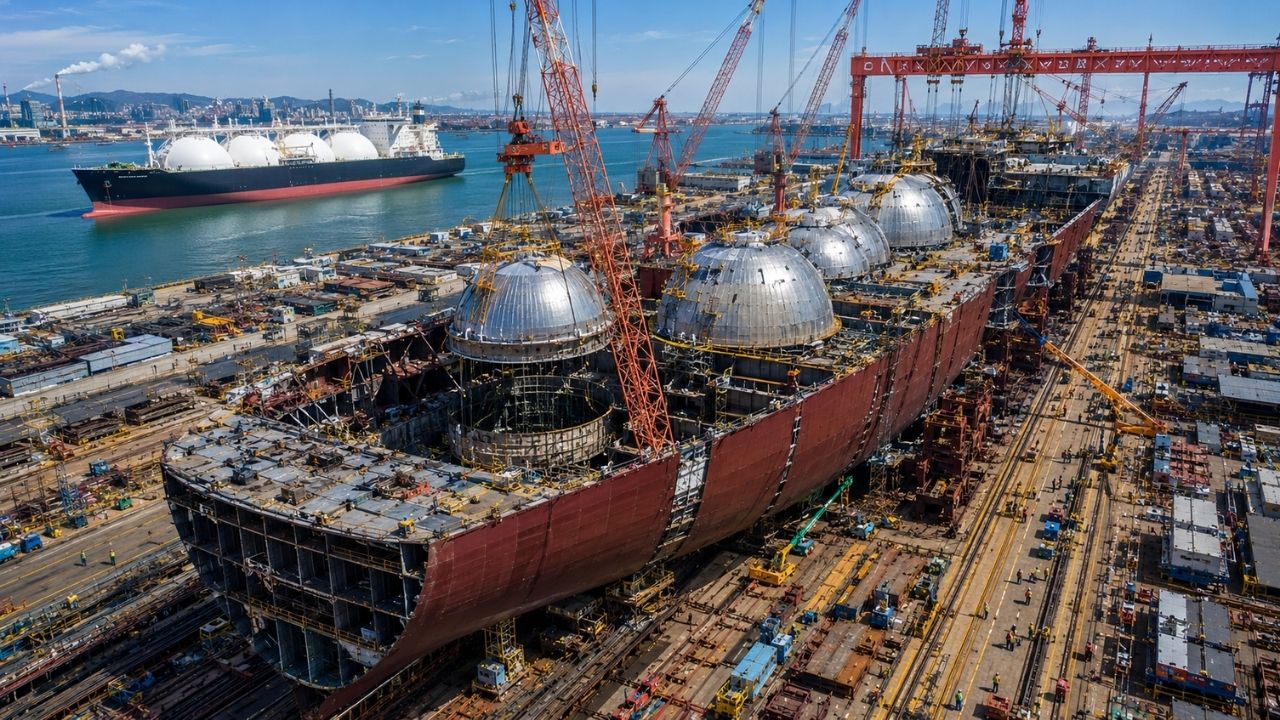

Long-haul navigation was responsible for the majority of the movement. In March, it accounted for 80.8 million tons, representing an increase of 7.85% compared to March 2024. Inland navigation handled 8.4 million tons, with a growth of 9.92%.
Among the types of cargo, the highlight was general cargo, which grew by 8.67% and reached 5.6 million tons. Solid bulk also performed well, with 67.8 million tons, an increase of 7.25%. Liquid bulk totaled 27.5 million tons, with a rise of 3.22%.
Container movement also saw an increase, albeit modest. There were 12.6 million tons, a growth of 0.16%. Of this total, 8.6 million were by long-haul navigation and 3.9 million by cabotage.
The products with the highest growth in March were corn and fuels. Corn increased by 132.9% compared to the same month of the previous year, with 400 thousand tons. Fuels, oils and mineral products grew by 79.98%, totaling 300 thousand tons.
The public ports also contributed to the record. Together, they handled 40.1 million tons, an increase of 1.96%. The Port of Santana (BA) was the highlight, with a rise of 47.33%, reaching 400 thousand tons.
At the private terminals (TUPs), the volume reached 73.5 million tons, an increase of 7.52%. The Ponta Ubu Maritime Terminal (ES) led in percentage increase, with 44.90%, totaling 1.2 million tons.
With information from Brasil 247.