






 Portuguese
  Spanish
  5 min of reading
  0 comments


Brazil Grows Less Than Emerging Asian Countries and Even Neighbors in South America. Experts Point to Historical and Structural Factors That Explain the National Difficulty in Sustaining Economic Advance in the Last Four Decades.
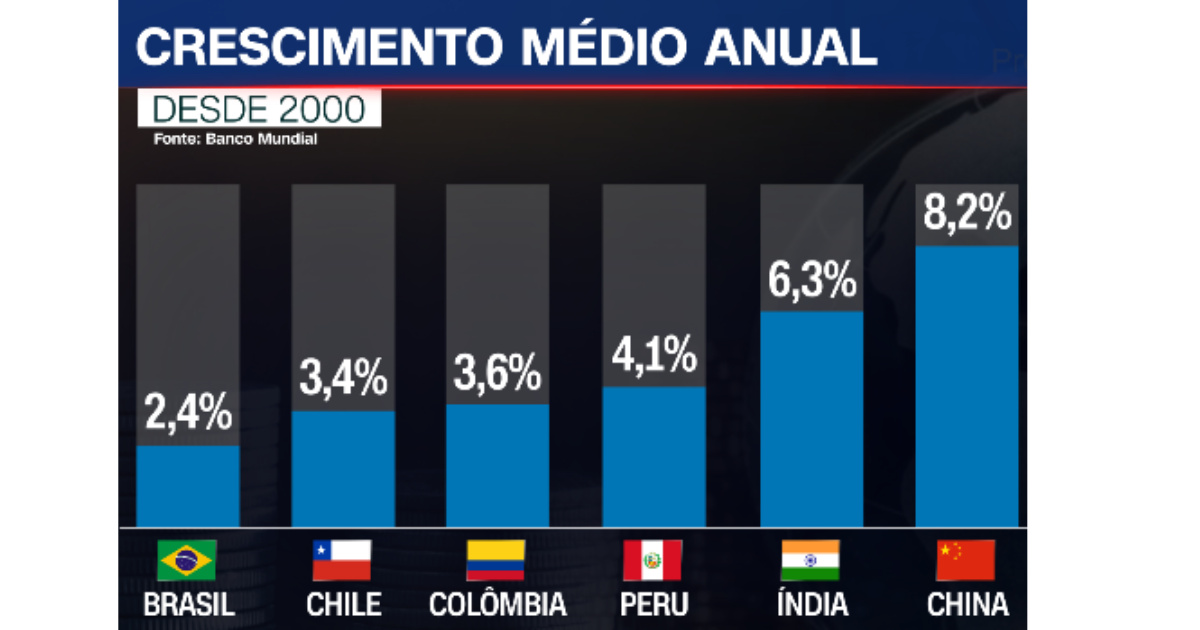
The Brazil has lost momentum in the last four decades and, since 2000, has grown on average 2.4% per year, a pace lower than that of China (8.2%), India (6.3%), and even neighbors like Peru (4.1%), Colombia (3.6%), and Chile (3.4%).
According to a survey by CNN Brazil, the combination of recurring fiscal crises, low savings, stagnant productivity, educational delays, insufficient investment in technology, indexation that fuels high interest rates, and political instability helps explain why the country alternates between short growth periods and new slowdowns, without sustaining long cycles of expansion.
Although there is no single solution, there is consensus that the country needs structural changes to resume solid and lasting growth.
-
Brazilian Joins Homeownership Consortium, Faces Decade of Dual Payments Totaling $141,000, Surpassing Traditional Mortgage

-
Land Rover to Halt Production in July, Putting 371 Jobs at Risk, as Chinese Automaker Negotiates to Convert Factory to 100,000 Vehicles Annually by 2027

-
Mexican Pest Threatens U.S. Cattle Herds at Historic Lows, Potentially Boosting Brazilian Beef Exports as Burger Prices Soar

-
Brazilian Freight Bill Progresses in Congress with $5,000 Minimum Wage, 70% Advance Payment, and Fines Up to $1 Million, as Agriculture and Industry Warn of Rising Costs and Legal Uncertainty


The balance of public accounts emerges as a starting point to reduce risks, lower the cost of credit, and unlock private investment.
Brazil’s Growth in International Comparison
The Brazilian performance was close to the average of Latin America and the Caribbean, but far from the emerging economies that advanced more rapidly.
At various times, the economy accelerated for a few years and then lost traction.
According to CNN Brazil, fiscal fragility and low productivity have created a ceiling for GDP growth.
The 7 Barriers Holding Back Brazilian GDP
1) Fiscal Imbalance and High Mandatory Spending
Public accounts are burdened by mandatory spending pressures and repeated debt shocks.
For Sílvia Mattos of FGV IBRE, “the problem with Brazil is that fiscal crises are recurrent.”
Henrique Meirelles, former president of the Central Bank and former Minister of Finance, states that reforms — administrative, tax, and social security, in addition to constitutional adjustments — are necessary to contain spending rigidity and reduce the recurrence of imbalances.
2) Low Domestic Savings and High Interest Rates
The accumulation of deficits has reduced domestic savings, an essential source of productive investment.
When fiscal risk increases, interest rates rise, credit becomes more expensive, and investment cools.
Marcos Lisboa observes that “in the few moments when the fiscal issue was addressed, interest rates fell.”
Alexandre Schwartsman adds that the public sector spends more than emerging peers, which puts pressure on savings and limits the capacity to grow.

3) Stagnant Productivity and Low-Value Industry
The economy has focused efforts on “old assembly,” with chains of low added value and little innovation.
Lisboa criticizes the narrow view of industry: according to him, public debate has been captured by lobbies that associated industrial production only with the assembly of cars and appliances, while computing, AI, and innovation in other sectors have been sidelined.
Countries that advanced — such as South Korea, Taiwan, Singapore, and China — invested in technology, human capital, and efficiency gains.
4) Educational Delays and Weak Learning
The qualification of the workforce continues to be a bottleneck.
Brazil invests a significant share of its GDP in education but achieves inferior results in assessments like PISA.
For Armínio Fraga, it is necessary to make the teaching profession attractive, bringing in those who were among the best students.
The criticism extends to the focus of the debate: funding is prioritized while learning, timely literacy, and pedagogical practices that elevate performance are rarely discussed.
5) Lack of Investment in Technology and Innovation
While other countries established technology hubs and chains of high complexity — from semiconductors to medical products and telecommunications — Brazil has not consolidated a long-term strategy that connects universities, companies, and government.
Continuity in R&D policies, predictable regulatory frameworks, and funding instruments to scale innovative projects have been lacking.
The result is a technological gap that limits the sophistication of exports and productivity.
6) Indexation, Resistant Inflation, and Credit Cost
The widespread indexation of prices and contracts makes disinflation difficult and keeps real interest rates high.
Meirelles argues that monetary policy, inflation targets, and fiscal policy need to move in the same direction.
When expectations are unanchored and public spending increases without compensations, the Central Bank tends to keep interest rates high for longer, increasing the cost of capital and stalling long-term investments.
7) Political Instability and External Shocks
The redemocratization was accompanied by episodes of political crisis, deadlocks between Executive and Legislative, and two impeachments, which raised uncertainties.
In addition to domestic turmoil, external shocks and tensions in global trade affected terms of trade, supply chains, and confidence.
As highlighted by CNN Brazil, Marcos Mendes, an associated researcher at Insper, notes that the country has been operating in chronic public deficit since 2014, which tightens the constraints on growth by requiring more resources to close accounts and maintain high interest rates.
Industrialization, Economic Miracle, and Fiscal Legacy
Between the 1930s and 1980s, Brazil adopted import substitution, which expanded the industrial base.
The Goals Plan of Juscelino Kubitschek completed strategic links and boosted the economy.
Subsequently came the economic miracle (1968–1973), with growth above 10% per year.
Contrarily, the cycle was financed with debt and in an adverse international environment, marked by oil shocks and rising U.S. interest rates.
The country entered the 1980s with high external debt and accelerating inflation.
The decade became known as lost, with stagnation, income erosion, and the subsequent need for a long struggle against near hyperinflation.
“The way Brazil sought to grow in the 1970s was based on forced indebtedness during a difficult period for the world,” sums up Márcio Holland from FGV.
What Can Unlock the Economic Future
To reverse the trajectory, experts converge on three fronts: fiscal consolidation to reduce risk premium and credit cost; productivity agenda with emphasis on basic education, technical training, and technological diffusion; and opening to the outside with a focus on competitiveness.
In the view of Armínio Fraga, Brazil needs to connect with the world, break down barriers beyond tariffs, and pursue agreements that expand markets.
Without regulatory predictability, project governance, and quality spending, reforms lose traction.
The country has already demonstrated the capacity to grow; the challenge is to sustain gains for more than one cycle and reduce the distance to economies that advanced more rapidly in recent decades.
In your opinion, what should be Brazil’s priority to return to consistent growth?





Be the first to react!