






 Portuguese
  Spanish


Mercosur Signed Free Trade Agreement with Efta, Block of Four European Countries (Switzerland, Norway, Iceland, and Liechtenstein), Creating Market of 290 Million People and GDP of US$ 4.39 Trillion
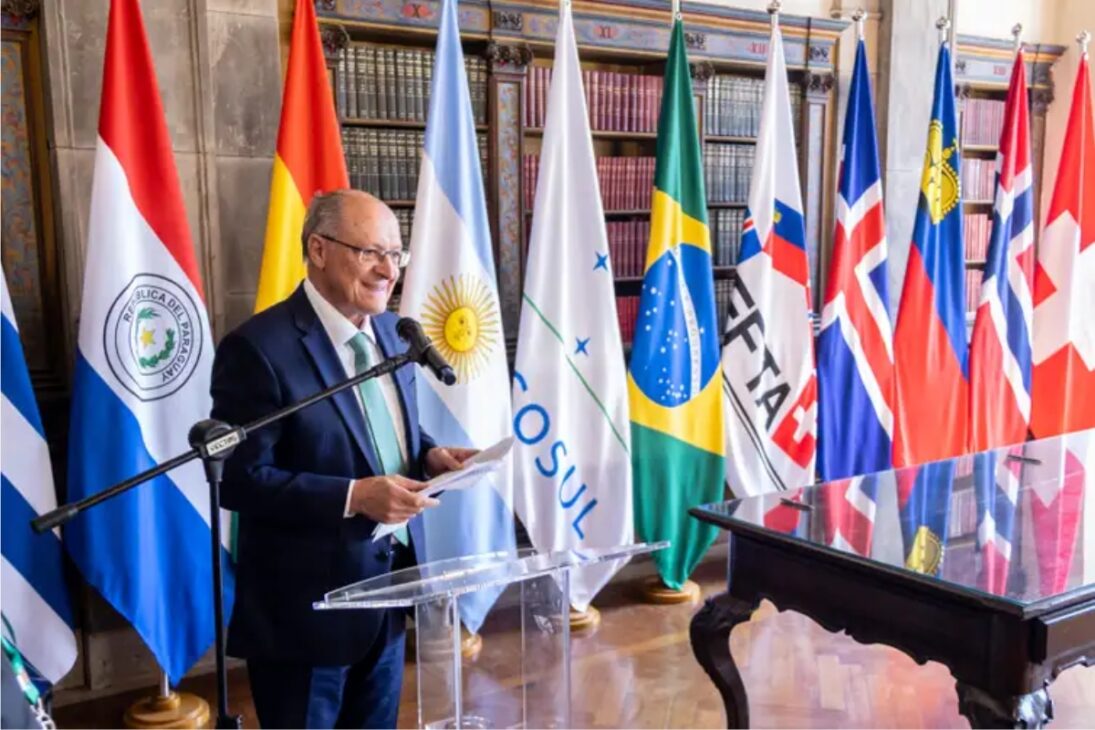
Mercosur took an important step in its global integration strategy by signing, this Tuesday (16th), a free trade agreement with the European Free Trade Association (Efta), a bloc that includes Switzerland, Norway, Iceland, and Liechtenstein.
The partnership, signed at the Itamaraty Palace in Rio de Janeiro, opens a market of 290 million people and a combined Gross Domestic Product (GDP) of US$ 4.39 trillion — a value exceeding R$ 23 trillion in 2024.
Strategic Agreement Beyond the European Union
While negotiations with the 27 countries of the European Union continue to be analyzed, the new alliance demonstrates Mercosur’s search for alternatives to reduce trade barriers.
-
Brazil’s Federal Revenue Auction: iPhone 13 for $95, PlayStation 4 for $80, and Volkswagen Jetta for $2,600 Among 232 Lots Available

-
Tech Giant Oracle Lays Off 21,000 Employees and Invests $70 Billion in Artificial Intelligence

-
Chilean Giant Acquires St. Marche, Expanding from Discount to Premium Supermarkets in São Paulo’s High-End Retail Market
-
After 60 Years of Selling Cheap Milk, Brazilian Family Invests in $4,000 Equipment to Transform Farm’s Milk into Premium Sweets, Producing 2 Tons Daily and Aiming for $6.4 Million


Negotiations with Efta began in 2017 and were concluded in June 2025, in Buenos Aires, during Argentina’s presidency of the South American bloc.
Currently, Mercosur counts Brazil, Argentina, Paraguay, Uruguay, and Bolivia as full members, in addition to Venezuela (suspended) and associated countries such as Chile, Colombia, Peru, and others.
The signing occurs at a time of tensions in international trade, marked by tariff increases imposed by the U.S. government under Donald Trump.
Defense of Multilateralism
At the ceremony, Vice President Geraldo Alckmin classified the agreement as a “great and important step,” highlighting its social and economic impacts.
He emphasized that trade can generate jobs, income, innovation, and productive integration, as well as boost industrial chains in a scenario of global uncertainties.
The Minister of Foreign Relations, Mauro Vieira, mentioned that negotiations only advanced thanks to the “persistence and spirit of cooperation” between the two blocs.
He highlighted that the signing reinforces the defense of international trade based on rules, as opposed to protectionist policies.
European representatives also celebrated the partnership. Norway’s Minister Cecile Myrseth stated that the agreement sends a “clear message of cooperation in times of uncertainty,” while Iceland’s Minister Logi Már Einarsson emphasized his belief in regulated trade as a path to progress.
Economic and Environmental Impacts
With the treaty, Efta will eliminate 100% of import tariffs in the industrial and fishing sectors, opening space for greater competitiveness of Mercosur products.
In addition, strategic agricultural sectors such as meat, corn, soybeans, fruits, and juices will have new opportunities in European markets.
The agreement, however, also includes reciprocity: South American countries will need to open space for Efta products, although there are safeguards to protect sensitive sectors.
Another innovative point is the inclusion of environmental clauses. Digital service companies, for example, will only receive benefits if their countries use at least 67% clean energy in their electricity matrix.
For Mauro Vieira, this commitment is a milestone for sustainability and gains even more relevance on the eve of COP30, which will be held in Belém.
Next Steps and Ongoing Negotiations
The agreement does not enter into force immediately. Each country will need to fulfill internal ratification processes, such as approval in the National Congress in Brazil’s case.
According to a joint note from the Ministries of Foreign Relations, Agriculture, and Development, the Brazilian government is also committed to expanding its network of agreements.
Among the priorities are negotiations with the United Arab Emirates, resuming dialogue with Canada, and expanding partnerships already established with Mexico and India.
European Union Still on the Agenda
Despite the signing with Efta, attention remains focused on the awaited Mercosur-European Union agreement, discussed for 25 years and with terms agreed in 2024.
The text was forwarded by the President of the European Commission, Ursula von der Leyen, to the European Parliament in September but still needs approval by a qualified majority of the Member States.
While Germany and Spain support the partnership, France resists, citing environmental concerns and protection of the agricultural sector.
President Lula countered, stating that Paris adopts a protectionist stance toward its internal interests.
If approved, the Mercosur-EU treaty will create a market of over 700 million people, representing 26% of the global GDP — and could reposition South America as a protagonist in international trade.
The information in this article was based on data and official statements released by agenciabrasil.ebc.com.br.


