






 Portuguese
  Spanish


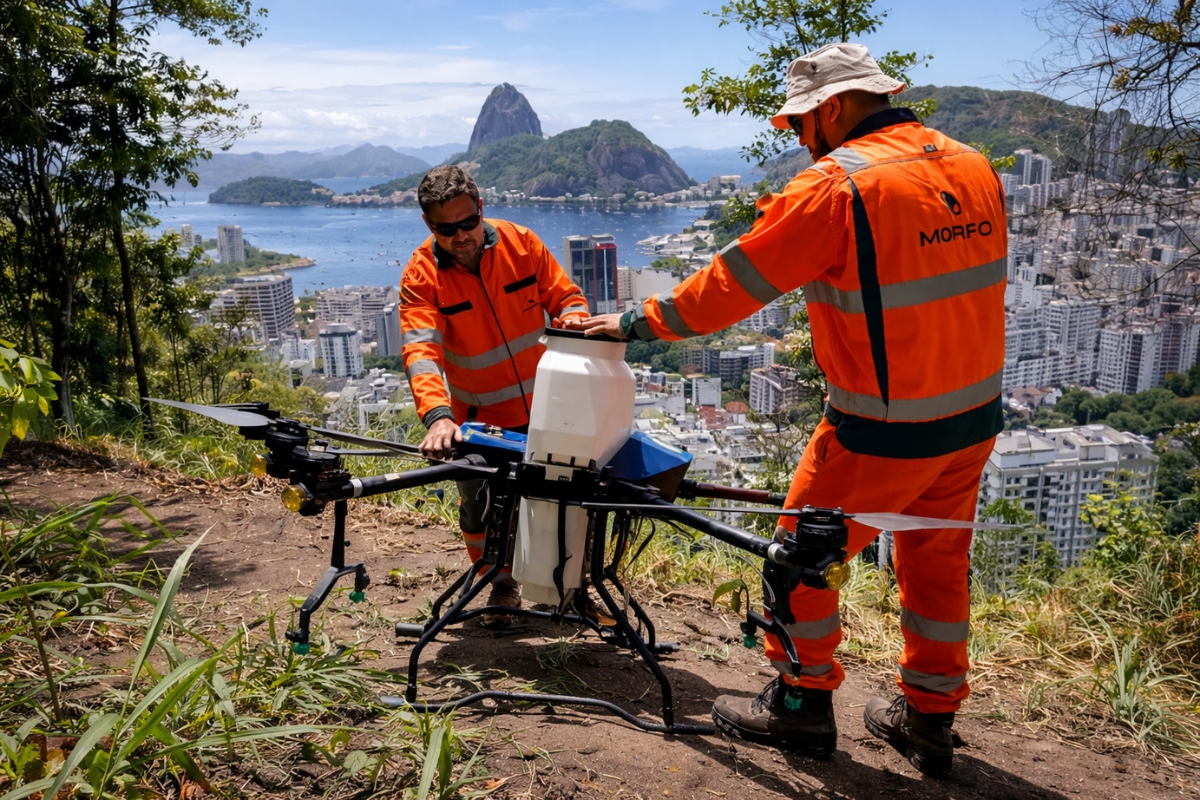


A New Race for Reforestation Uses Autonomous Drones and Artificial Intelligence to Seed Slopes and Burned Areas, Reduce Field Costs, Optimize Routes, and Monitor Germination with High-Resolution Images
Environmental restoration is entering a new phase in Brazil and worldwide. Technology companies are using drones equipped with artificial intelligence to plant seeds in degraded areas that are hard to access, such as steep slopes, fire-affected regions, and zones isolated due to lack of infrastructure.
Combining computer vision, aerial mapping, and route optimization algorithms, this technology allows thousands of seeds to be launched precisely in a matter of hours. The goal is to accelerate forest regeneration, reduce operational costs, and scale up reforestation projects.
How Aerial Seeding with Artificial Intelligence Works
Before planting, drones perform detailed mapping of the terrain using sensors and high-resolution cameras. From these images, AI models analyze soil type, moisture, slope, and existing vegetation cover to define the ideal seed dispersal points.
-
James Webb Telescope Uncovers Unexpected Clues on Mysterious Moon, Potentially Redefining Planetary Origins

-
$1.5 Billion Sleipnir Vessel Transforms Ocean into Floating Construction Site with 12 Hybrid Engines and Capacity to Lift 20,000 Tons

-
23 Years After Tragedy, Brazil’s Alcântara Space Center to Launch New Suborbital Rocket in 2026 with South Korean SEBIT Project Targeting Near-Space Tests
-
Entrepreneur Turns Neighbor’s Coffee Grounds Waste into Eco-Friendly Pellets, Earning Up to $40,000 Monthly in Brazil


Based on this data, the system calculates optimized routes to maximize flight efficiency and seedling survival rates. The seeds, often encapsulated in biodegradable capsules with nutrients, are launched in a targeted manner, reducing waste and increasing planting accuracy.

According to Dendra Systems, a company operating in the ecological restoration sector with the support of artificial intelligence, the technology enables thousands of seeds to be planted per day in areas that would be unfeasible for ground teams, significantly extending the reach of environmental projects.
Large-Scale Recovery of Degraded Areas
Wildfires, mining, agricultural expansion, and climate change have left millions of hectares degraded. Traditional reforestation logistics require large teams, ground transport, and long execution timelines, limiting the speed of environmental recovery.
With autonomous drones, planting can be carried out in remote regions without the need to build roads or mobilize large structures. This reduces costs, minimizes additional impacts on the soil, and speeds up the onset of the natural regeneration process, especially in sensitive biomes.
The application of artificial intelligence also allows for continuous monitoring after planting. New flights capture periodic images to assess germination, growth, and possible failures, adjusting strategies in real-time.

Green Technology and the Future of Reforestation
The use of drones with AI represents a convergence between technological innovation and sustainability. Besides planting, the systems collect strategic data that help governments, NGOs, and companies measure environmental outcomes more accurately.
This model could become essential in carbon neutrality targets and environmental compensation projects. As the pressure for climate solutions increases, tools capable of restoring large areas efficiently and based on scientific evidence are likely to gain prominence.
Reforestation with drones does not completely replace human work, but it redefines the scale and speed of ecological restoration. In a climate emergency scenario, technology and nature begin to work side by side in rebuilding entire ecosystems.


