






 Portuguese
  Spanish
  4 min of reading
  14 comments


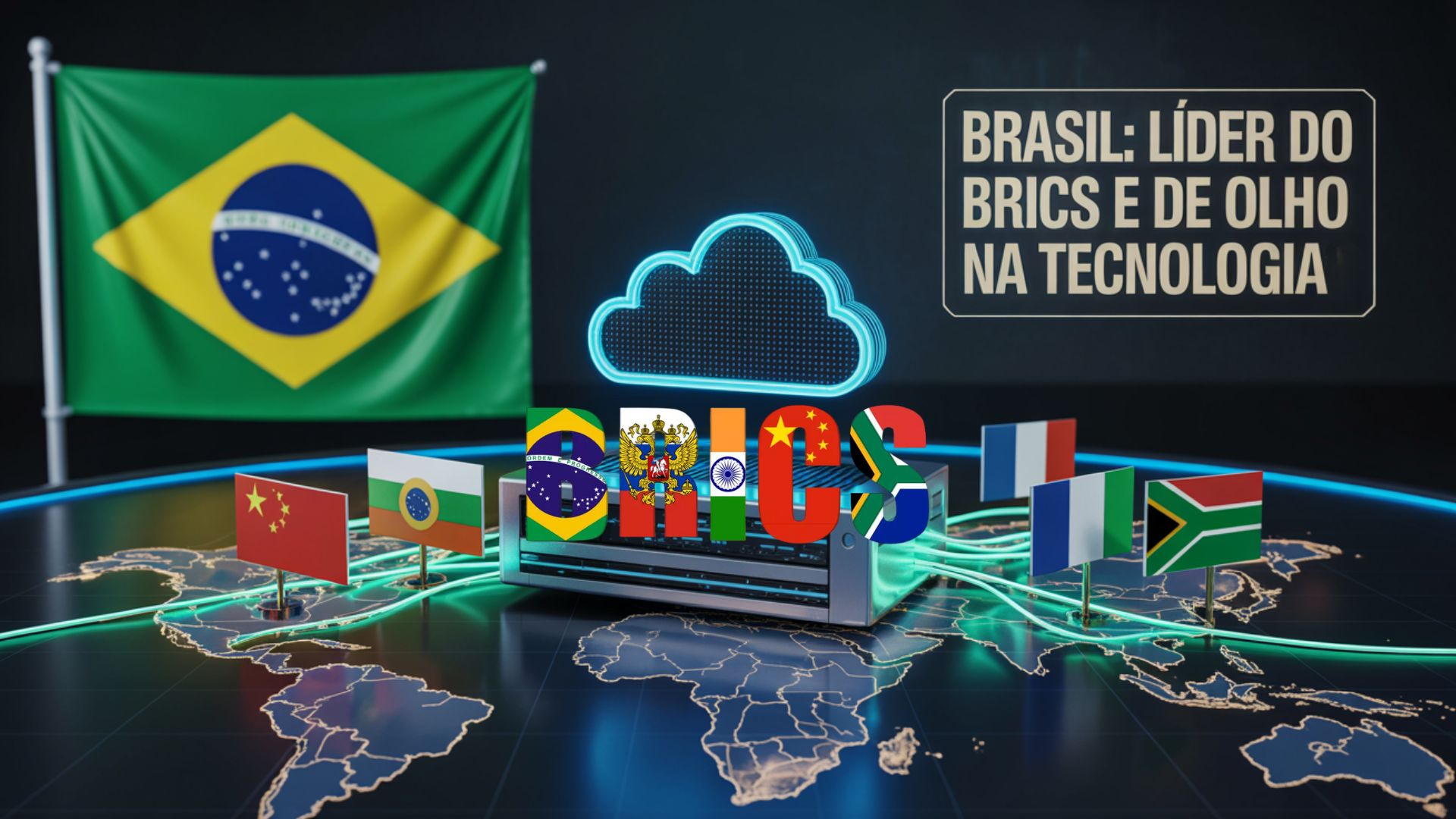


Brazil Articulates With BRICS Countries An Intercontinental Submarine Cable, Creation of Its Own Artificial Intelligence Cloud and Acquisition of Billion-Dollar Supercomputer to Reduce Technological Dependence and Strengthen Digital Sovereignty.
Brazil is articulating, within the framework of BRICS, a package of initiatives to reduce technological dependence on providers and infrastructures influenced by the United States.
In an interview with Deu Tilt, from UOL, Ambassador Eugênio Vargas Garcia, director of the Department of Science, Technology, Innovation, and Intellectual Property at the Itamaraty, described the strategy: building an intercontinental submarine cable, creating a BRICS Cloud, and expanding supercomputing capacity, with the purchase of equipment costing R$ 1.8 billion.
Submarine Cable and BRICS Cloud
Among the projects under study is a submarine cable that would connect Brazil to Africa, the Middle East, India, South Asia, and China.
-
Illegal betting money may change destination: government announces freezing of funds, contacts banks, and explains how the amounts could finance the fight against organized crime after a billion-dollar operation in three states.

-
Two sisters, aged 12 and 13, collected cans for a year, set up a lemonade stand without any help, and turned $236 into a business that has already grossed $65,000.

-
Central Bank changes rule that lasted decades and allows dollar and euro accounts in Brazil for exporters and companies with foreign capital, eliminating the need for currency exchange in some transfers starting in October 2026.

-
The Central Bank ends the R$ 500 limit on Pix by approximation, and account holders will be able to use the general Pix limit to pay any amount by tapping their phone on the terminal starting in October 2026.




The proposal is still in the feasibility analysis phase, and the government is seeking interested partners for financing.
According to the Itamaraty, the alternative route would have a direct impact on international data traffic and reduce concentration on routes controlled by major powers.
Another initiative is the BRICS Cloud, which aims to integrate the supercomputers already installed in each country of the group.
The goal is to share resources for artificial intelligence and high-performance computing, preserving digital autonomy.
“There are several supercomputers in various BRICS countries. Why can’t we have our own cloud?,” Garcia said.
Artificial Intelligence as a Priority
Artificial intelligence was the theme of the last joint statement of the bloc.
In the document, the countries reinforced multilateralism, the leadership of the UN in international governance, and the defense of digital sovereignty, understood as each state’s autonomy to decide how to regulate emerging technologies.
“Establishing regulation is a right of each country. Whether to regulate and how, each nation must decide for itself,” the ambassador stated.
According to the Itamaraty, this alignment seeks to strengthen the position of BRICS in multilateral debates and facilitate technical cooperation in strategic areas, such as academic research and development of open-source software.
Brazil Between China and the United States
When asked about the technological dispute between China and the United States, Garcia stated that Brazil should not automatically align with any power.
The ambassador advocated for internal investments in science and technology, as well as international agreements involving knowledge transfer.
As an example, he cited the partnership with Sweden for the production of Gripen fighter jets, which included clauses for access to military technologies.
“Brazil doesn’t have to choose one side or the other, it must choose Brazil’s side. […] What I want to do now is develop my own country, achieve scientific and technological development,” he declared.
Military Use of AI
The advancement of AI in military operations is being closely monitored by the Itamaraty. According to Garcia, the trend is global but requires the establishment of usage parameters.
He advocated that critical decisions remain under human control.
“We should not delegate life-or-death decisions to machines,” he said, citing both the military environment and civil applications, such as hospitals.
For him, the discussion is not whether the technology will be used but how it will be controlled:
“The genie is out of the bottle. AI is already being used by armed forces worldwide, especially by military powers. There’s no turning back.”
Dependence on Semiconductors
Brazil’s vulnerability regarding chips was another highlighted point.
According to the ambassador, national production covers only about 10% of domestic demand, forcing the country to import semiconductors on a large scale.
He explained that export controls imposed by major manufacturers affect global supply, reinforcing the need to develop local alternatives.
While the semiconductor industry does not achieve scale, the government focuses its efforts on supercomputing.
Currently, the Santos Dumont, installed at the National Laboratory for Scientific Computing, operates at a capacity of 20 petaflops.
Garcia added that the process of purchasing a new international-level supercomputer is underway, with an expected investment of R$ 1.8 billion.
Five Brazilian Priorities
In formulating public policies, Brazil presents five main axes: digital sovereignty, multilateralism, open access to technologies, linguistic diversity, and robust ethical standards.
“Digital sovereignty is the right of each country to self-determine its own digital destiny, develop, regulate, and control,” Garcia said.
The strategy seeks to ensure that AI tools also cover languages of the Global South and that open-source systems can be used in research and public services.


Next Steps
According to the Itamaraty, the execution of these initiatives depends on public-private partnerships and coordination among different ministries.
In the case of the cable, support from development banks and telecommunications operators will be necessary.
BRICS Cloud requires negotiations on technical architecture, data security, and governance mechanisms. “We have many challenges, of course. But we need to face them head-on,” Garcia stated.
The current debate is which of these fronts — submarine cable, BRICS Cloud, or supercomputing — should advance first to accelerate the country’s technological autonomy.





Monte de iludidos acharem que esse cachaceiro entregar o Brasil para aqueles monte de ditadores do brics que os brasileiros irão se dar bem kkkkkkkkkkkkkkk
Viva o Brasil soberano. Não é atoa que o império reclama do crescimento dos Brics, e da postura de Lula, e vão fazer de tudo para a volta dos lambe botas no poder.
Muito Importante Brics será uma moeda digital de fácil parâmetro de negociação “poder de compra e valida em mais de 70 países o mundo não precisará de dolares que ficará para trás nas negociações bilateral entre paises para comércio e turismo Brics venha participar do futuro já 🎁 presente.