






 Portuguese
  Spanish
  5 min of reading
  0 comments


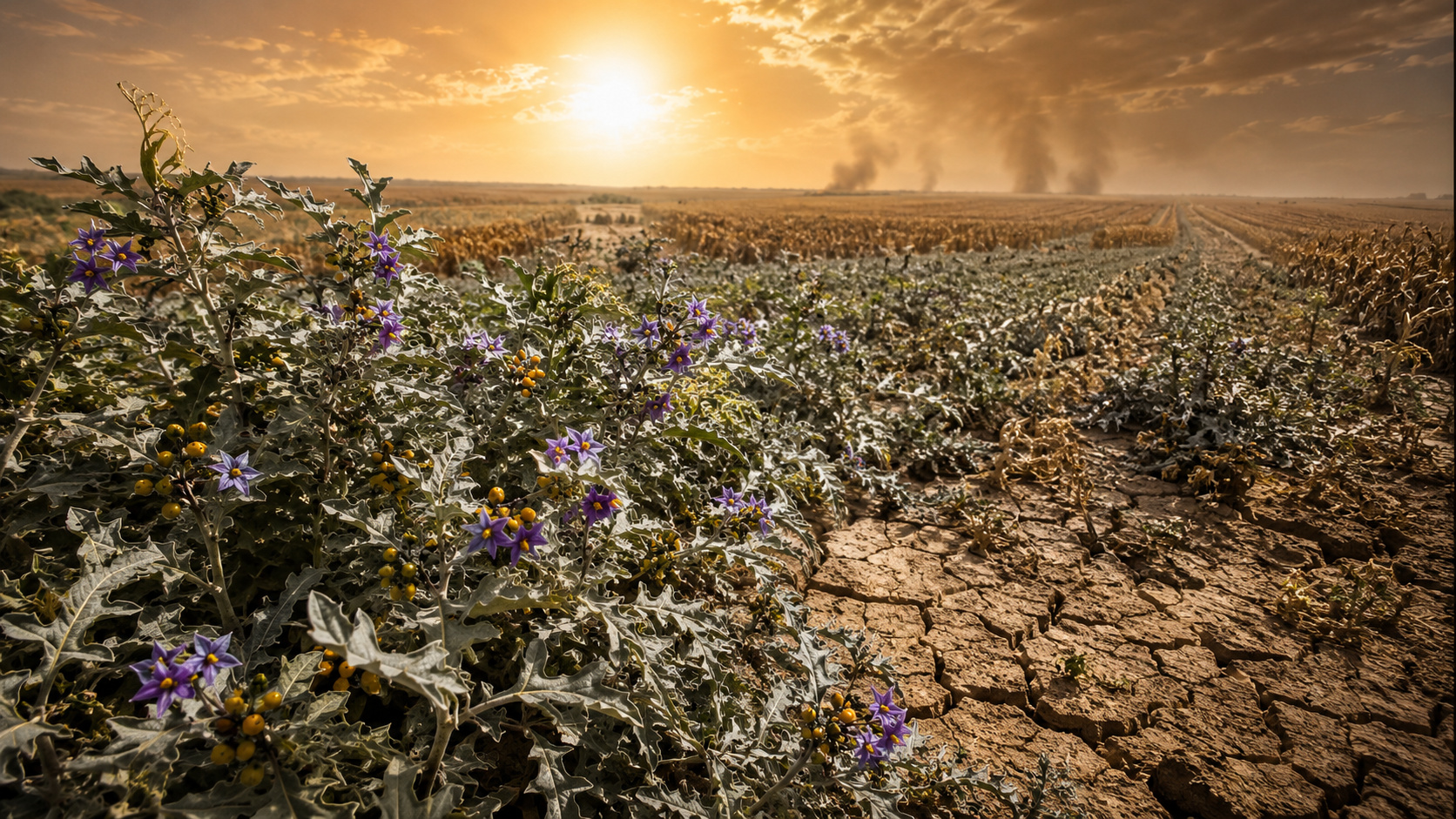
Silverleaf Nightshade advances with climate change and human transport, expands risk areas worldwide and concerns agriculture, biodiversity, and environmental management.
The Silverleaf Nightshade, common name of the species Solanum elaeagnifolium, has entered the center of scientific debate after a global study summarized by the European Commission showed that its worldwide expansion is being driven simultaneously by climate change and human activity, especially trade and transportation of goods. The survey used 9,536 occurrence records, including 7,860 from the native area in the Americas and 1,676 from invaded areas in Africa, Australia, China, and Europe, to map the risk of the species’ advancement on a planetary scale.
The result raised an alert because the research showed that many areas with highly favorable conditions have not yet been occupied. In other words, the plant has already advanced significantly, but it can still spread more in the coming decades if the climate continues to change and if human vectors continue transporting propagules between regions.
Silverleaf Nightshade has already spread to several continents and still has room to advance
According to the European Commission, the species is native to the Americas, but today it already has a broad global distribution. The most concerning point of the study is not just where it has already reached, but the fact that its expansion does not solely depend on finding areas similar to its region of origin. The modeling indicates that the invasion was substantially influenced by climate change and human activities, including the transportation of goods and commercial circulation.
-
While other coffees escape the American tariff hike, Brazilian instant coffee is excluded, raising an alert in the sector and may become up to 37.5% more expensive in the United States.

-
Degraded lands could become São Paulo’s new asset to expand planted forests, strengthen wood, cellulose, and biomaterials, as well as keep the state competitive in the international market.
-
Iran and Russia announce that they are working on creating a grain exchange for BRICS countries, with support from Moscow, one of the world’s largest grain producers, and call on central banks to simplify payments to boost agricultural trade.

-
Even without an official rural area, Florianópolis maintains family farming in Ratones, Ingleses, and Ribeirão, producing cassava, honey, oysters, and organic products, transforming farms into schools and rural tourism, but faces an uncomfortable question: how long can the countryside withstand within a growing capital?


The analysis also showed that the plant managed to adjust to new conditions through evolutionary adaptation. In China and Europe, it began to thrive in areas with lower temperatures and higher precipitation than in its native range. In Africa and Australia, the opposite movement occurred, with a shift to conditions of higher heat and lower precipitation.
This behavior greatly increases the global risk. The logic shifts from “the plant will invade places similar to the original environment” to “the plant can also adjust to new climates,” making future expansion much more difficult to predict and contain.
Climate change increases the risk because the plant has already shown adaptability
The main conclusion highlighted by the European Commission is that the advance of Silverleaf Nightshade does not depend solely on conserving the original climatic niche. The study showed that niche adaptation was even more important during the invasion than simply remaining in conditions similar to the native area.
In practice, this means that the plant has already demonstrated the ability to respond to more challenging environments and to occupy new combinations of temperature and rainfall. As there are several highly suitable areas not yet invaded, the combination of global warming and human movement creates an especially favorable scenario for new biological invasions.
This is exactly why the study advocates for proactive prevention and mitigation measures. When an invasive species gains this environmental flexibility, waiting for the advance to happen and then reacting tends to be much more costly and much less efficient.
The plant is concerning because it competes with crops, affects ecosystems, and is difficult to control
The European Commission summarizes the Silverleaf Nightshade as an invader that threatens agriculture and ecosystems. According to the summary published by the body, the species competes with agricultural crops for light, water, and soil, affects the growth of native plants, and also hosts pests, viruses, fungi, and bacteria. The same summary also notes that its berries are toxic to livestock.
The problem is exacerbated because controlling the species is difficult even after identification. The study published in the journal Plants highlights that the Silverleaf Nightshade has a deep root system, a characteristic that helps the plant withstand dry conditions and increases its persistence in the terrain.
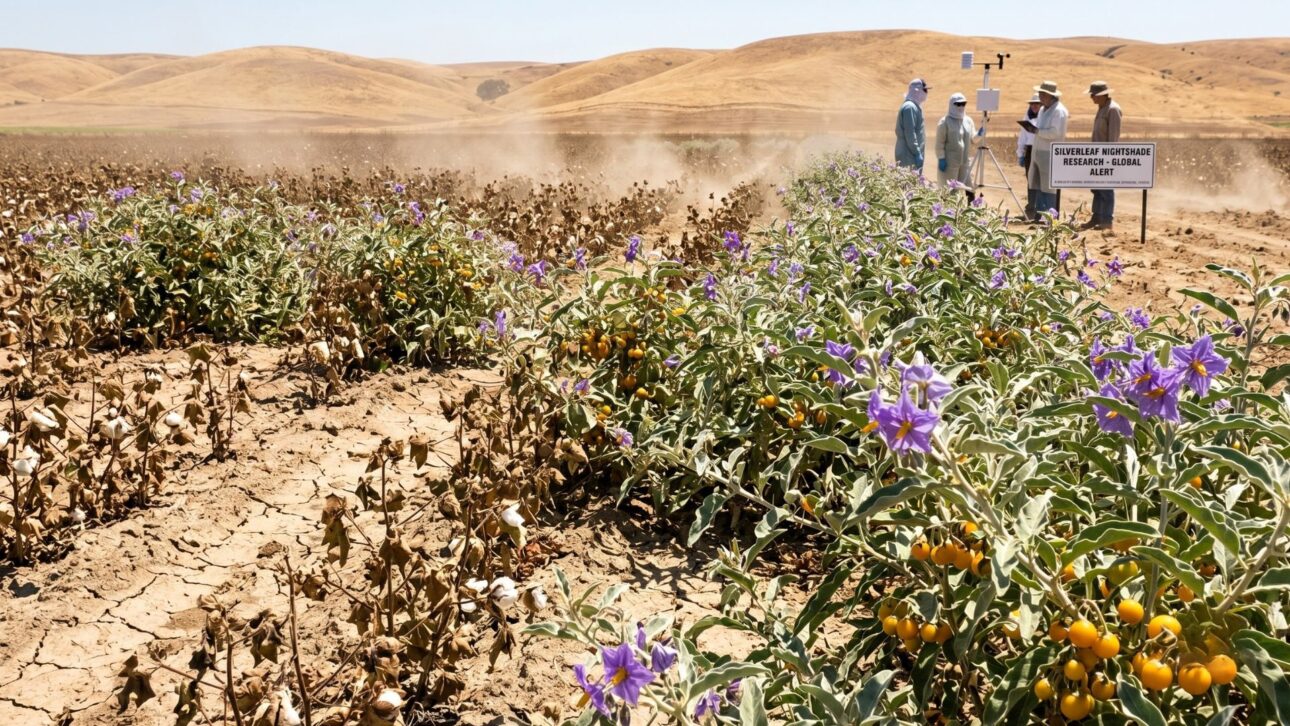
Additionally, the research notes that the management of invaded areas itself can favor dissemination when there is fragmentation of viable roots. This makes management more complex and helps explain why this plant frequently appears among the most problematic invasives in agricultural areas and roadsides.
In Greece, the expansion has already reached 1750% and has reached protected areas
One of the strongest signs of the species’ potential for advancement appeared in Greece. According to a study published in the journal Plants, the distribution of Silverleaf Nightshade in the country recorded an increase of 1750% in recent decades, doubling main centers of occurrence and reaching higher altitudes.
The authors also recorded the presence of the invasive in areas of the Natura 2000 network, the main European system of protected areas. This shows that the expansion is no longer limited to just agricultural or urban environments and can reach environmentally sensitive zones.

The same work identified a strong association between the presence of the species and agriculture, human settlements, and road networks, reinforcing the idea that human disturbance and territorial connectivity act as drivers of the invasion.
Early prevention costs less than combating the consolidated invasion
The best response is still to act early. The European Commission highlights that risk areas can be identified before the plant establishes itself, while the study from Plants reinforces the need for rapid monitoring and the incorporation of preventive measures in agricultural, road, and conservation policies.
Once the Silverleaf Nightshade establishes itself, control tends to become expensive, time-consuming, and technically difficult, especially due to its underground persistence and ability to spread in disturbed areas. This makes prevention a much more efficient strategy than late removal.
In the end, the Silverleaf Nightshade became a clear example of how climate change, human transportation, and biological adaptation can work together to expand an invasion on a global scale. And this explains why the species has moved from the field of local problematic weeds to the international radar as a growing threat to agriculture and biodiversity.







Be the first to react!