Portuguese
  Spanish




Technical Partnership with Japan Focuses on Preventive Engineering, Changing Institutional Culture, and Centenary Solutions to Reduce Deaths, Urban Damage, and Billion-Dollar Losses Caused by Natural Disasters in Brazil
A significant international articulation gained strength recently in the country. Brazil wants to learn from Japan how to prevent natural disasters, especially floods and landslides. These events have become recurrent in urban areas and mountainous regions.
This movement gained prominence after extreme episodes. The rains in January 2011 caused nearly a thousand deaths in the mountainous region of Rio de Janeiro. Since then, the country has come to recognize the fragility of prevention, given the intensification of climatic events.
Prevention Is Still Recent in Brazil
Authorities and experts say that Brazil started late on the culture of prevention. The government established the National Policy for Protection and Civil Defense only in 2012. The policy began to guide actions to reduce risks and manage disasters.
-
The Arctic is no longer just a frozen region and is becoming a new military board with the opening of maritime routes, expansion of bases, nuclear icebreakers, and competition among Russia, NATO, the United States, and China.

-
U.S. Dismisses Brazilian Foreign Ministry’s Military Risk Warning as “Absurd,” Cites Brazilian Criminal Gangs Operating in the U.S. Since May 2026
-
Ukraine War Impacts Brazilian Fuel Supply: Russian Diesel Imports Drop 65% in June, Brazil Turns to US and India Amid Market Concerns

-
Chinese Nuclear Submarine Launches Simulated Warhead Missile in Pacific, Heightening Regional Tensions Amid Naval Drills with Russia Near Qingdao; New Zealand and Papua New Guinea Warn of Persistent Chinese Military Presence



In addition, the government launched the first National Plan for Protection and Civil Defense only in 2025, during COP30. The plan aims to integrate actions among the Union, States, and municipalities.
Budget Prioritizes Response and Reconstruction
Despite institutional advances, the government still concentrates resources on reacting to disasters. Data from the Federal Court of Accounts (TCU) shows that, between 2012 and 2025, the Union allocated R$ 28.3 billion to disaster management.
Of this total, only 23.4%, about R$ 6.64 billion, financed prevention actions. Meanwhile, 74% of the resources funded emergency relief and recovery of affected areas.
Pioneering Project Brings Japanese Technology to the Country
Given this scenario, Brazil began to treat its partnership with Japan as strategic. The Asian country has historically dealt with earthquakes, tsunamis, typhoons, and heavy rains.
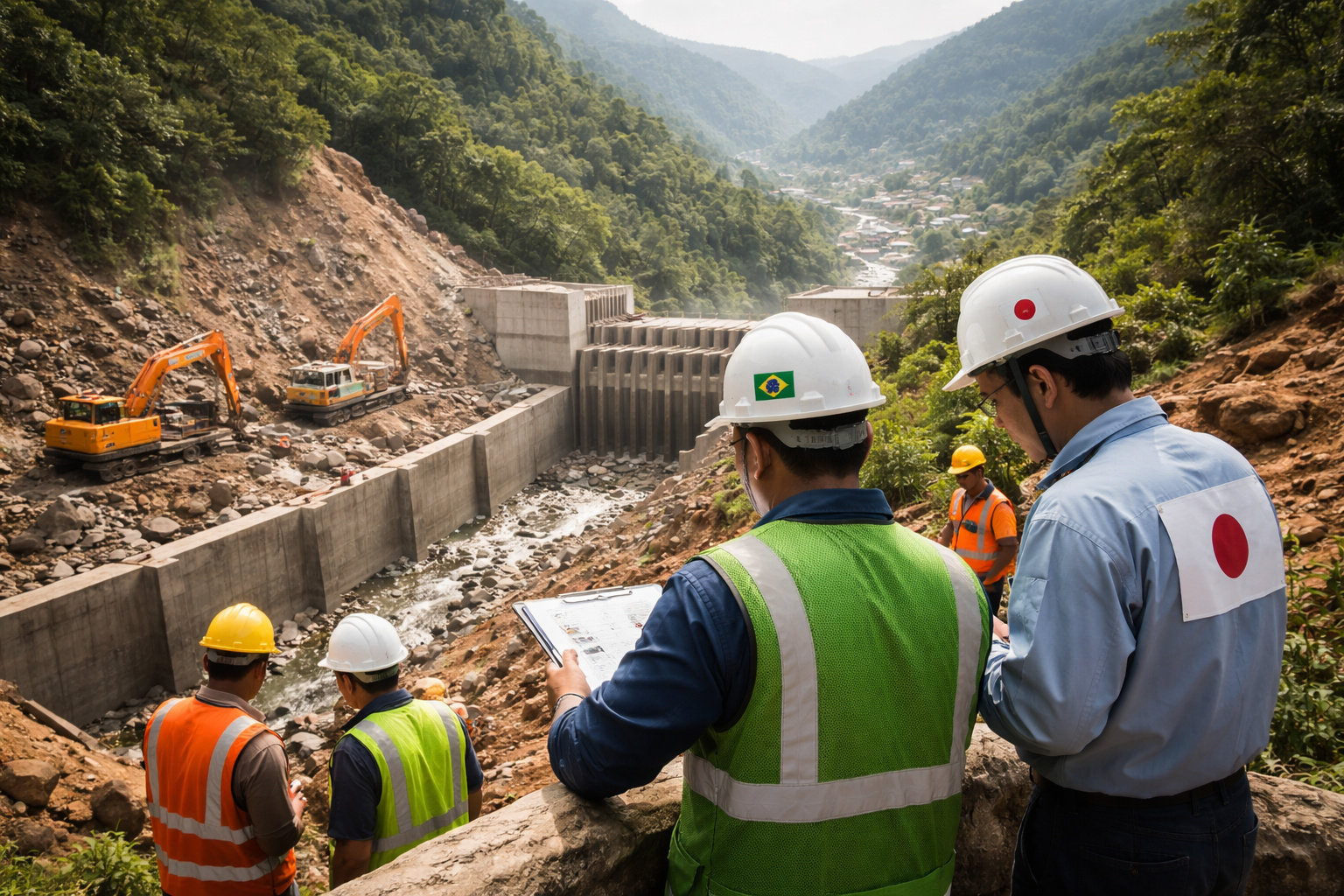
Over more than a century, Japan has built a robust public policy for prevention. In Brazil, this experience started to take shape in Nova Friburgo and Teresópolis, cities affected by the 2011 rains.
How Sabo Barriers Work
In these locations, the government will implement Sabo barriers, structures that contain debris flows on slopes and riverbeds. The goal is to reduce the impact of intense runoff.
Japan has used these barriers for over a hundred years. The term Sabo means land protection. The structures retain sediments, rocks, and vegetation swept away by the rains.
According to Takasue Hayashi, chief advisor to the project, the debris flow has high destructive power. Water mixes with rock blocks. This combination can reach speeds between 40 and 60 kilometers per hour.
Projected Works and Timeline in Brazil
The Ministry of Cities stated that the work in the Duas Pedras neighborhood in Nova Friburgo will begin in January 2026. Completion is expected by June 2027.
In Teresópolis, construction in the Campo Grande neighborhood is scheduled to start in December 2026. The two projects total R$ 43 million in resources from the New PAC.
Adapting the Technique to Brazilian Reality
According to Wolnei Wolff, national secretary of Protection and Civil Defense, debris flow has occurred in Brazil since the 1970s. The phenomenon has always represented a technical challenge.
Based on Japanese experience, technical teams are adapting methodologies to the Brazilian terrain and local rainfall patterns.
Technical Cooperation with Support from JICA
The Japan International Cooperation Agency (JICA) supports the project. As Issei Aoki, deputy director-general of the agency, explains, the partnership involves sending specialists.
In addition, the agreement provides for technical training and equipment provision. The actions focus on risk reduction, rainfall monitoring, and river management.
Municipalities Bear the Greatest Losses
Despite ongoing projects, municipalities still lack consistent preventive policies. A study by the National Confederation of Municipalities (CNM) shows that 95% of Brazilian cities experienced impacts between 2013 and 2024.
According to Paulo Ziulkoski, president of the entity, the accumulated losses reached R$ 732.2 billion. The damages include floods, droughts, landslides, and wildfires.
Millions Still Live in Risk Areas
Data from the Geological Service of Brazil (SGB) indicates that 4.6 million people currently live in risk areas, distributed across 1,801 mapped municipalities.
At the same time, the Ministry of Cities reported new investments. Since 2023, the government has contracted R$ 4 billion for landslide containment and R$ 22.1 billion for urban drainage.
The Contrast with Japanese Experience
Japan structured its prevention policy at the end of the 19th century. In 1897, the country enacted legislation that defined the control of rivers and slopes.
In 2023, the Japanese government allocated 1.7 trillion yen to disaster management. This amount is equivalent to R$ 59.19 billion, according to professor Mikio Ishiwatari from Meiji University.
These investments drastically reduced the economic damage from floods. In the 1940s and 1950s, they reached up to 7% of GDP. Today, they are around 0.4%.
In light of this history, the Japanese experience shows that continuous prevention saves lives and reduces economic losses. It remains to be seen whether Brazil will manage to transform this cooperation into a permanent policy before the next major climate tragedy.