Portuguese
  Spanish


More than 140 Brazilian representatives brought a clear message to the world’s largest industrial fair: the country wants to transform clean energy, technology, AI, and engineering into a competitive advantage to attract investments and compete for space in global green production chains.
Brazil entered the world’s largest industrial fair in 2026 with a rare showcase for its recent history. Its participation as a Partner Country placed the country at the center of a global dispute for clean production, applied technology, and new industrial chains. The move showed that Brazilian industry wants to be seen beyond the export of raw materials.
The bet was direct. With an electricity matrix that is 88.2% renewable in 2024, the country sought to transform clean energy into an economic argument. In a market increasingly pressured by climate goals, producing with fewer emissions can be decisive for attracting factories, suppliers, investors, and international partners.
The central point was not an isolated discovery, nor a single technological announcement. The highlight was the combination of renewable energy, artificial intelligence, data engineering, biofuels, critical minerals, aviation, machinery, applied research, and decarbonization projects. This sum helped present Brazil as a potential green industrial hub.
-
Brazilian Startup Converts Tucumã Seeds into Bioplastic for Bicycle Pedals, Cups, and Construction Materials

-
NASA Captures Rare Encounter of South Korean “Surfboard” Spacecraft Crossing Lunar Orbit at Over 11,000 km/h

-
Germany Opens World’s Largest Smart Power Semiconductor Factory with €5 Billion Investment, Creating 1,000 Jobs and Doubling Capacity for AI and Energy Needs

-
Kazakhstan’s Torysh Valley Holds Thousands of Giant Stone Spheres, Intriguing Scientists with Ancient Oceanic “Cannonballs”
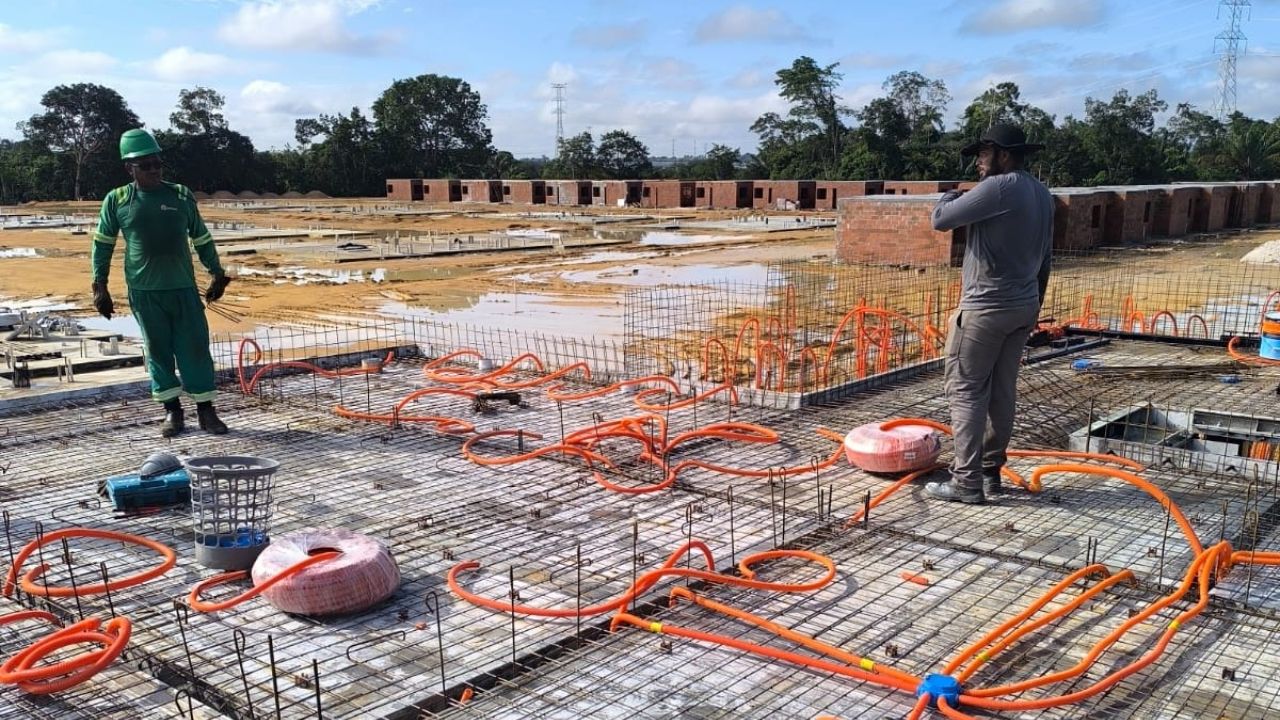

Brazil gained a central position in Germany between April 20 and 24, 2026

The Brazilian presence took place between April 20 and 24, 2026, in the German city of Hannover, during the main global industry gathering. The status of Partner Country amplified the country’s visibility before companies, governments, banks, research centers, and international buyers. The choice gave Brazil a political, technological, and commercial showcase all at once.
This position allowed the country to advocate for a new interpretation of its economy. Instead of appearing only as a supplier of ore, oil, grains, and energy, Brazil presented itself as a productive base capable of delivering industrial goods, digital solutions, aircraft, machinery, clean technologies, and chains with lower carbon emissions.
The message was strong because it connected natural resources with industrial capacity. The country has large-scale clean energy, mineral reserves, an agricultural base, heavy industry, global companies, and technical centers. When these factors are organized around innovation, data, and sustainable production, the narrative shifts from raw exporter to industrial platform.
More than 140 Brazilian exhibitors showcased machinery, energy, data, and engineering
The Brazilian showcase brought together more than 140 exhibitors, including companies, entities, public banks, research centers, and organizations linked to industry. Names like Embraer, Vale, Petrobras, BNDES, and ABIMAQ helped give weight to the national pavilion. The presence showed different facets of the economy, from aviation to mining, from energy to machine manufacturing.
The Brazilian space exceeded 2,000 m² and was organized into areas related to automation, robotics, digital industry, energy, sustainability, machinery and equipment. This format helped show that the agenda was not concentrated in a single sector. The country sought to prove that it can compete in various stages of new global production.
The presence of Embraer reinforced the image of advanced engineering and sustainable aviation. Vale brought themes related to critical minerals, logistics, and future mining. Petrobras appeared connected to research, energy, and energy transition. BNDES, in turn, helped bring the industrial showcase closer to the green financing agenda.
According to Hannover Messe, organizer of the world’s largest industrial fair, Brazil was presented as a force for sustainable transformation

Brazil’s choice as a Partner Country highlighted themes such as renewable energy, digitalization, sustainable technologies, and low-carbon industry. The fair emphasized the country as a relevant actor for global industrial transformation, especially due to the combination of natural resources, productive base, domestic market, and innovation capacity.
This framing gave Brazil a chance to dispute the narrative. In a world where countries compete for clean factories, strategic minerals, hydrogen, batteries, semiconductors, biofuels, and industrial software, appearing as a territory of renewable energy became a concrete advantage. The global industry seeks to reduce emissions without losing productivity.
This interpretation also strengthened the bridge with Europe. Germany and the European Union are looking for partners for more resilient, clean, and secure supply chains. In this scenario, Brazil tried to present itself as a provider of solutions, and not just inputs. The effect is direct on investments, contracts, joint research, and presence in international supply chains.
88.2% Renewable Electricity Became an Economic Argument for Industry
Brazil’s electricity matrix was one of the strongest points of the national presence. In 2024, the country achieved 88.2% renewability in electricity generation, a rate well above the standard of several major economies. This data helps support the thesis that Brazil can produce steel, aluminum, machinery, fuels, processed foods, and industrial components with a lower carbon footprint.
In practice, clean energy can become a differential in price, reputation, and market access. Global companies need to prove lower emissions in their supply chains. When a factory operates in a country with more renewable electricity, part of this challenge becomes less burdensome. This can attract industrial projects that seek to meet climate goals without relying solely on environmental compensations.
The strength of this argument increases with the introduction of artificial intelligence. AI systems help predict failures, reduce waste, control consumption, optimize transport, and improve maintenance. Data engineering allows measuring emissions, tracking production, and proving to the international buyer that the product was made with greater efficiency.
New Brazil Industry Provided Political Basis for the Industrial Showcase Until 2033
The Brazilian agenda was underpinned by the New Brazil Industry, a policy focused on productivity, innovation, digital transformation, sustentability, and value aggregation until 2033. The program helps explain why participation in the fair was presented as a country strategy, and not just as a commercial presence of companies.
The central idea is to increase the capacity to produce technology within Brazil. This involves machines, equipment, biotechnology, defense, energy, health, digitalization, and more sophisticated industrial chains. The political goal is to reduce dependence, strengthen qualified jobs, and ensure that national resources generate more value before being exported.
At the German fair, this agenda gained international dimension. The country tried to show that it has scale to receive investments and competence to develop solutions. The showcase helped bring together industry, government, banks, and research centers around a common image: Brazil can enter the low-carbon economy with greater strength.
Artificial intelligence, critical minerals, and hydrogen expanded Brazil’s ambition
Brazil’s participation also highlighted themes that drive global industry. Artificial intelligence, digital mining, low-carbon hydrogen, sustainable aviation fuels, rare earths, batteries, and clean logistics appeared as pieces of the same dispute. These are areas that can define who leads the next phase of world production.
Critical minerals received special attention because they are essential for electric vehicles, turbines, batteries, energy grids, and industrial equipment. Brazil has potential in this area, but the challenge is to avoid the old pattern of merely exporting raw material. The strategic leap lies in processing, transforming, and developing technology linked to these resources.
Low-carbon hydrogen also emerged as a relevant industrial promise. With abundant renewable energy, the country can compete for projects related to fertilizers, fuels, green chemistry, and the export of derivatives. Still, the transformation depends on infrastructure, contracts, regulatory security, financing, and real demand.
Brazil left the fair with a more ambitious image. The strength of the national presence lay in the attempt to bring together clean energy, AI, engineering, financing, and industry into a single thesis. It’s not just about selling products, but about selling the country as a productive base for a cleaner economy.
The real impact still depends on execution. Contracts need to materialize, factories need to advance, green projects require capital, and technological chains take time to mature. Nevertheless, Brazil’s 2026 showcase changed the strategic perception and repositioned Latin America.