






 Portuguese
  Spanish





The PET bottle filled with water, created by Alfredo Mozer in Uberaba during the blackout of 2001, spreads the equivalent of a 60-watt bulb using sunlight. The idea inspired Litro de Luz, an NGO now led in Brazil by Rodrigo Eid.
A simple PET bottle, invented by a Brazilian mechanic during the blackout of 2001, became the seed of an NGO now present in 30 countries, which has already brought lighting to 40,000 people in 200 communities without energy in Brazil. The organization is Litro de Luz, led in the country by Rodrigo Eid, and the spark of the idea came from mechanic Alfredo Mozer.
The work addresses a problem that much of the country doesn’t even see. According to information from G1, using materials such as PET bottles, solar panels, and PVC pipes, Litro de Luz claims to have impacted 40,000 Brazilians in 200 riverside, quilombola, and urban periphery communities in nearly 50 cities. The IBGE estimates that 450,000 people do not have electricity at home, a number that reaches 2 million when considering precarious access, where light does reach, but in a rationed manner.
The PET bottle that was born in the blackout of 2001
The story begins with an ingenious improvisation. During the blackout crises of 2001, mechanic Alfredo Mozer, in Uberaba, created a lighting solution from a PET bottle filled with water, with a bit of bleach to prevent moss. Placed half outside the roof and half inside, it captures solar radiation and spreads the equivalent of a 60-watt bulb throughout the room.
-
Distant Galaxy Shaped Like a Giant Jellyfish Sheds Gas, Forming New Stars as It Moves Through Hot Cosmic Gas

-
Nearly 40% of Treated Water in Brazil is Lost Before Reaching Homes; Companies Use Satellites, AI, Helium, and Innovative Tech to Improve Access in Remote Areas

-
Steel Sphere Cylinder Achieves 14% Damping in Tests, Functions Without Sensors or Electricity, and Can Reduce Vibrations in Skyscrapers, Bridges, and Sensitive Equipment with US Patent Registered
-
Man Transforms Childhood Building in Detroit into Community Bookstore, Draws 400 to Opening




It was the good improvisation that Brazilians know how to do. The invention illuminated Mozer’s own community, and the impact of his lamp inspired a Filipino to create the Liter of Light movement. In 2014, the initiative was founded in Brazil as Litro de Luz, which began adapting the solutions to the local needs of the country.
From solar lamp to light that turns on by itself
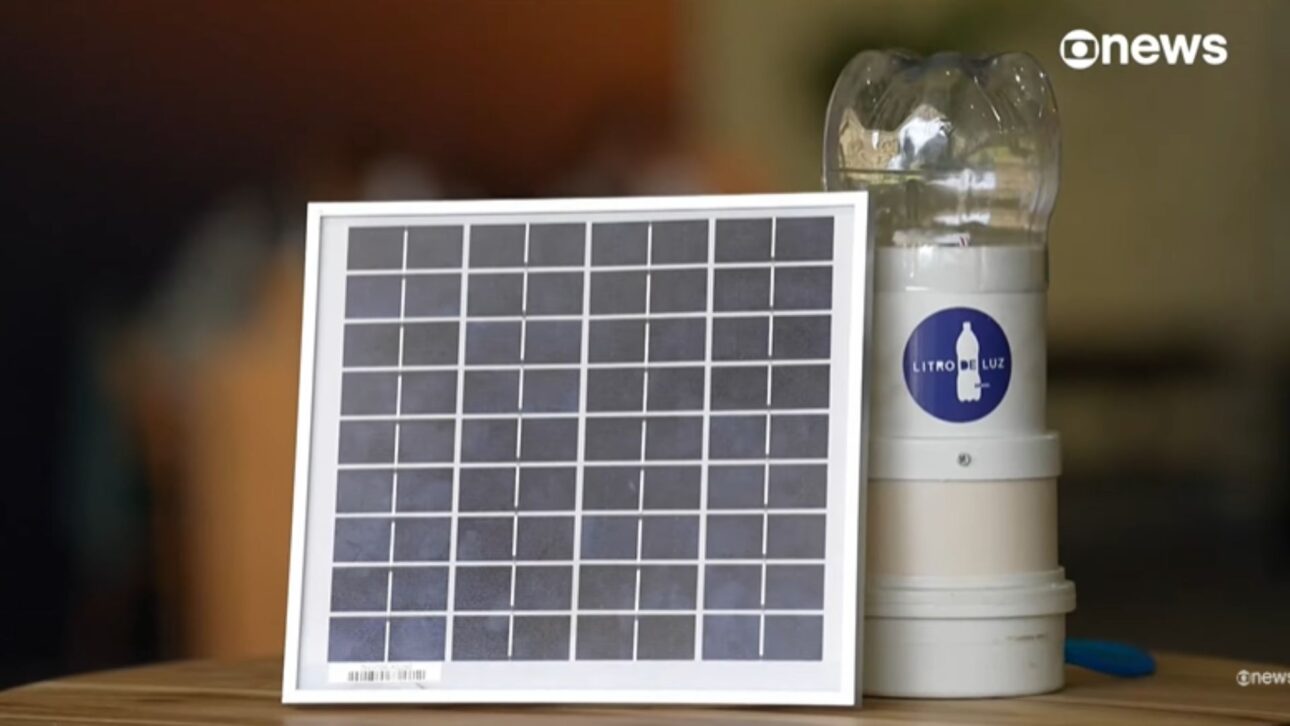
In Brazil, the organization developed simpler versions of the PET bottle idea. One of them is the solar lantern, whose structure uses a PET bottle and PVC pipes, with a battery, a small circuit, and an LED bulb inside. The community resident can turn on the lantern to illuminate the surroundings.

The secret lies in a self-sustaining operation. To power the equipment, a solar panel is connected and left in the sun, and while the sun shines, the lantern turns off while charging the battery, automatically turning on again at night. Litro de Luz insists on simplicity, precisely so that community members can assemble and replicate the solution wherever they want, with a methodology that teaches residents to build the equipment.
The Brazil that is still in the dark
The PET bottle technology tries to fill a void that persists in the country. The IBGE estimates that 450 thousand Brazilians do not have electricity at home, a total that rises to 2 million when including precarious access, and many people walk through streets and alleys without lighting, where accidents and even violence occur. It is a Brazil that remains in the dark and that much of the population does not even imagine exists.
This country without light is quite diverse. According to Litro de Luz, the effort reaches riverside communities, indigenous peoples, quilombolas, urban slums, and rural areas. Rodrigo Eid mentions about 1 million people without access to energy in the Amazon, the region that needs it most, and almost 2 million throughout Brazil, especially in the North and Northeast, but also in the Southeast, and notes that many resort to illegal connections, while the lack of public lighting affects about 6 million people walking through the alleys of the communities.
Light as a right: education, safety, and income
For Litro de Luz, the PET bottle carries a motto: light is not a privilege, it is a right. Through lighting, the organization claims to seek economic impacts, with people being able to produce and work later, access to education, with children and teachers studying longer, and more safety, so that residents of riverside communities can walk the paths without stumbling and seeing venomous animals.
The entity points to concrete cases of this turnaround. In Kalunga, a quilombola community in Chapada dos Veadeiros, a student told the teacher she wanted to pursue the same profession and that the NGO’s lamp would allow her to study more, as the oil lamp emitted a lot of smoke and soot and hindered reading, and that with clean energy light, she could focus on pursuing a public university. A resident of the Pantanal, accustomed to the lamp that blackened everything, noticed that the new portable light can go wherever he works.
A complementary solution to public power
The NGO itself recognizes that it reaches where the State has not reached. Although access to energy is a right that the public power should guarantee, the arrival of the PET bottle and other solutions ends up occupying this space. When asked if the initiative has pressured the public sector, Rodrigo Eid points to cases since 2017 where, after the organization arrived and gave visibility to a territory, the repercussion helped bring regular energy.


Even so, official service is not always enough. In many cases, the regular energy that arrives, such as isolated systems in riverside communities, still does not cover all local needs, and therefore the PET bottle solution continues as a complement. Litro de Luz claims to maintain dialogue with the public power to improve quality of life, presenting itself as a complement, not a substitute, to State infrastructure.
Rodrigo Eid’s journey went from marketing and people management to social impact, seeded by volunteer work in childhood and sealed on a first trip to the Amazon, where children who had never seen artificial light convinced him of the strength of the cause.
At the Web Summit, the largest technology meeting in Latin America, in Rio de Janeiro, he summarized the NGO’s message as listening, applying the startup logic to the social field to understand the client, in this case, to understand the pains of each community and lead the country to know the real Brazil, beyond urban centers. Born from a PET bottle and Brazilian creativity, Litro de Luz claims to have illuminated 40,000 people in 200 communities and reached 30 countries, and the declared dream is, ironically, to become unnecessary.
And you, what do you think about a PET bottle bringing light to communities where the public power has not yet reached? Did you know that this Brazilian invention has spread to 30 countries and has already illuminated thousands of people? Share your opinion and exchange ideas with other readers about access to energy, with respect for different views.


