Portuguese
  Spanish


Patented in the United States in December 2025, the device created at the University of Sharjah uses friction between metallic spheres and internal rods to dissipate vibrations. The proposal targets tall buildings, bridges, technical installations, and sensitive equipment, with a practical advantage in critical situations, the system operates without sensors, cables, or electricity.
A new passive friction damper created at the University of Sharjah, in the United Arab Emirates, caught the attention of civil engineering with a simple idea: using steel spheres inside a cylinder to reduce vibrations in structures subjected to earthquakes, strong winds, or constant tremors.
The device gained prominence for combining structural protection and operation without electricity, a relevant point in natural disasters, when power grids and electronic systems may fail precisely at the moment of greatest risk, as reported by Brasil 247.
The invention was developed by Professor Moussa Leblouba, linked to the civil engineering area of the University of Sharjah. The registration appears in the United States patent system as US12498014B2, published on December 16, 2025, with ownership attributed to the university itself.
-
Artist’s 15-Meter Lighthouse in the Mojave Desert, 160 km from the Sea, Intrigues Visitors with 19 km Range After Years of Bureaucracy

-
Bluetti AC70 Solar-Powered Station: Powers Fridge and Wi-Fi During Blackouts, Delivers 1,000W, 3,000 Charge Cycles, Priced at $900

-
Enormous Black Hole Phoenix A* Challenges Scientific Understanding with Mass of 100 Billion Suns, Surpassing Famous TON 618 in One of the Largest Known Galaxy Clusters
-
Say Goodbye to Storing Wine in a Regular Fridge: Midea’s Climate-Controlled Cellar Holds 34 Bottles, Maintains 5-18°C, and Uses Only Half a kWh Daily


In practice, the technology does not replace the structural design of a building or a bridge. It acts as an additional energy dissipation component, designed to reduce part of the oscillations that can damage structures, scientific equipment, electrical installations, and communication systems.
What is inside the cylinder that transforms vibration into controlled friction
The device described in the patent has a straightforward mechanical construction. It uses a hollow cylinder filled with solid spheres, crossed by a longitudinal shaft with small rods designed to protrude outward, like internal branches.
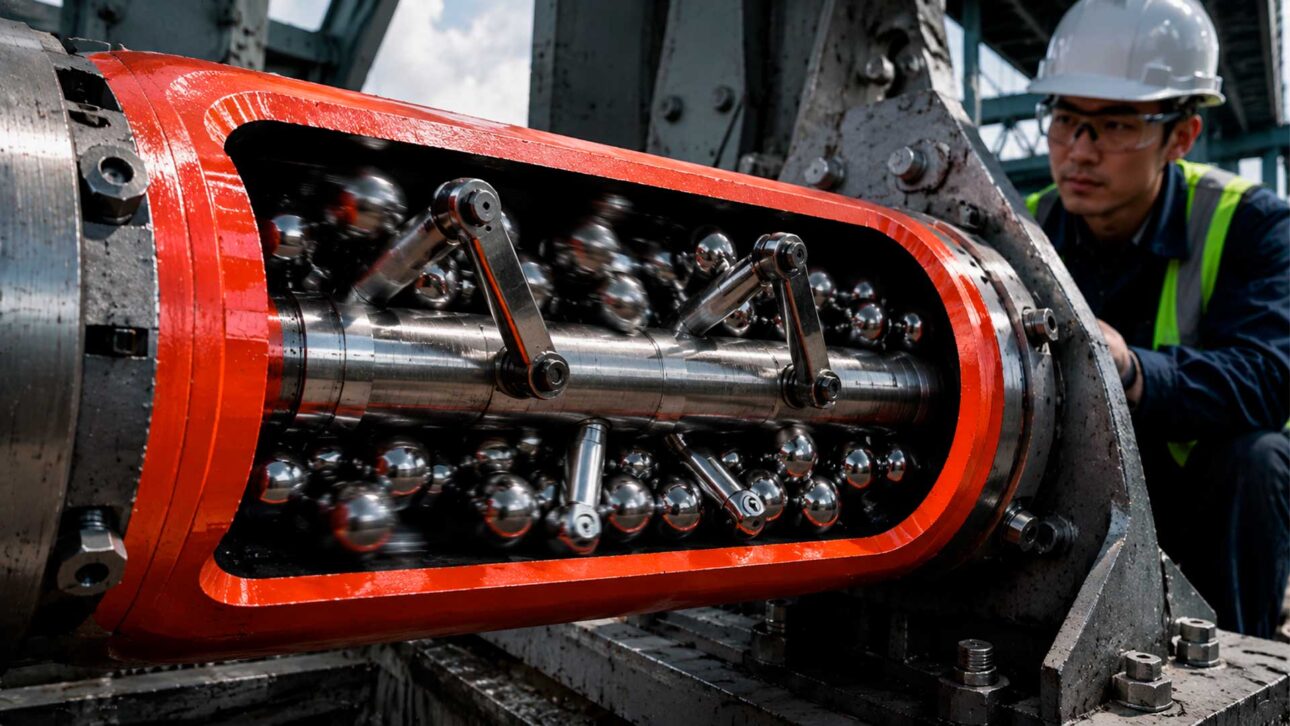
When the structure vibrates, this axis moves inside the cylinder. The rods push the compressed spheres, creating friction between the metal parts. This friction consumes part of the mechanical energy which, without dissipation, would continue to propagate through the structure.
According to the statement published by EurekAlert!, linked to the American Association for the Advancement of Science, Leblouba states that the system “does not require energy” and operates through pure physics, from the friction generated between the internal components.
In the tests mentioned by the researcher, the set achieved an effective damping index close to 14%, a result considered promising for a completely passive system.
The advantage is less in the isolated piece and more in what it dispenses with
Engineering has been using dampers in buildings, bridges, and industrial structures for decades. There are viscous, metallic, viscoelastic, and friction models, each with different costs, applications, and maintenance requirements.
The difference with the steel sphere model lies in the simplicity of the assembly. The patent describes a system without an external energy source, with few main parts and the possibility of replacing individual components in case of damage.
This can reduce maintenance costs in locations where inspection, part replacement, and technical access are difficult. On a busy bridge, for example, each intervention requires blockages, specialized teams, and a short operational window.
Another point is the installation in already constructed structures. The university’s statement claims that the device can be adapted to existing works, provided the engineering project indicates the correct fixation points and the load capacity involved.
Even so, there is a clear limitation. The equipment needs to undergo validations on a real scale, local standards, fatigue studies, and case-by-case evaluation before being used in public works or occupied buildings.
Bridges, tall buildings, and sensitive equipment emerge as targets of the technology
The patent cites applications in structures and equipment subjected to vibrations caused by seismic activity, wind, and forces produced by human use, such as machines, heavy traffic, or technical installations. The document also mentions buildings, electrical installations, communication systems, vehicles, aircraft, ships, and scientific or military equipment.
In tall buildings, the interest lies in reducing lateral oscillations caused by wind or tremors. In bridges, the target is repetitive movements caused by traffic, gusts, and dynamic variations that accumulate stress over time.
In industrial environments, the use can be even more specific. Machines, generators, measurement benches, laboratories, and sensitive equipment lose precision when they receive constant vibration from the floor or structure.
Why operating without electricity is so burdensome in an emergency
Active structural control systems may rely on sensors, actuators, computers, and electrical power. They are capable of responding in real-time but require more complex support and maintenance infrastructure.
The ball damper takes another path. It responds mechanically to the movement of the structure itself, without waiting for an external command. The vibration enters the assembly, moves the shaft, presses the balls, and generates friction.
This autonomy is relevant in earthquakes, severe storms, network failures, and blackouts. If the power goes out, the system continues operating because it does not depend on a motor, software, or battery to produce mechanical resistance.
The price of this simplicity is that the device does not “think” or adjust itself during the event. The performance depends on the sizing done before installation, including cylinder size, number of balls, diameter of the parts, number of rods, and position in the structure.
The patent shows potential, but engineering still needs to prove its use in the field
The registration in the United States strengthens the intellectual property of the University of Sharjah, but a patent does not mean a product ready for mass installation. It confirms the technical protection of the invention, not automatic approval for use in any building, bridge, or public work.
To reach the market, the device still needs to face typical civil engineering stages: larger scale tests, comparison with existing dampers, analysis of lifespan, cost per unit, behavior after thousands of cycles, and compatibility with the standards of each country.
Even so, the proposal draws attention because it swaps electronic complexity for a mechanical solution with a low number of parts. In cities with old constructions, overloaded bridges, and structures exposed to daily vibrations, this type of technology could pave the way for simpler and more accessible reinforcements.
Would you use a mechanical solution like this in old bridges and buildings, or do you think the technology still needs many tests before leaving the laboratories? Leave your opinion in the comments and say where this type of damper would make more sense in Brazil.