






 Portuguese
  Spanish


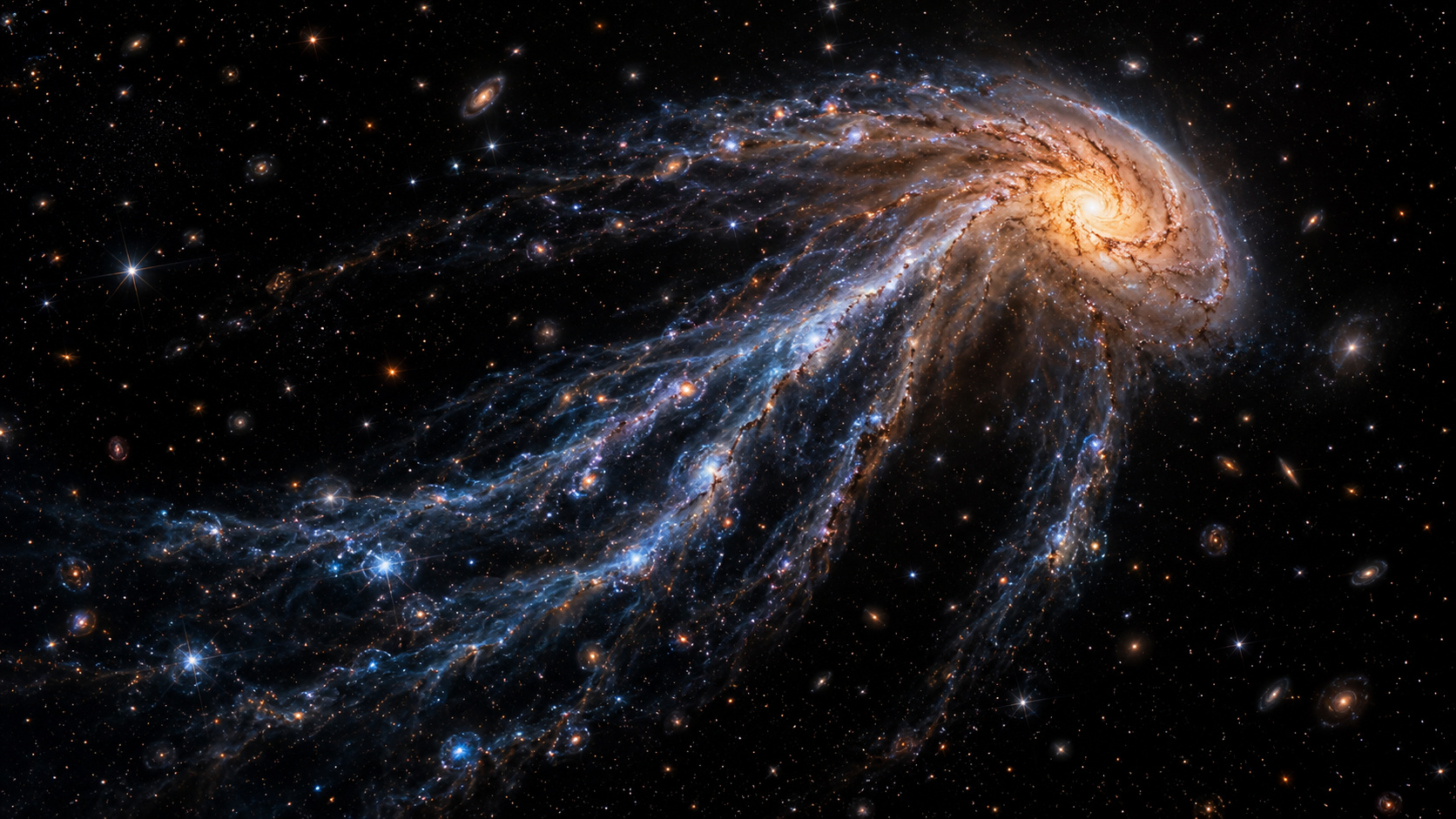

James Webb reveals the most distant jellyfish galaxy ever detected, with gas tentacles, young stars, and clues about galaxy evolution.
The James Webb Space Telescope has revealed one of the most unusual images ever recorded of a distant galaxy: COSMOS2020-635829, a structure with long trails of gas resembling jellyfish tentacles. According to the study published in The Astrophysical Journal, the object appears at redshift z = 1.156, which means it is being observed as it was about 8.5 billion years ago.
The discovery was led by Ian D. Roberts from the University of Waterloo, and gained prominence for recording the most distant jellyfish galaxy identified so far. The observations indicate that this type of galactic transformation was already occurring when the Universe was much younger than traditional models used to suggest.
What is a jellyfish galaxy and why it attracts so much attention
Jellyfish galaxies get their name because of the long streams of gas that extend backward, forming structures similar to tentacles.
-
Nearly 40% of Treated Water in Brazil is Lost Before Reaching Homes; Companies Use Satellites, AI, Helium, and Innovative Tech to Improve Access in Remote Areas

-
Steel Sphere Cylinder Achieves 14% Damping in Tests, Functions Without Sensors or Electricity, and Can Reduce Vibrations in Skyscrapers, Bridges, and Sensitive Equipment with US Patent Registered
-
Artist’s 15-Meter Lighthouse in the Mojave Desert, 160 km from the Sea, Intrigues Visitors with 19 km Range After Years of Bureaucracy

-
Bluetti AC70 Solar-Powered Station: Powers Fridge and Wi-Fi During Blackouts, Delivers 1,000W, 3,000 Charge Cycles, Priced at $900


In the case of COSMOS2020-635829, the study describes a relatively symmetrical galactic disk accompanied by a one-sided tail with extraplanar star-forming sources.


These objects are important because they show a galaxy being transformed in real cosmic time. Instead of just revealing the final form of an already altered galaxy, they expose the process of gas removal that changes its structure and affects its ability to continue forming stars.
Dynamic pressure is the cosmic wind that strips the gas from the galaxy
The mechanism behind the tentacles is called ram-pressure stripping. According to the team from the University of Waterloo, the galaxy moves rapidly through a hot, dense cluster environment, and this medium acts as a strong wind pushing the gas backward.
This process does not mean that the galaxy is exploding. What happens is a progressive removal of gas through interaction with the surrounding medium, leaving a visible trail and profoundly altering the galaxy’s future evolution.
Gas tentacles also turned into nurseries for young stars
One of the most important points of the discovery is that the tentacles do not only contain dispersed gas. The study reports the presence of blue star-forming knots embedded in this tail, indicating that new stars are being born outside the galaxy’s main disk.
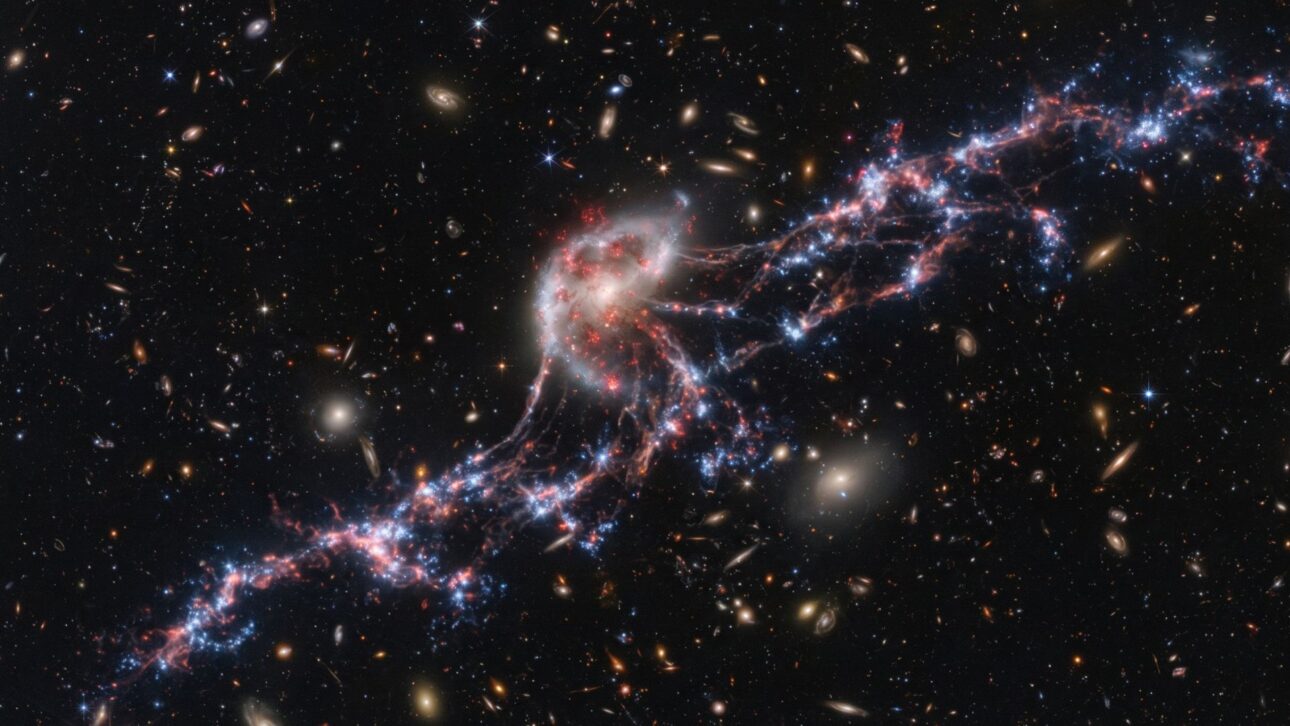
According to the scientific article, these extraplanar sources harbor extremely young stellar populations, with ages up to 100 million years, as well as stellar masses around 10⁸ solar masses and star formation rates between 0.1 and 1 solar mass per year.
This reinforces the interpretation that the stripped gas was not only lost but also compressed and converted into new stars.
Discovery challenges the old view on young Universe clusters
The team states that the discovery is particularly significant because, at this time in the Universe, many scientists expected clusters still forming and less efficient at producing this type of gas stripping.
The presence of such a distant jellyfish galaxy indicates that these environments were already severe enough to intensely alter galaxies much earlier than anticipated.
In the University of Waterloo statement, Ian Roberts highlighted that cluster environments were already harsh enough to strip gas from galaxies, suggesting a strong environmental influence earlier than imagined. The team also points out that this type of process may have helped build the large population of “dead” galaxies seen in clusters in the current Universe.
James Webb made it possible to see the jellyfish galaxy 8.5 billion years in the past
The identification of COSMOS2020-635829 was only possible with the resolution and sensitivity of James Webb in deep observations of the COSMOS field, one of the most studied regions of the sky to investigate distant galaxies.
The work combined images from the JWST with spectroscopic data from the Gemini GMOS IFU, allowing the ionized tail to be linked to the galaxy’s disk.

The article published in The Astrophysical Journal classifies the object as a candidate jellyfish galaxy, and not as a closed case without room for refinement.
Even so, the authors state that if the interpretation holds, it is the highest redshift example ever observed with an ionized tail produced by dynamic pressure.
COSMOS2020-635829 became a rare window into galaxy evolution
More than an impressive image, the discovery offers a window to understand how galaxies were shaped during a crucial phase of cosmic history.
It suggests that the interaction between galaxies and the surrounding environment already strongly influenced star formation and gas loss when the Universe was still far from its current age.
By revealing such a distant structure with details of its tentacles and its stellar nurseries, the James Webb expanded the reach of observational astronomy in one of the most important themes of modern cosmology: how galaxies stop forming stars and how the environment accelerates this transformation.


