Portuguese
  Spanish


While part of the country still lives with buckets, improvised connections, and open sewage, utilities are starting to use satellites, smart valves, robots, sensors, and underground excavation to reduce losses and expand networks without relying solely on large traditional works
Brazilian sanitation has entered a phase where old pipes, invisible leaks, and neighborhoods without regular networks are being monitored by artificial intelligence, satellite images, helium gas, and small tunnel boring machines. Technology does not replace construction, investment, and management, but it begins to tackle one of the sector’s biggest bottlenecks, treated water that is produced, pumped, and paid for, but does not reach those in need.
The difference appears within the same city. In Rio de Janeiro, residents of formal areas in the South Zone experience more regular supply, while nearby communities have spent years using improvised solutions for cooking, washing clothes, and bathing.
In such places, the problem is not only producing water but distributing it with the correct pressure, reducing leaks, and connecting houses to official water and sewage networks.
-
Steel Sphere Cylinder Achieves 14% Damping in Tests, Functions Without Sensors or Electricity, and Can Reduce Vibrations in Skyscrapers, Bridges, and Sensitive Equipment with US Patent Registered

-
Artist’s 15-Meter Lighthouse in the Mojave Desert, 160 km from the Sea, Intrigues Visitors with 19 km Range After Years of Bureaucracy

-
Bluetti AC70 Solar-Powered Station: Powers Fridge and Wi-Fi During Blackouts, Delivers 1,000W, 3,000 Charge Cycles, Priced at $900
-
Enormous Black Hole Phoenix A* Challenges Scientific Understanding with Mass of 100 Billion Suns, Surpassing Famous TON 618 in One of the Largest Known Galaxy Clusters


According to the Instituto Trata Brasil, based on SINISA 2024 data, 39.5% of the water is lost before reaching homes, 84.1% of Brazilians have access to treated water, and about 90 million still live without sewage collection.
The same panel points to an investment of R$ 29.1 billion in basic sanitation in 2024, a high number, but still insufficient given the accumulated backlog in outskirts, favelas, rural areas, and smaller municipalities.
The leak that does not appear on the street has become a target for satellites and artificial intelligence
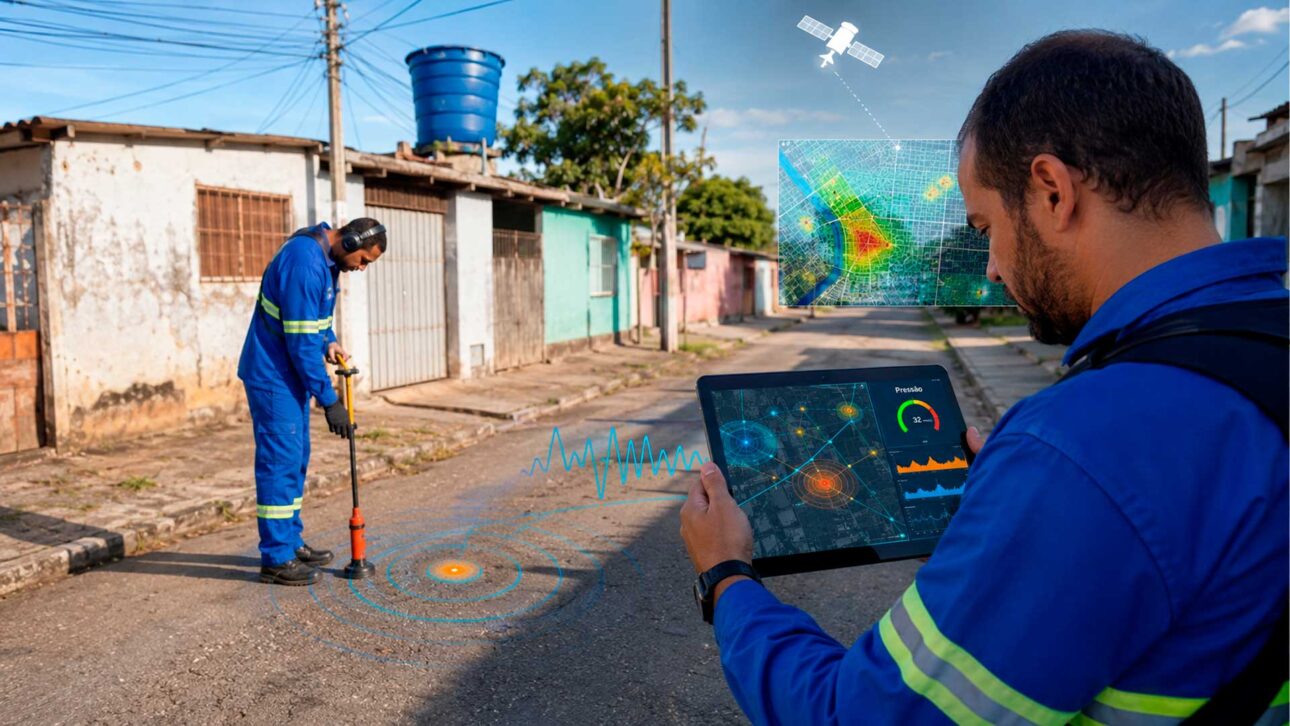
A large part of the losses occurs underground. The pipe breaks, the water escapes, but the asphalt remains dry. In extensive networks, waiting for the leak to appear on the surface can mean months of waste, loss of pressure and irregular supply in entire neighborhoods.
This is where technologies that once seemed distant from the routine of sanitation come into play. Asterra reported that it uses polarimetric synthetic aperture radar data, PolSAR, combined with artificial intelligence, to detect soil moisture signals and guide field teams. The company signed a contract with Aegea to provide leak detection solutions between 2024 and the end of 2026.
In practice, the satellite does not “fix” the pipe. It indicates probable points, and the teams confirm on the ground with acoustic equipment, such as geophones. The method changes the logic of maintenance: instead of searching in the dark, the operator starts working with a risk map.
Revista Pesquisa Fapesp cited a test by Sabesp on a 50-kilometer stretch of pipelines in the metropolitan region of São Paulo. The satellite system found 81 leaks, compared to 14 located by conventional tools in the same area, according to the publication.
Smart valves try to correct a network that sends too much water to one side and too little to another
In Rio de Janeiro, Águas do Rio began installing smart valves to control pressure in the pipelines. The concessionaire reported, in April 2024, that the program planned for 266 valves in strategic points and that losses reached 19 billion liters of water per month in its area of operation.
The logic is simple, but the operational effect is significant. When the pressure is too high, the network bursts more. When it’s low, the water can’t overcome the altitude of hills, slopes, and areas far from reservoirs. The valves adjust the flow by sector and help send the necessary volume to each region.
This control also reduces the dependence on manual maneuvers. Previously, operators needed to open and close registers according to the network’s perception and population complaints. Now, sensors, water meters, valves, and operation centers allow monitoring of pressure, flow, and failures in near real-time.
The gain is not only in water savings. Each recovered liter avoids new capture in water sources, reduces energy used in pumping, and increases the chance of serving neighborhoods that experience intermittent supply.
Helium gas enters the pipeline to report hidden leaks underground
Another front in the fight against leaks uses a gas known for being light, inert, and naturally present in the atmosphere. Veolia’s He-Tracer solution injects helium into the water network to locate leaks that do not appear by noise or visible moisture.
According to Veolia, the service seeks non-visible leaks without interrupting supply, using helium as a tracer gas. In an application in Chile, the company stated that the methodology achieved a detection efficiency of over 95%, with analysis of the gas concentration in the soil above the pipelines.
The process works because the helium dissolved in the water escapes through the leak point, crosses the soil, and can be detected by equipment on the surface. In deep or noisy networks, where geophones lose precision, the technique helps reduce unnecessary excavations.
Even so, there are limitations. The technology works best in public networks with known layouts and less interference from private structures. In areas with improvised connections, old networks without precise registration, or multiple overlapping pipelines, field confirmation remains indispensable.
Tatuzinhos carry pipelines under the streets without opening trenches throughout the community
Finding leaks is one part of the problem. The other is bringing new networks to places where opening a trench can block alleys, garages, businesses, and resident access. In dense communities, traditional construction becomes expensive, slow, and socially difficult.
In the Complexo da Maré, in the North Zone of Rio, Águas do Rio started a sanitation project that includes 18 kilometers of sewage networks, a 4.5-kilometer collector trunk, pipelines up to 1.50 meters in diameter, and an investment of R$ 120 million. The project aims to direct sewage to the ETE Alegria and prevent about 1.3 billion liters of sewage per month from reaching Guanabara Bay.
To reduce the impact on the streets, part of the installation uses small equipment called “tatuzinhos.” They dig the underground and advance by installing the pipeline, in a process similar to that used in subway construction, but on a smaller scale.
The method does not eliminate construction sites, noise, and disturbances. However, it reduces the need to tear up entire streets and allows work in areas where the circulation of residents, motorcycles, cars, ambulances, and local businesses cannot stop for long periods.
The 2033 goal depends on technology, but also on regular connection and affordable tariffs
The New Legal Framework for Sanitation set tough national goals: by the end of 2033, 99% of the population must have access to treated water and 90% to sewage collection and treatment, according to the Ministry of Cities.
The distance to this point is still significant. SINISA itself describes that losses can be real, when water escapes through leaks in pipelines, branches, and reservoirs, or apparent, when consumption exists but is not measured or billed due to registration failures, meters, reading errors, fraud, and illegal connections. The 2025 water supply report pointed out 39.5% total distribution losses and 39.1% billing losses.
In communities, the word “loss” does not always mean just physical waste. Many informal connections arose because regular service never arrived or arrived in an unstable manner. When the official network enters, the challenge is no longer just technical and involves registration, social tariffs, fair measurement, and clear communication with residents.
Technology can show where the pipe leaks, which valve should be adjusted, and where the construction causes the least disruption. But universal sanitation requires another less visible part: monitored contracts, continuous investment, preventive maintenance, and the ability to serve those who are currently outside the formal network.
If satellites, robots, helium, and small tunneling machines are arriving in sanitation, the question now is whether these tools will become daily improvements at the tap and in the sewage of communities. Do you think technology can accelerate universalization, or is the main problem still in management and investment? Leave your opinion in the comments.