Portuguese
  Spanish


At Poli-USP, in partnership with IFSP, researchers created an affordable breast cancer exam: a portable device that uses microwaves instead of radiation, painless, costs about R$ 1,000 and works even in dense breasts, where mammography often fails.
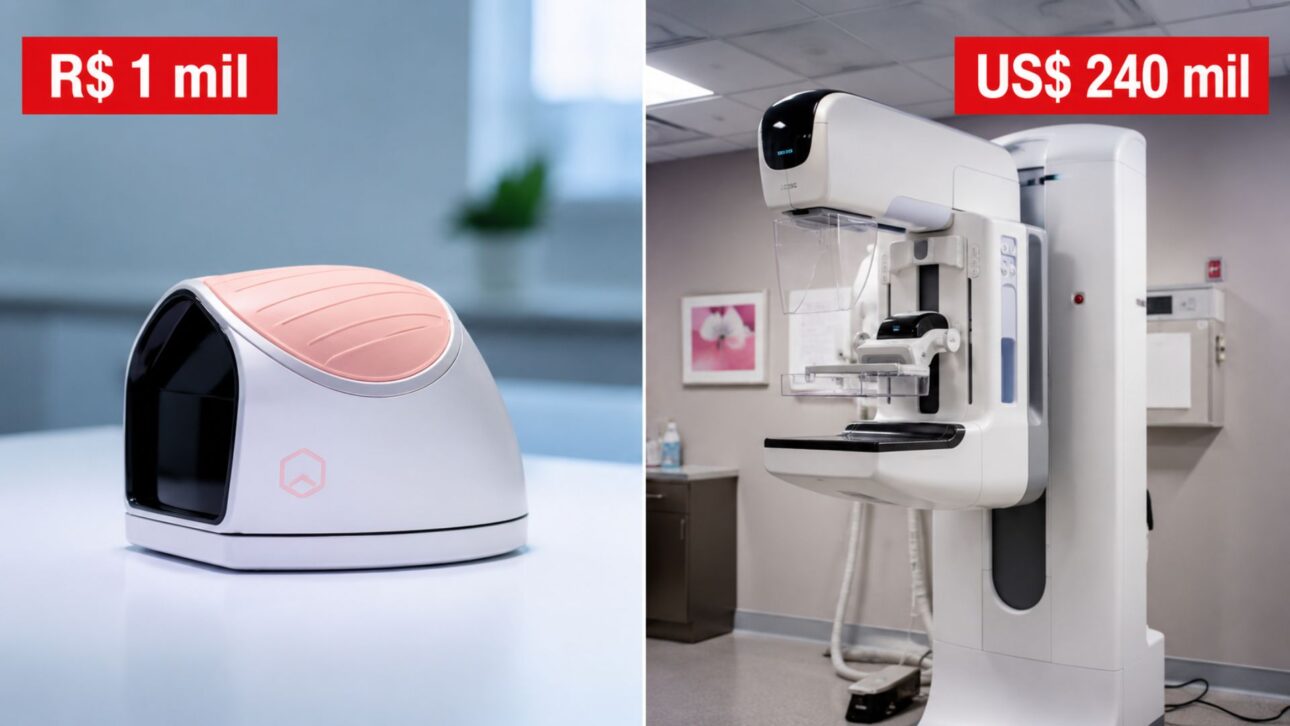
Mammography saves lives, but it is expensive, uncomfortable, and not always accessible to those who need it. Brazilian researchers have created an alternative that could change this scenario: a portable device that screens for breast cancer using microwaves, without pain and without radiation. Developed at Poli-USP in partnership with IFSP, the device is an affordable breast cancer exam, costing about R$ 1,000. For comparison, a traditional mammogram machine can cost from US$ 65,000 to US$ 240,000, meaning the new device is a fraction of the price.
The invention was reported by Só Notícia Boa. Instead of the radiation from mammography, the device uses microwaves, waves similar to those from cell phones and Bluetooth, with no health risk even in frequent exams. It’s not science fiction: it’s national technology, created at the university, that can bring screening to many more people.
Microwaves instead of radiation
The device works like a radar: it emits a microwave signal that passes through the skin and returns, carrying information about the different tissues of the breast.
-
Beer as a Vaccine? Scientist Develops Experimental Method with Live Yeasts, Tests Own Brew, and Publishes Results on Zenodo

-
Brazilian Researchers Develop ‘Rapha’ Device Using Natural Latex and LED Light to Heal Diabetic Foot Ulcers and Prevent 50,000 Annual Amputations

-
Brazilian Startup Offers Free Home Cleaning in Exchange for Data to Train AI-Powered Domestic Robots

-
Bangladeshi Student Transforms E-Waste into Solar-Powered Water Purifier for Flooded, Off-Grid Areas


Since each tissue reacts differently, the system can identify suspicious areas, which may indicate a tumor, without using the radiation of mammography. The waves are of the same type as those emitted by cell phones, kitchen microwaves, and Bluetooth, considered safe.
Therefore, the exam can be repeated without fear. It’s screening without the burden of radiation.
R$ 1,000 against a mammogram machine of up to US$ 240,000
The number that shocks the most is the price. While a traditional mammogram costs from US$ 65,000 to US$ 240,000, the new device should cost around R$ 1,000.
The prototype, in fact, cost only about US$ 175 to manufacture, a tiny fraction of the value of a conventional machine. This huge difference is what makes it a truly affordable breast cancer exam.
Expensive equipment is restricted to large hospitals; affordable equipment can reach everywhere. It is precisely at this point that the invention promises to make a difference.
A device that looks like a bra and is portable
The device’s design was conceived for comfort. The model resembles a bra, which molds to the breasts and captures signals without needing to compress, unlike mammography, which squeezes and hurts.
Moreover, the equipment is portable and can be taken anywhere, including regions without hospitals or diagnostic centers. This changes the reach of the exam.
Instead of the woman having to travel to an expensive machine, the affordable machine can come to her. Convenience and mobility in one device, the kind of detail that decides whether an exam reaches those in need.
Effective even in dense breasts
There is a technical advantage that can be decisive. The device is especially promising for women with dense breasts, those with more firm tissue, common in younger women.
In dense breasts, traditional mammography often struggles and gives inconclusive results, allowing tumors to go unnoticed. Since the microwave method reads the tissue differently, it can see where mammography fails.
The device detects tumors from about 1 centimeter, up to 3 centimeters deep. Covering the blind spot of dense breasts is a real gain for early diagnosis.
Who’s behind it: Poli-USP and IFSP
Behind the innovation is public university science. The project is led by Professor Bruno Sanches from the Polytechnic School of USP, Poli-USP, in partnership with the Federal Institute of São Paulo, IFSP.
The system records microwave signals on a microchip, and an algorithm transforms this data into a diagnostic map that points out suspicious regions. It’s cutting-edge engineering put at the service of women’s health.
The research, conducted at Poli-USP, shows how an academic invention can become a practical solution. It’s not a guess, it’s a scientific project with a patent application in progress.
Why this democratizes the exam
The biggest impact of the device is on access. Today, many women go without breast cancer screening because there isn’t a mammogram nearby or because the exam is expensive.
A cheap and portable breast cancer exam can bring screening to small towns, remote areas, and populations that were left out. The earlier a tumor is detected, the greater the chances of cure, so democratizing the exam saves lives.
Taking the diagnosis out of the expensive and centralized circuit is a public health advancement. It’s affordable technology tackling a real inequality.
What the invention shows
The biggest lesson is the power of Brazilian science focused on the people. The team from Poli-USP and IFSP showed that it is possible to create a cheap, painless, and radiation-free breast cancer exam using microwaves.
Of course, it’s important to stay grounded. The device is still in the prototype phase and, for now, is intended to complement mammography, not completely replace it, and it needs more tests and approval to reach the market.
Even so, seeing a device costing around R$ 1,000 detect tumors even in dense breasts, where mammography fails, is the kind of advancement that can transform breast cancer screening. From the university lab to the health center, the invention combines engineering, access, and care, and proves that a well-thought-out affordable solution can reach where expensive ones never did.
And you, did you know that breast cancer can be screened with microwaves, without pain or radiation? Tell us in the comments what you think of this innovation in Brazilian science.