






 Portuguese
  Spanish
  6 min of reading
  0 comments


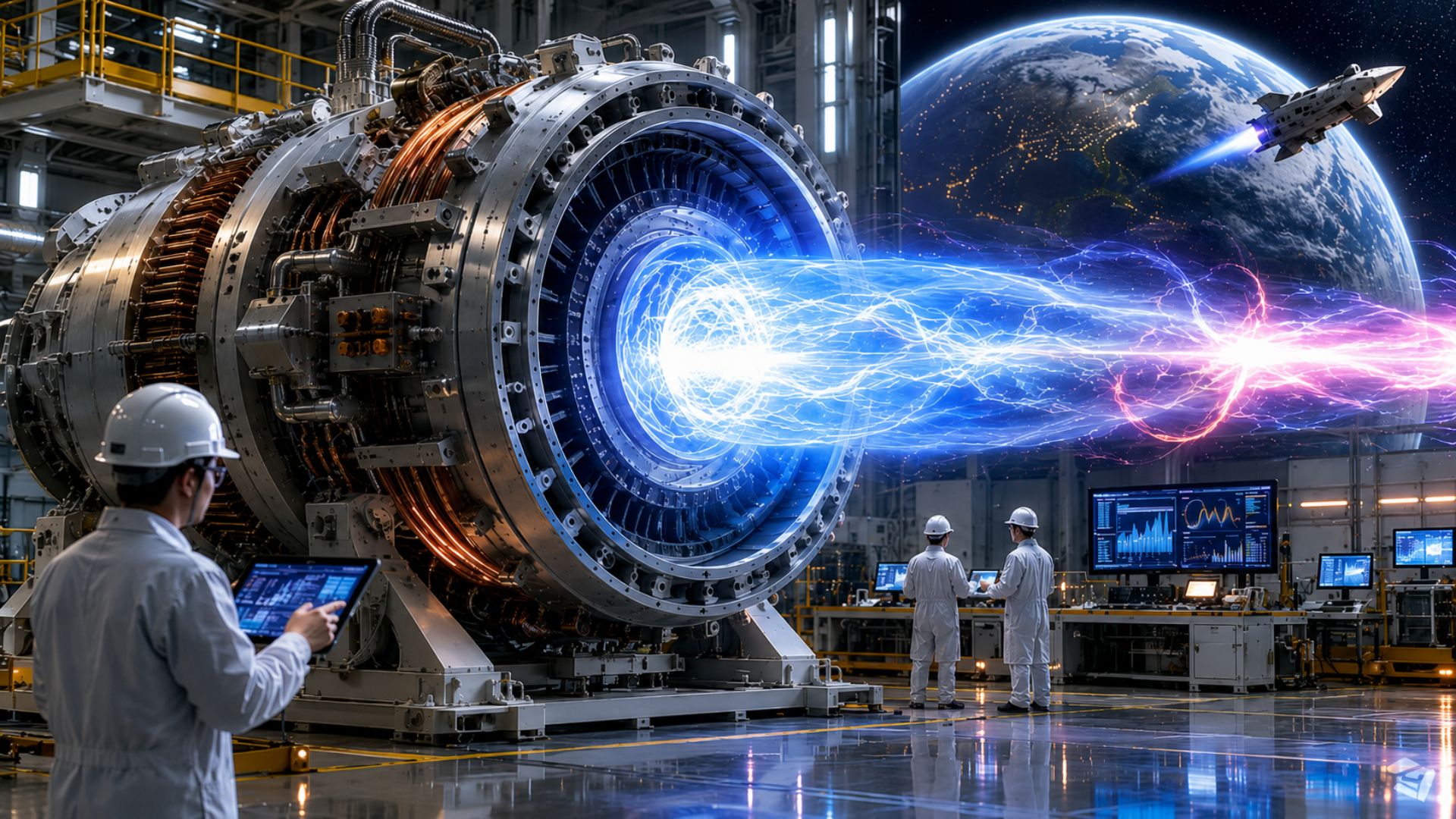
Plasma engine developed in China reaches power above 100 kW and draws attention for targeting larger spacecraft, interplanetary cargo transport, and deep exploration missions, in progress still restricted to the testing stage officially disclosed.
With effective power above 100 kilowatts, a space plasma engine developed in China entered full operation during tests disclosed by the country’s official media, in progress presented as relevant for future long-distance missions.
Described by the state agency Xinhua as a high-thrust magnetoplasmadynamic thruster, the equipment uses plasma accelerated by electromagnetic fields to generate propulsion and was associated with applications in interplanetary cargo transport and deep space exploration.
The announcement was made in Xi’an, on March 10, 2025, after trials conducted by a Chinese team linked to the aerospace sector, according to information released by the official agency.
-
Brazilian Nuclear Science Uses Advanced Techniques to Combat Microplastics in Waterways and Food, Paving the Way for Innovative Environmental Solutions

-
German Collector Discovers New Mineral in Ancient Mine, Named After Him
-
Elon Musk Plans $25 Billion Chip Factory with SpaceX and xAI at Tesla’s Massive Texas Site, Visible from Space

-
Brazilian Innovator Marcelo Loureiro Sets Guinness World Record with 12,000 km Robotic Surgery from Brazil to Kuwait


In the assessment presented by Xinhua, the operation at full power indicates that the experiment reached a level of functioning considered important within the development stage publicly communicated.
Engines of this category arouse interest because they can meet missions that require continuous performance, high efficiency, and the ability to operate for extended periods, especially on trajectories where the use of conventional propulsion presents operational limitations.
The most highlighted number in the announcement is the effective energy input exceeding 100 kW, a level that, according to Xinhua, is above the range of tens of kilowatts normally associated with similar systems.
This difference helps explain the project’s impact, as the power scale directly influences the size of the spacecraft, the type of cargo transported, the mission duration, and the propulsion strategy adopted.
Plasma engine targets large spacecraft

Responsible for the development, the Xi’an Aerospace Propulsion Institute stated, according to Xinhua, that the system can provide strong and reliable thrust for large and extra-large Chinese spacecraft.
The indicated application shifts the announcement from the field of an isolated technical demonstration to a broader scenario, in which future space platforms require greater energy capacity, operational stability, and integration with complex navigation systems.
In practical terms, the technology seeks to address a recurring limitation of long-distance missions: moving heavier structures over extended trajectories without relying solely on chemical engines, which deliver high force in shorter intervals.
Chemical systems remain essential in many stages of space exploration, especially in launches and maneuvers requiring immediate high thrust, but they are not always the most suitable solution for long journeys and sustained operations.
In plasma propulsion, the propellant is ionized to form plasma and then accelerated by an electromagnetic field, generating a high-speed particle flow capable of producing thrust.
By following this logic, the system operates differently from traditional chemical combustion and focuses its potential advantage on sustained performance over time, a characteristic valued in extensive missions.
There is still no public confirmation that the engine has been integrated into a spacecraft, tested in flight, or linked to an official operational mission schedule, according to the information available so far.
Thus, the disclosed result should be understood as an important experimental advancement, but not as proof of immediate use in a real space mission or in an already defined vehicle.
3D Printing and Superconductors Support Technical Advancement
The announced performance was associated by the institute with the use of new materials produced by 3D printing and the application of high-temperature superconducting magnets, two elements treated as central in the Chinese disclosure.
According to Xinhua, this combination allowed the thruster to achieve effective power exceeding 100 kW, a mark that differentiates the project within the cited range for similar magnetoplasmadynamic engines.
In space components subjected to extreme demands, 3D printing can allow for more complex geometries, more precise adjustments, and structural solutions adapted to environments where heat, resistance, and efficiency need to function in combination.
In the case of a plasma thruster, this type of manufacturing can be especially relevant because the equipment needs to handle thermal control, material integrity, and energy flow stability during operation.
The high-temperature superconducting magnets play a role directly linked to sustaining the electromagnetic field necessary to accelerate the plasma, an essential step in the functioning of a magnetoplasmadynamic engine.

Without this field, the system would not be able to efficiently transform electrical energy into plasma acceleration, a process that is at the center of the technological proposal presented by the Chinese team.
The announcement also linked the engine to scenarios with significant scientific appeal, such as interstellar travel, interplanetary cargo transport, and deep space exploration, although these applications depend on other critical systems.
Among the requirements not yet publicly detailed are a compatible power source, thermal control during prolonged operation, integration with spacecraft, and validation under conditions that replicate the demands of a real mission.
100 kW Power Increases Interest in the Space Sector
In space electric propulsion, the available power usually indicates the class of mission a system can support, as larger vehicles require enough energy to maintain performance, stability, and reliability over long periods.
When Xinhua highlights that similar thrusters usually operate in tens of kilowatts, the announcement reinforces the understanding that the 100 kW mark represents a technical leap within the presented category.
This potential gain does not eliminate the need for additional testing, but places the project in a range of interest for more ambitious missions, where mass, distance, and operation time are decisive factors.
Programs aimed at the Moon, Mars, and deep space seek technologies capable of expanding reach and transport capacity without compromising the safety of systems that need to operate for extended periods.
In this environment, magnetoplasmadynamic engines appear as a line of research focused on high-power applications, especially when the priority is to maintain continuous propulsion rather than producing intense and immediate acceleration.
The technology does not replace all space engine models but may gain space in specific scenarios where energy efficiency and prolonged operation are more important factors than concentrated thrust at a few moments.
China Reinforces Bet on Advanced Space Propulsion


The disclosed test is part of a period of expansion of Chinese space capabilities, with initiatives aimed at lunar exploration, space stations, planetary probes, and support technologies for longer-range missions.
Within this framework, a plasma engine above 100 kW combines scientific interest, technological competition, and the practical need to develop systems capable of supporting larger spacecraft and more complex missions.
The description made by Xinhua emphasizes precisely the application in large and extra-large vehicles, a focus that brings the project closer to demands associated with the next generation of space platforms.
The combination of themes such as plasma, superconductors, 3D printing, high power, and long-distance travel also contributes to public interest, elements that connect advanced engineering to space exploration objectives.
Despite the impact of the announcement, the disclosed information does not detail specific thrust, propellant used, system efficiency, test duration, or complete operating conditions, data necessary to better assess the technical scope of the engine.
For this reason, the more balanced reading is to treat the result as a relevant stage in high-power electric propulsion research, still far from confirmation of operational use in a space mission.
Operation at full power shows that the project has reached an important milestone within the laboratory and draws attention to the next phase: transforming experimental performance into reliable technology for large spacecraft.


Be the first to react!