Portuguese
  Spanish


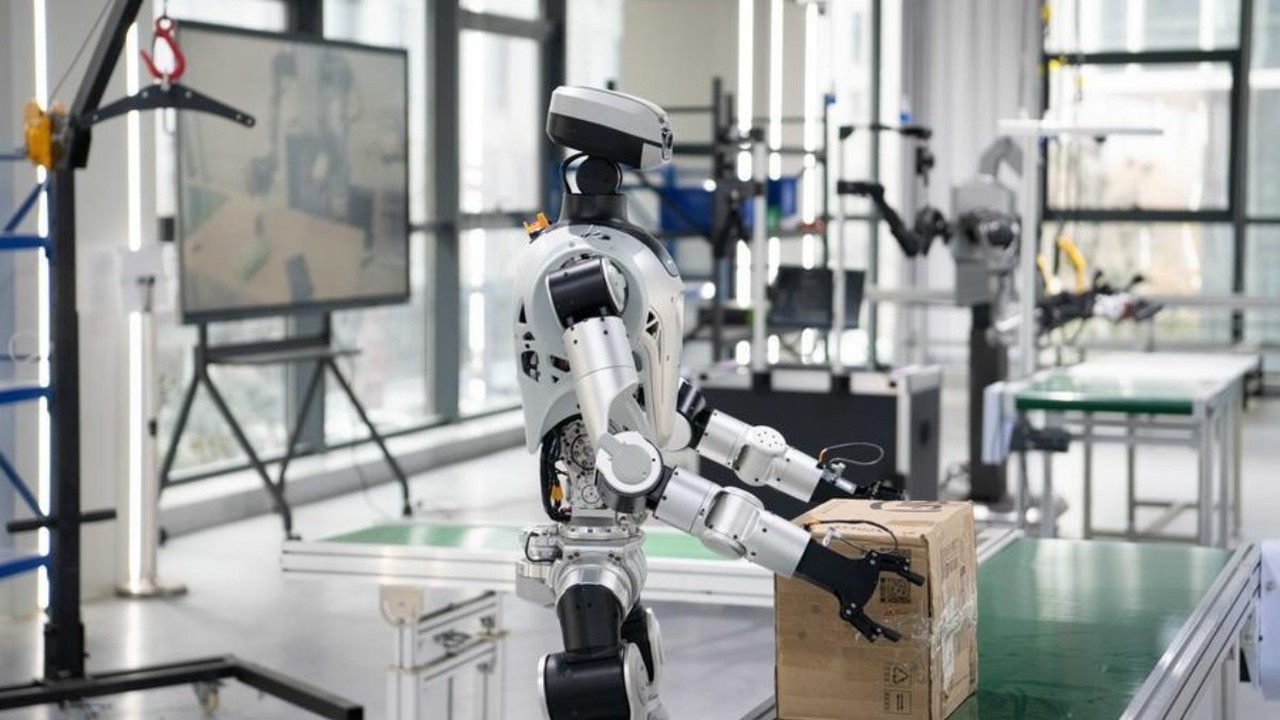

For the first time in history, a humanoid robot capable of reasoning has entered a chip factory to work alongside employees, in a step that seemed like science fiction and is now happening on a real production line.
The future of work has reached a silent but enormous milestone. The semiconductor manufacturer STMicroelectronics has signed an agreement with the Italian company Oversonic Robotics to place a humanoid robot named RoBee within its production and logistics processes. It is noted as the first time a chip company has brought a cognitive humanoid to the factory floor.
The detail that makes this special is the word cognitive. The RoBee is not a mechanical arm fixed in place repeating the same movement, but rather a human-shaped robot capable of perceiving the environment, making small decisions, and adapting to tasks. Seeing it working alongside people in a high-precision factory is one of those moments when science fiction suddenly becomes part of everyday life.
A robot that thinks, not just repeats
The difference between traditional industrial robots and a cognitive humanoid is enormous. Traditional factory robots are specialists in a single task, fixed in one spot, great for repeating a movement millions of times, but incapable of doing anything else. The RoBee proposes the opposite, a body similar to ours, flexible, capable of taking on varied tasks and moving around the factory like an additional worker.
-
The Trap of Modern Technology: How Screen Overload and Digital Connections Can Impact Your Mental Health and Well-being

-
Wyoming Couple Grows Tropical Fruits Year-Round in -40°C Using Geothermal Greenhouse, Demonstrating Earth’s Heat Can Produce Oranges and Lemons in Snow Without Traditional Heating

-
Ship Returns from Brazilian Coast with Thirty Newly Discovered Life Forms
-
Nigerian Professor Invents Electricity-Free Refrigerator Using Clay Pots and Wet Sand, Extending Shelf Life of Vegetables to 27 Days; 7,000 Units Distributed in Energy-Deprived Villages



I confess there is something both fascinating and unsettling about seeing a human-shaped machine reasoning in the middle of a production line. It’s fascinating due to the ingenuity of creating something so versatile, and unsettling because of the questions it raises about the future of work. A robot that thinks and adapts begins to occupy a space that, until recently, seemed reserved only for humans.

Why a chip factory
It’s no coincidence that this is happening precisely in a chip factory. Semiconductor production is one of the most demanding and precise environments in the world, with clean rooms where even a speck of dust can ruin an entire batch. Bringing a humanoid to such a place is quite a test, as it requires the robot to be reliable, delicate, and capable of operating under rigorous conditions without causing problems.
Starting with logistics and support processes makes sense in this scenario. The RoBee can transport materials, supply machines, and handle tasks that tire or expose employees, freeing people for more qualified work. If a humanoid proves its value in an environment as critical as a semiconductor factory, it becomes much easier to imagine it in any other type of industry afterward.
There is also a practical reason for the human shape of these robots, and it’s smarter than it seems. Factories, tools, and corridors have all been designed over decades for the human body, with handles, stairs, benches, and spaces designed for people. A robot with legs, arms, and hands similar to ours can move in this world without needing to rebuild anything, unlike a fixed mechanical arm, which requires adapting the entire factory around it. That’s why so many companies bet on the humanoid shape, instead of inventing machines with stranger appearances: the robot that resembles us fits directly into the environment we’ve already built for ourselves.

Working side by side with machines
The image of a humanoid robot working alongside people raises the inevitable question, does this threaten jobs? The honest answer is that we don’t know yet. Companies bet that these humanoids will take on dangerous, repetitive, or tiring tasks, complementing human work rather than simply replacing it. But it’s natural that their arrival sparks both enthusiasm and concern.
What seems certain is that this frontier is being crossed now, right in front of us. Every time a RoBee takes on a function previously done by people, society needs to rethink how the division between what belongs to machines and what belongs to people should be. It’s a debate that goes far beyond the chip factory, touching on how we want the future of work to be for future generations.

The first of many steps
I imagine how we will look back at this moment in a few decades, perhaps as the moment when humanoid robots truly began to leave the labs and enter real factories. A single RoBee on a chip production line seems small today, but it could be the first of a multitude that will redefine how things are made in the world, just as the first computers seemed curiosities before changing everything.
For better or with its dilemmas, the fact is that this door has been opened. The partnership between STMicroelectronics and Italian robotics shows that the humanoid has ceased to be a tech fair promise and has become a real work tool. We must closely follow how this coexistence between people and machines will evolve, because it promises to change not only factories but the very idea we have of work.
Would you feel comfortable working alongside a humanoid robot that thinks and makes decisions?