






 Portuguese
  Spanish


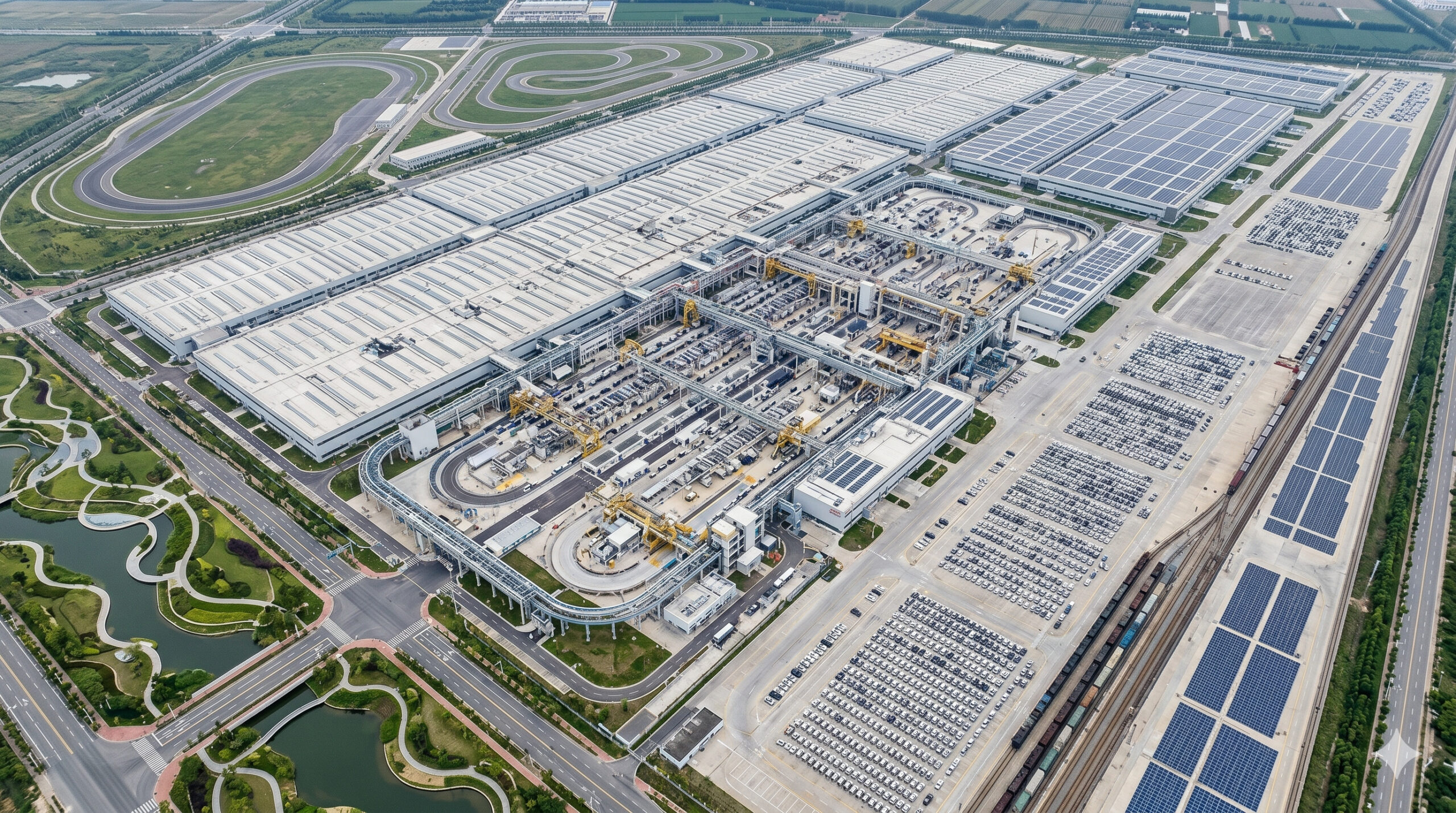


BYD produced 4.27 million vehicles in 2024, operates a factory in Xi’an with up to 4,400 cars per day, and began competing for global leadership with Tesla in pure electric vehicles.
According to Electrek, BYD’s largest factory, located in Xi’an, Shaanxi province, operates four assembly lines simultaneously and produces between 4,000 and 4,400 vehicles per day. During peak shifts, this means one car every 20 seconds, an industrial pace that helps explain the Chinese automaker’s ascent in the global electric car market. The Xi’an factory alone produced 1 million vehicles in 2024 before the end of the year, for the first time in the plant’s history. BYD has nine production bases in China, in Xi’an, Shenzhen, Changsha, Changzhou, Hefei, Fuzhou, Jinan, Zhengzhou, and Xiangyang, which together produced 4,272,100 vehicles in 2024, a growth of 41.26% compared to 2023.
In 2025, BYD consolidated its position as the world’s largest manufacturer of pure electric cars, surpassing Tesla in global BEV production and sales. The comparison is striking because Tesla pioneered the sector in 2003, while BYD accelerated its electric car scale in just a few years, going from around 500,000 annual vehicles to over 4.3 million.
BYD’s Xi’an Factory Produces Up to 4,400 Vehicles Per Day and Became a Symbol of Chinese Scale
BYD’s Xi’an plant is not just one of the world’s largest electric vehicle factories by production volume. It has become the most concrete symbol of what happens when industrial infrastructure, state policy, and market demand converge simultaneously.
-
Brazilian Blacksmith Arrives in Boston, Founds Metal Structure Firm, Becomes U.S. Regional Leader with Four Branches

-
Batista Brothers Secure Full Acquisition of Avibras Amid Recovery and Strategic Expansion into Defense and Aerospace

-
Over 200 Ukrainian Women Trained to Drive Trucks and Buses as New Program Launches for Excavators, Loaders, and Electric Machines in Reconstruction Effort
-
New $265 Million Transformer Plant in Betim to Produce 144,000 Units Annually, Create Hundreds of Jobs, and Position Brazil as a Hub for Latin America


Xi’an has 20 years of operation and started by producing conventional combustion vehicles. The progressive conversion to electric vehicles and plug-in hybrids transformed the unit into one of the most efficient production centers in the Chinese automotive industry.


The four assembly lines operate in parallel, each dedicated to different models. This structure allows the production mix to be altered according to demand without paralyzing the entire operation, maintaining high productivity and delivery speed.
BYD Produces More in One Factory Than Many Automakers Achieve Across Multiple Markets
To understand the significance of 4,400 vehicles per day, this volume needs to be compared with major global automakers. Operating at an annualized rate, the Xi’an factory alone could produce over 1.6 million vehicles per year.
This volume is equivalent to a significant portion of the global sales of traditional groups. Stellantis, which brings together Fiat, Chrysler, Jeep, Peugeot, and Citroën, sold approximately 5.6 million vehicles worldwide in 2024, while Ford produced approximately 4.3 million.
BYD achieved a similar number to Ford with its nine factories in China. The difference is that the Chinese automaker built this scale in a much shorter time and with a direct focus on electric vehicles and plug-in hybrids.
BYD’s Growth from 2019 to 2024 Shows Progress That Western Industry Has Not Been Able to Replicate
BYD’s trajectory between 2019 and 2024 helps explain why Western automakers are under pressure in the electric vehicle segment. In 2019, the company produced 461,422 vehicles; in 2020, it dropped to 427,086 due to the pandemic.

After that, the curve changed rapidly. In 2021, production rose to 730,093 units; in 2022, it doubled to 1,857,378; in 2023, it reached 3,024,417; and, in 2024, it hit 4,272,100 vehicles.
This advance represents approximately ninefold growth in five years. Few automakers in modern automotive history have managed to expand production at this speed without relying solely on inherited capacity from previous decades.
BYD factories have been expanded for electric and hybrid cars since their recent origin
BYD’s growth was not based solely on old factories hastily adapted for electrification. The company expanded and built lines already designed for electric motor architectures, batteries, inverters, and energy management systems.
This difference matters because electric vehicles require a distinct production logic from combustion cars. The battery occupies structural space, the electric motor has fewer moving parts, and the electronic system plays a central role in the car’s operation.

Traditional automakers need to adapt plants created for engines, transmissions, and exhausts. BYD, on the other hand, accelerated with an industrial structure more aligned with the product that the Chinese market began to demand en masse.
BYD versus Tesla shows two different strategies in the electric car market
The comparison between BYD and Tesla is one of the most repeated in the sector, but the two companies operate with different business models. Tesla was born as a manufacturer of premium electric vehicles, with a strong appeal for software, autonomy, performance, and brand.
In 2024, Tesla produced approximately 1.77 million vehicles, almost all pure electric. Analysts cited in the source text do not expect the company to exceed 2 million units before 2027, after a period defined by the industry as weaker in 2025.
BYD operates in a different market segment. Models like the BYD Seagull, sold in China for around US$10,000, and the BYD Dolphin, popular in markets like Brazil, show a strategy based on volume, aggressive pricing, and broad coverage of the urban middle class.
BYD surpassed Tesla in BEVs while maintaining strength in plug-in hybrids
In 2025, BYD sold more pure electric cars than Tesla globally, a significant milestone in a market that the American automaker had led for over a decade. Still, BYD’s strength is not limited to BEVs.
In 2024, only 41% of vehicles sold by BYD were pure electric. The other 59% were plug-in hybrids, a technology the company uses as a bridge for consumers who still depend on extended range and irregular charging infrastructure.

This strategy is central to China and emerging markets. BYD grew because it did not bet on a single solution, but combined cheap pure electric vehicles with long-range plug-in hybrids.
BYD’s plug-in hybrids use DM technology and extend range in markets with limited charging infrastructure
BYD’s plug-in hybrids use the fifth generation of DM technology, launched in May 2024. According to the source text, the system allows for an electric range of up to 200 km and an additional hybrid range of up to 1,500 km.
This combination solves a significant barrier for consumers who want to reduce fuel consumption but are still hesitant to rely exclusively on electric charging. In countries with long distances, plug-in hybrid technology has strong commercial appeal.
In December 2024, BYD’s monthly sales reached 514,800 units, the best monthly result in the company’s history up to that point. In November 2025, the record was again pressured, with 480,186 units in a single month.
BYD sold more pure electric vehicles than Volkswagen, Mercedes-Benz, and BMW combined
BYD’s strength is clearly evident when compared to major German automakers. Volkswagen, Mercedes-Benz, and BMW together sold approximately 650,000 pure electric vehicles in 2024.
In the same period, BYD sold approximately 1.76 million BEVs, a volume much higher than the combined German trio. The difference does not mean an absence of technology in European automakers, but it highlights bottlenecks in scale, cost, and production speed.

German electric cars are competitive in engineering, finish, and performance. The challenge lies in producing high volume, at an accessible price, and with a sustainable margin, exactly where BYD built its main advantage.
BYD’s vertical integration reduces the cost of batteries, motors, and semiconductors
The reason BYD can produce millions of vehicles per year at prices difficult to replicate is not just the size of its factories. It’s in the vertical integration built over three decades.
The company manufactures its own batteries through FinDreams Battery, the world’s second-largest manufacturer of batteries for electric vehicles, behind CATL. It also manufactures semiconductors, electric motors, traction control systems, and energy management components.

This structure reduces dependence on external suppliers and lowers costs per component. While many automakers buy batteries, chips, and motors from third parties, BYD controls critical parts of its own production chain.
BYD better resisted the semiconductor crisis by controlling part of its own supply chain
Vertical integration also helped BYD during the global semiconductor crisis of 2021 and 2022. While several automakers reduced production due to a lack of chips, the Chinese company managed to keep its factories operating with fewer interruptions.
This was because some of the semiconductors used in motor control and energy management systems came from within the group itself. In an electric car, these components are essential for performance, safety, and efficiency.
The advantage is not just financial, but operational. Having control over batteries, chips, and motors allows for faster production adjustments and reduces the risk of shutdowns due to a lack of strategic components.
BYD in Brazil grows with Dolphin Mini, Sea Lion 6, and Camaçari factory
Brazil is one of the international markets where BYD has grown most rapidly in recent years. The brand’s presence has advanced both in imported vehicle sales and in its industrial strategy with the Camaçari factory in Bahia.

The BYD Dolphin Mini, imported from China, led electric vehicle sales in Brazilian retail in April 2026 for the third consecutive month, with 5,943 units. This data shows the brand’s strength among consumers looking for a more affordable electric car.
The BYD Sea Lion 6 was the first model produced at the Camaçari factory, which has an initial capacity of 150,000 vehicles per year and an expansion plan for 600,000. If it reaches this volume, it will be the largest electric vehicle factory in Latin America.
BYD shows how the Chinese industry came to lead the new phase of the automobile
BYD did not grow just because it sold cheap cars. It grew because it brought together battery, motor, semiconductor, software, factory, logistics, and industrial policy into a single production structure.
Tesla paved the symbolic way for the modern electric car, but BYD transformed electrification into mass volume. This difference explains why the Chinese company began to dispute, and in some segments surpass, global leadership in electric vehicles.
BYD’s advance shows a shift in the automotive industry’s axis. The dispute is no longer just about who designs the best car, but about who controls the entire chain to produce millions of electric vehicles at an affordable price and industrial speed.


