






 Portuguese
  Spanish
  3 min of reading
  0 comments


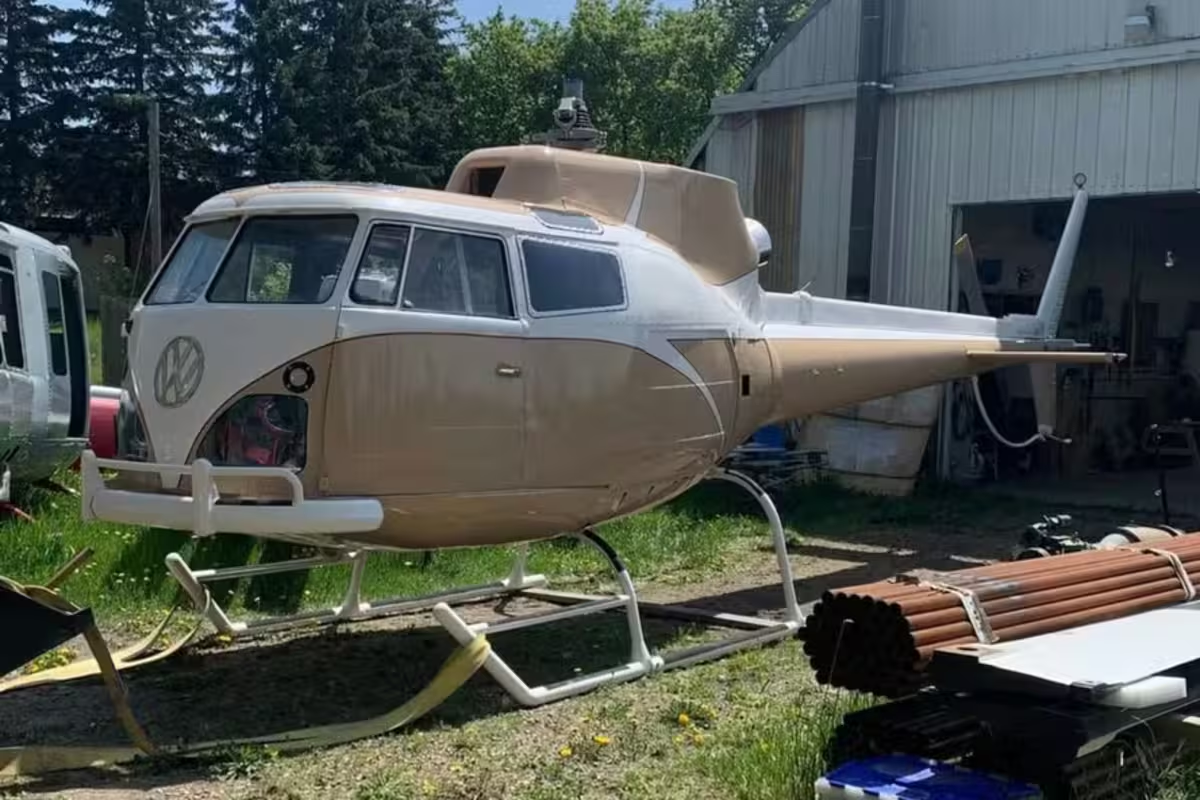
Canadian Transforms Classic Volkswagen Kombi Into Helicopter, Preserving Original Look and Capturing Attention on Social Media
The iconic Volkswagen Kombi, a symbol of freedom and movement during the 1970s, has gained a new and unexpected version: a helicopter.
The unusual transformation was carried out by Canadian Chuck Jurgen Teschke, an aircraft maintenance technician with 38 years of experience in the field.
The project, named FrankenCopter 4, has been shared by Teschke on his Instagram profile, where he already has over 50,000 followers.
-
Survivor of 1966 SS Daniel J. Morrell Shipwreck in Lake Huron Recounts 38-Hour Ordeal in Extreme Cold

-
The Greatest Hoax in World Cup History? The Film That Denied Brazil’s 1958 Victory and Exposed How Fake Evidence Can Seem Convincing on TV
-
Fake South Korean Online Stores Offer Shopping Thrill Without Spending Money or Receiving Products
-
The War of Jenkins’ Ear: How a Severed Ear Sparked One of the 18th Century’s Most Unusual Conflicts


Adaptation Keeps the Classic Look of the Kombi
From the beginning, Teschke’s goal was not to create a functional vehicle for flying, but rather to develop a creative fusion between the classic van and a helicopter.
The original structure of the Kombi was preserved up to the B-pillar, maintaining the distinctive design of the front end.
However, the traditional sliding doors were removed to allow for the adaptation of the rear fuselage from the Airbus H125, the aircraft used as a base.
Structural Transformations and New Equipment
With the alterations, the project received an elongated tail, a tail rotor — responsible for stability and direction —, landing skis, and a specific mount for three propellers.
The propellers were recently installed, as recorded in a post made by Teschke five days ago.
The absence of interior images suggests that assembly is still ongoing, with parts of the cabin lacking visible finishing and possible absence of seats.
Aesthetic Details Preserve the Van’s Identity
Some aesthetic details were also designed to unite functionality with the classic look. The headlights maintain their original position but have increased in size to enhance visibility in the cabin.
On the roof, two rounded windows, typical of helicopters, were added. The chosen paint refers to the vintage design of the Kombi, with shades of beige and white.
The red lines highlight the triangular detail of the front, while the original white bumper matches the landing skis.
No Flight Capability Until Now
Despite all the care in development, the so-called “Kombicopter” has no flight capability. Teschke has not publicly revealed the reason, and there is no confirmed information about the engine or any type of propeller installed in the vehicle. Nonetheless, the creation has attracted curiosity and praise from followers on social media.
History of Unusual Projects
The name FrankenCopter 4 refers to the Frankenstein creature, suggesting the experimental nature of the construction.
This was not Teschke’s first time dedicating himself to uniting unlikely vehicles. In another project, he transformed a tractor into a helicopter, using a methodology similar to that applied in the Kombi.
Kombi Corujinha Continues to Be an Admired Classic
The example chosen for the project is from the first generation of the Volkswagen Kombi, known in Brazil as “Corujinha” due to the shape of the front headlights.
This model was produced and sold in the country between 1957 and 1975, equipped with a four-cylinder flat engine and air cooling.
Model Was in Production in Brazil for 56 Years
The Kombi continued to be produced in Brazil until 2013, totaling 56 years of manufacturing. With this long production period, it established itself as one of the models with the longest production run in the Brazilian market.
Last year, it was possible to visit the Volkswagen museum, at the factory in São Bernardo do Campo, where a unit of the Kombi Corujinha remains on display, preserving the history of the model.
With information from Auto Esporte.





Be the first to react!