






 Portuguese
  Spanish
  5 min of reading
  0 comments


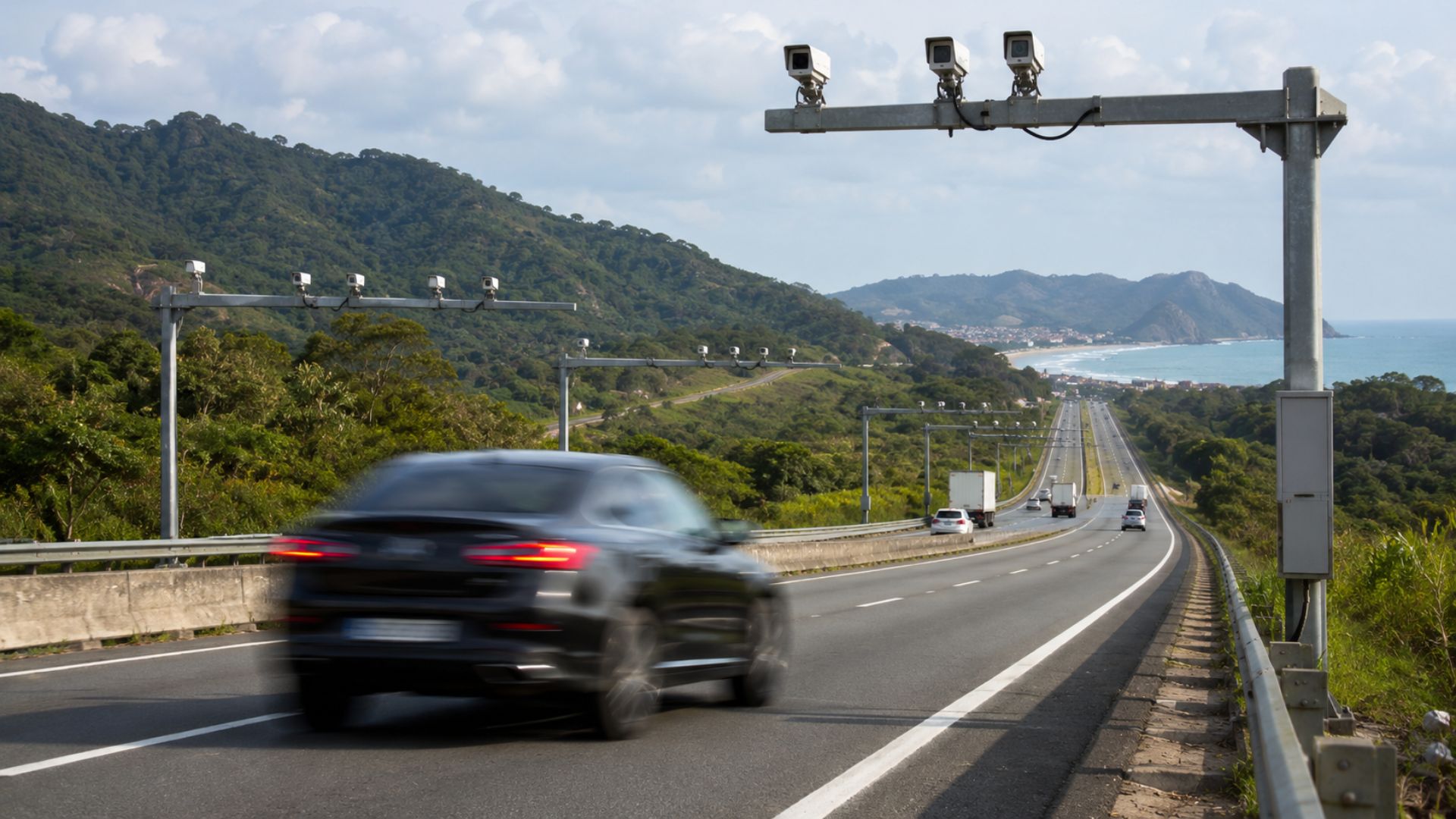
The technology uses two radars: one marks the entrance, the other the exit, and the system calculates the average over the entire route. Important: for now, this does not result in fines in Brazil, as there is no law allowing fines for average speed. It was an educational action of Maio Amarelo, not a fixed radar in effect.
Braking only in front of the radar and accelerating right after may no longer be an option for drivers. The concessionaire Ecovias Capixaba tested on the BR-101, in Espírito Santo, a system that measures the average speed of the vehicle over an entire stretch, and not just at one point, and caught a car at an average of 124 km/h on a road where the limit is 60 km/h. The test, however, was educational and did not result in a fine.
The action took place on May 26, 2026, in the municipality of Sooretama, in the north of the state, as part of the Maio Amarelo traffic awareness campaign. It is important to clarify from the outset, to avoid confusion: this is not a fixed radar installed for enforcement, but a one-off educational action demonstrating how this type of monitoring would work. Currently, there is no legal provision in Brazil to fine drivers based on average speed, as confirmed by the Federal Highway Police.
How the average speed radar works

Instead of measuring speed at a single point, the system uses two radars installed at different locations on the highway: the first records the time the vehicle passes, and the second calculates how long it took to travel the stretch, thus determining the average speed maintained throughout the journey.
-
Detran RJ starts requiring a toxicological test for those obtaining their first driver’s license in the car and motorcycle category starting June 29; see who will be affected.

-
Florida takes TikTok to court and accuses the Chinese giant ByteDance of ignoring the law that bars minors under 14, while parents and authorities demand more protection for children on social networks.
-
Chamber approves constitutional amendment reducing the age of criminal responsibility from 18 to 16 years; what now?

-
Justice confirms that old debts in tax executions that have been stalled for more than 15 years can no longer be collected through judicial or administrative means.


The logic is simple and effective: if the driver reaches the second point before the minimum expected time for that route within the limit, it means they traveled above the allowed speed at some point along the way. As explained by Carlos Diniz, traffic coordinator at Ecovias Capixaba, the goal is to make users aware that safety needs to be maintained throughout the journey, not just in front of the equipment.
The 124 km/h Incident
The case that drew attention illustrates well the problem that the technology aims to combat. In the monitored section in Sooretama, where the limit is only 60 km/h due to the proximity to the Sooretama Biological Reserve, a driver was identified maintaining an average speed of 124 km/h, more than double the allowed limit, according to the managing director of Ecovias Capixaba, Roberto Amorim.
The most revealing detail is that, according to Amorim, this driver did not exceed the limit at the isolated points where the radars were located. In other words, he probably reduced speed when passing by the equipment and accelerated on the rest of the route, exactly the maneuver that the average speed system can uncover. “He did not exceed the speed at the two radars, but maintained an average of 124 km/h,” stated the director.
Why It Doesn’t Result in Fines Yet


This is the most important point for the driver to understand and not be unnecessarily alarmed. Although the monitoring is already technically operational, the action is purely educational and does not result in fines because Brazilian legislation currently does not provide for fines based on the calculation of average speed between two points on the highway. The Federal Highway Police itself reinforces that there is no legal provision for this type of penalty.
It is also worth clarifying the role of each party: Ecovias is responsible for the operation of the equipment and the technology used in the tests, but official enforcement and the application of fines remain the responsibilities of the competent authorities, such as the PRF. Therefore, contrary to what some headlines may suggest, there is no average speed enforcement in effect in Brazil at this moment, and the driver caught at 124 km/h was not fined.
How Much the Fine Would Be, If Applicable
Even so, the case serves as a warning about the seriousness of the infraction. If that driver had been caught by a conventional radar traveling at 124 km/h on a road limited to 60 km/h, the infraction would be classified as very serious, with a fine of R$ 880.41 and suspension of the right to drive, since the speed would be more than 50% above the allowed limit.
This is precisely the message the campaign wants to convey. More than punishing, the idea is to show the driver the risk he creates for himself and others by maintaining high speeds, especially in a sensitive area, near an environmental reserve, where the speed limit reduction exists for good safety and wildlife protection reasons. The discussion, at its core, is about both enforcement and ethics in traffic.
A technology that is already a reality abroad
Although it does not yet have legal backing in Brazil, the average speed system is not new in the world. Countries like the United Kingdom have been using the so-called average speed cameras for years, which monitor entire stretches of highways and are pointed out by studies as more effective in reducing accidents than fixed-point speed cameras, precisely because they inhibit sudden braking followed by acceleration.
The test in Espírito Santo may, therefore, be an indication of where traffic enforcement is heading, should Brazilian legislation be altered in the future to allow this type of citation. For now, the debate and learning continue, at a time when Ecovias claims to have recorded a reduction in accidents and fatalities on the BR-101 in the first quarter of 2026, attributed to the combination of infrastructure, enforcement, and traffic education.
The average speed radar test on the BR-101 is a window into the future of traffic enforcement in Brazil, showcasing a technology capable of catching those who only respect the limit in front of the equipment. For now, it is worth emphasizing, it is an educational action that does not generate fines, as there is no legal provision for it. But the safety message is timeless: respecting the speed limit throughout the entire route, and not just in front of the radar, is what truly saves lives on the roads.
And you, what do you think of a radar that measures the average speed along the entire stretch? Do you believe that this type of enforcement should be adopted in Brazil to curb those who only brake in front of the radar? Leave your comment, share your opinion on traffic safety, and share the article with that driver who always brakes sharply in front of speed cameras.





Be the first to react!