






 Portuguese
  Spanish
  6 min of reading
  0 comments


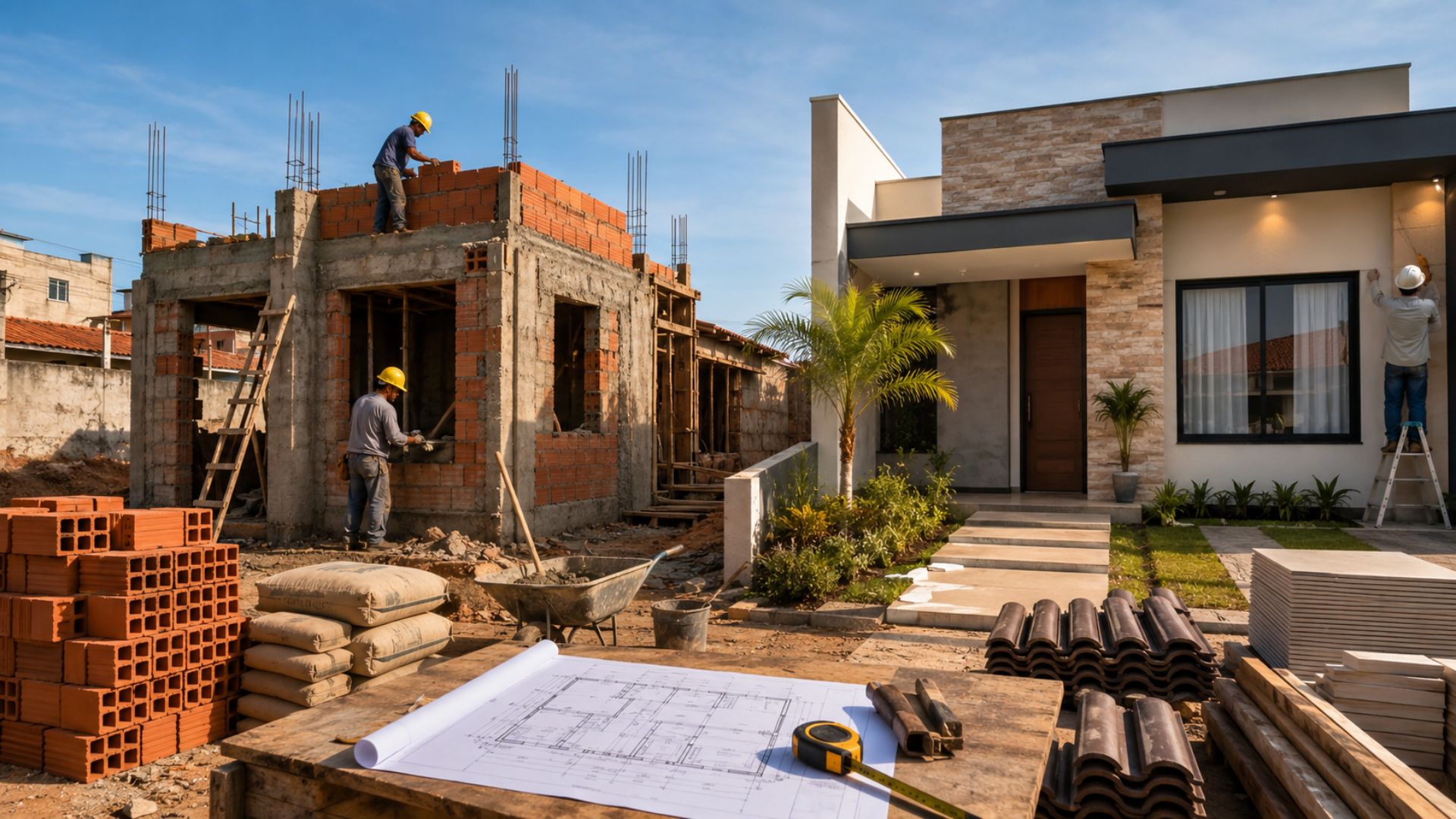
That price per square meter that serves as a starting point is misleading: it covers structure and labor, but leaves out land, reinforced foundation, projects, municipal fees, and finishing. That’s why two houses of the same size can have very different budgets, depending on where and how they are built.
Building a 95 square meter house in 2026 can start near R$ 185,000 at the reference base and exceed R$ 330,000 in high standard. The final value, however, depends on factors such as the land, the standard of finishing, the fees, and the region of the country, with southern states being among the most expensive to build in Brazil, according to construction industry estimates.
Before diving into the numbers, it’s essential to understand one thing: there is no single, fixed price for a 95 square meter house. What exists are reference values, such as the CUB, the Basic Unit Cost of construction, which serve as a starting point, and market estimates that help to have a general idea. The real budget only appears when detailing each stage of the work, from the land to the finishing, considering the city and the chosen standard.
How much it costs, in the base estimate
Let’s go to the numbers that serve as a starting point. Using the construction cost per square meter as a reference, a 95 square meter house can be around R$ 185,000 to R$ 195,000 just at the base, a value that considers materials and labor, but does not represent the cost of a house ready to live in, with everything included.
-
Without a mansion, without high investment, and without a traditional classroom, a teacher living in a 22 m² house taught students to build a 9 m² studio apartment with the equivalent of R$10,000.

-
Largest bridge in São Paulo reaches 75% completion and is expected to strengthen strategic connection in the interior of São Paulo.

-
Without her own home and pressured by rent, a 25-year-old bought a small 15-meter boat, gradually renovated the interior by herself, transformed the interior with paint, new flooring, a larger bathroom, and started living on the canals, paying much less per month.
-
Tired of seeing families sleeping on the street, São Paulo delivered 18 m² furnished microhouses and took 888 people off the streets: Vila Reencontro became the model social housing for the homeless population.


In practice, a more realistic budget needs to add margin for finishing, projects, fees, foundation, installations, and unforeseen events. With this, a simple house can be close to R$ 210,000, while a medium standard one can reach R$ 280,000 or more. It is worth reinforcing that these values are market estimates and vary greatly according to the reality of each work and each city.
What is the CUB and why it matters
To avoid pitfalls, it is important to know the main indicator of the sector. The CUB, or Basic Unit Cost, is the reference value per square meter of construction, calculated monthly by each state Sinduscon based on the technical standard NBR 12.721 of ABNT and Federal Law 4.591, of 1964. It guides a large part of the calculations and contracts in the construction industry in Brazil.
The most commonly used reference category is called R8-N, which represents the average residential standard. To give an idea of the magnitude, the average residential CUB in Rio de Janeiro, for example, was around R$ 2,395 per square meter in April 2026. This is precisely why the value varies so much between states: each region has its own CUB, updated month by month according to local material and labor costs.
Price ranges by finish standard


The finish is by far one of the factors that most affect the final price. Flooring, frames, coatings, sanitary ware, metals, painting, lighting, and carpentry can completely transform the budget, even if the built area remains the same at 95 square meters. A prudent estimate for 2026 usually follows some ranges.
In the economic standard, the construction would cost between about R$ 185,000 and R$ 220,000. In a simple but well-executed standard, the cost rises to something between R$ 220,000 and R$ 260,000. The average standard is around R$ 260,000 to R$ 310,000, while the high standard, with sophisticated finishes, exceeds R$ 330,000. These are broad ranges precisely because each material choice pulls the value up or down.
What is usually left out of the account
This is where the greatest risk lies for those who plan poorly. The reference value per square meter does not include a series of important costs, such as the architectural and complementary projects, city hall approval and municipal fees, water, energy, and sewage connections, as well as the entire external area, such as walls, sidewalks, gates, and landscaping. These items, when added up, weigh heavily on the final budget.
Also included in this list of often forgotten expenses are the foundation, which can be much more expensive if the land requires correction, containment, or landfill, and more elaborate internal finishes, such as custom furniture and decorative lighting. Ignoring these costs when planning is the sure recipe for the construction to blow the budget or stop halfway.
The reserve for unforeseen events is mandatory
No construction planning is complete without a cushion for emergencies. Experts recommend setting aside 10% to 20% of the total budget for unforeseen events, which, in a construction estimated at R$ 260,000, would represent something between R$ 26,000 and R$ 52,000 saved for what might go wrong along the way.
This financial cushion covers adjustments in material prices, small changes in the project, land corrections, and items that went unnoticed in the initial budget. Those who start building without this reserve often suffer more from delays, emergency purchases at higher prices, and the frustration of having to lower the standard of finishing at the end of the construction due to lack of money.
Why the region changes everything
The same 95 square meter project can cost very different amounts depending on where it is built. Since the CUB is calculated state by state, the cost of building varies according to the local price of labor and materials, and regions like the South often appear among the most expensive in the country, although the ranking changes depending on the month and type of construction.
Therefore, more than relying on a national average, those who are going to build should consult the CUB of their own state, published by the local Sinduscon, usually by the 5th of each month. Factors such as the distance from material distribution centers, the availability of professionals, and even the climatic conditions of the region influence the final cost. It’s a reminder that, in construction, generalizing price is always risky.
Is it worth building a 95 m² house in 2026?
Despite all the complexity, the answer can be positive for many people. A 95 square meter house allows for the creation of a comfortable home, with an integrated living room, functional kitchen, two or three bedrooms, well-distributed bathrooms, and service area, being a size that balances space and cost well for medium-sized families.
The secret, as in any construction, is to turn the initial estimate into a detailed budget, with a survey of materials, schedule, and well-defined responsible professionals. Thinking only about the value per square meter helps to start the calculation, but a safe decision comes from complete and realistic planning, aligned with the family’s lifestyle and budget. Building with a grounded approach avoids headaches and the nightmare of an unfinished construction.
Building a 95 square meter house in 2026 is a totally viable project, but it requires planning and realism. The starting values, ranging from around R$ 185,000 at the base to over R$ 330,000 at the high standard, give a good notion, but the true cost only appears when you add land, projects, fees, foundation, finishing, and the indispensable reserve for unforeseen events. More than chasing a magic number, the safe path is to detail each stage and consult the official indexes of your region, turning the dream of homeownership into a well-planned construction without unpleasant surprises.
And you, do you plan to build your own house in 2026? Have you calculated how much a 95 square meter house would cost in your city? Leave your comment, share your experience or your questions about construction, and share the article with those who also dream of leaving rent behind and building their own home.




Be the first to react!