





 Portuguese
  English
  Spanish
  5 min of reading
  0 comments


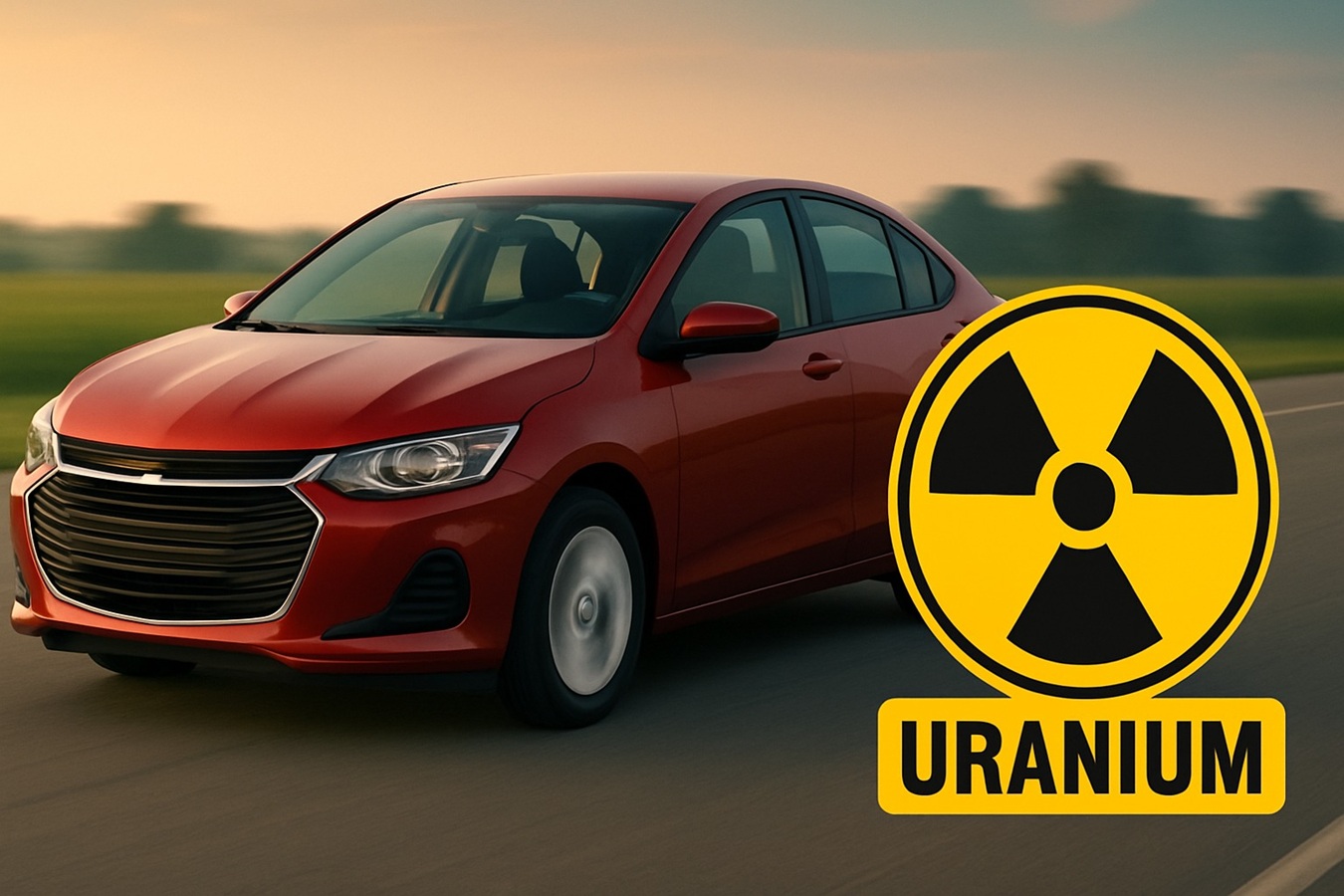
Have You Ever Imagined Driving for Years with a Car Without Ever Having to Refuel? Theories Involving the Use of Uranium as Fuel Suggest That This Could Be Possible. Some Experts Claim That Grams of the Radioactive Material Could Yield More Than 180 Thousand Kilometers of Autonomy.
A futuristic and at the same time dangerous idea has been sparking the curiosity of many: would it be possible for a car to drive hundreds of thousands of kilometers using only a small amount of uranium as fuel?
The proposal, although it seems straight out of science fiction, has gained traction in videos and reports that explore the immense energy potential of the radioactive element.
The most important thing is to understand that no automaker currently produces a car powered directly by uranium.
-
Neither human nor dinosaur: ancestral skeleton nearly 1,000 years old found on eroded road in Australia intrigues archaeologists by the way it was buried

-
Helicopters drop 9,000 discarded Christmas trees into New Orleans swamps to transform discarded trunks into natural barriers, rebuild nearly 330 football fields of wetlands, and strengthen the city’s defense against waves, erosion, and hurricanes.

-
Elon Musk prepares new Starlink Mini with integrated battery and up to 5 hours of autonomy, USB-C support, hybrid operation without outlet, and 99 Wh battery approved for air travel, according to codes discovered in an internal SpaceX update.

-
Bosch combines diesel and ethanol in sugarcane harvesters and tests a system capable of replacing up to 60% of fossil fuel without loss of power; agricultural machines consume up to 120,000 liters of diesel per year in Brazil.


However, there are theoretical estimates that attempt to calculate how efficient this fuel could be if it were possible to use it safely in a personal vehicle.
Surplus Energy
To begin with, it is essential to understand the energy potential of uranium, especially the isotope U-235, which is the same used in nuclear reactors and armaments.
Just 1 gram of uranium-235 can generate enough energy to move a car for thousands of kilometers. In comparison with gasoline, uranium has an energy power millions of times greater.
Brazilian physicist Pedro Loos, known for his YouTube channel, made an interesting estimate. According to him, a single pellet of enriched uranium — the size of a fingertip — would be capable of moving a car like the Onix for approximately 180 thousand kilometers.
The calculation takes into account an average consumption of 15 km/l and converts the energy generated by uranium into an equivalent mileage to gasoline.
Volga Atom and the Soviet Legend
Another story circulating on the internet involves a supposed Soviet project called Volga Atom. According to reports, the vehicle would be a prototype powered by nuclear energy, which would use 12 grams of uranium-235 as fuel.
The estimated autonomy would be 200 thousand kilometers with just that amount.
However, the most likely scenario is that the Volga Atom was never a functional car. Experts believe it never went beyond an idea or a model, used for propaganda or to demonstrate the technological ambitions of the time. There is no concrete evidence that it ever actually operated.
Nonetheless, the legend survives and reinforces public curiosity around the use of nuclear energy in automobiles.
Ford Nucleon: The American Concept
In the 1950s, the American automaker Ford presented a project called Ford Nucleon. The vehicle was designed to use a mini nuclear reactor in the rear, completely replacing the combustion engine.
The proposal was that the car would have a range of up to 8 thousand kilometers per reactor. When the fuel ran out, the driver would exchange the used reactor for a new one at specialized stations.
The project, however, remained on paper. Ford even built a full-size model, but never developed the propulsion system.
The technical difficulty of miniaturizing safe nuclear reactors, along with the risk to occupants and the environment, stalled the idea.
Why Is It Still Not Existing?
The answer is simple: safety. Uranium, despite being highly efficient, is a radioactive material.
To use it in a car, it would be necessary to encase the reactor in extremely heavy shielding, as is done with nuclear submarines or plants. This would make the vehicle unfeasible for everyday use.
Moreover, any traffic accident involving a nuclear car could lead to a catastrophic radioactive leak. This risk makes the proposal impractical, even with all the technological advances of recent years.
Another important point is the disposal of the fuel. Uranium, at the end of its cycle, remains highly dangerous and requires specific care for storage. A problem that the world still faces with nuclear waste from plants.
What Do Experts Say?
From time to time, scientists and communicators revisit the topic.
They explain that the energy density of uranium is indeed impressive. For comparison, 1 kg of uranium-235 can release as much energy as 1.5 million kilograms of coal.
In theory, a minimal amount of uranium could keep a car moving for years without the need to refuel. But this energy can only be harnessed through controlled nuclear reactions, which require very complex, heavy, and safe structures.
That is why the idea of a personal vehicle powered by uranium remains merely an exercise in imagination.
Popular Curiosity and Viral Videos
Despite the risks and limitations, the topic continues to gain traction on social media. Explanatory videos and curious theories spread rapidly.
Generally, they use simple language and easy analogies to explain complex concepts, such as nuclear fission and how a reactor works.
Many of these contents do not aim to propose real solutions, but rather to spark public interest in science. And on that point, they do their job well.
Additionally, they serve to compare the progress of nuclear energy with the limitations of fossil fuels, such as gasoline and diesel. And reinforce the idea that nuclear technology, despite being dangerous, remains one of the most powerful ever developed.
Therefore, although the idea of a car powered by uranium is fascinating, it remains distant from reality. Technical difficulties, high health and environmental risks, and the challenges of nuclear waste disposal render the project unfeasible with current technology.
Even so, the estimates made by experts and enthusiasts continue to fuel popular imagination. After all, the possibility of driving more than 180 thousand kilometers with a pellet the size of a finger is, at the very least, impressive — even if only on paper.
If in the future science finds safe ways to miniaturize and shield reactors, perhaps this idea may cease to be mere theory. But for now, it remains one of the most risky dreams in the automotive world.






-

1 person reacted to this.