






 Portuguese
  Spanish


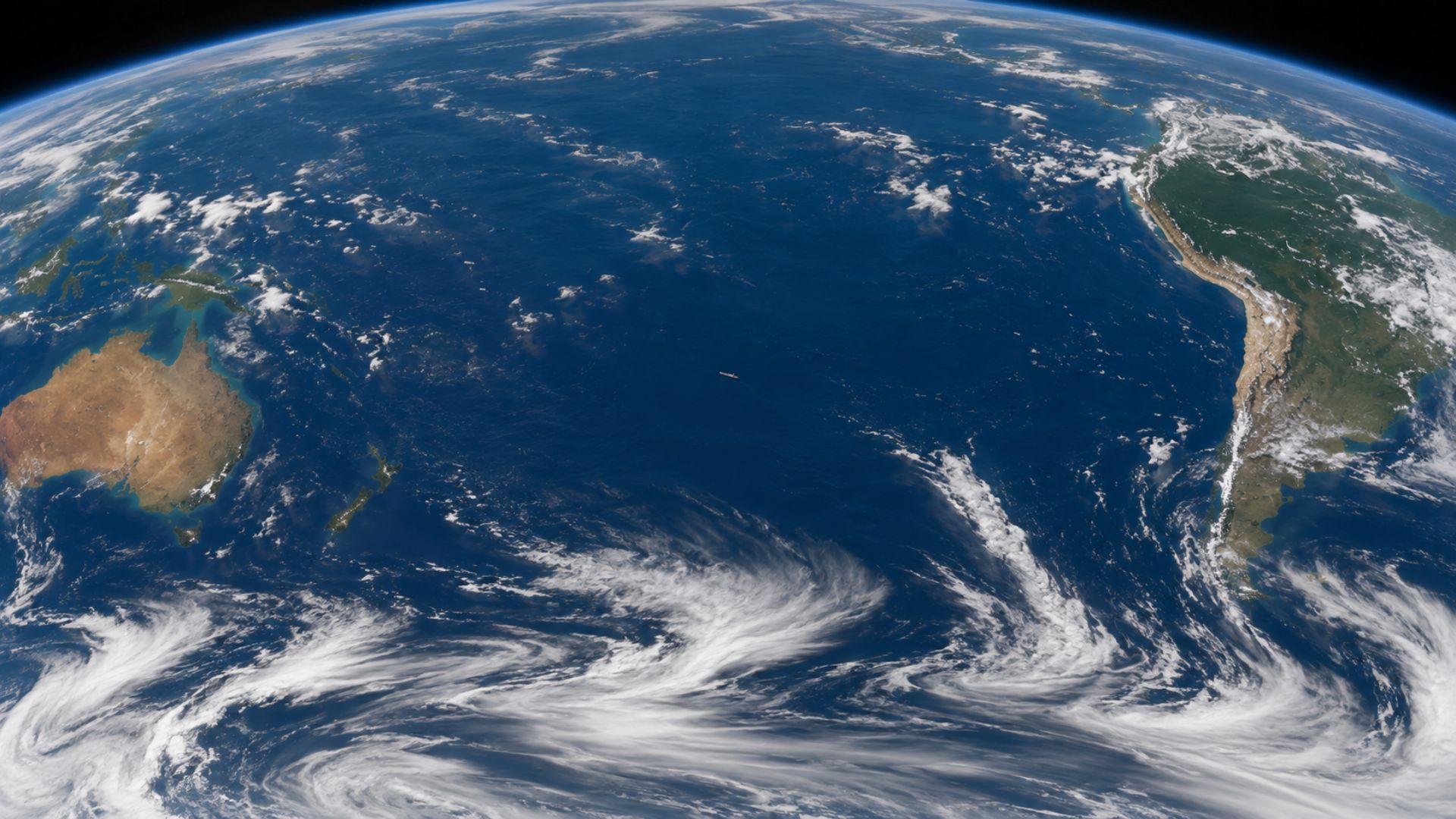


At the heart of this void lies Point Nemo, the most remote ocean location from any land, nearly 2,700 kilometers from the nearest island. It is so isolated that when the Space Station passes overhead, the astronauts at 400 kilometers altitude become the closest humans. Hence, it has become a cemetery for spacecraft.
Almost no ship sails directly between South America and Australia, and this is no coincidence. The reason is a combination of factors: the enormous distance between the two continents, winds so strong they circle the planet without encountering obstacles, and the almost total absence of ports along the way. The result is that the South Pacific has turned into a kind of water desert, with very little maritime traffic.
Anyone looking at a real-time map of ship traffic worldwide immediately notices the contrast. While the North Pacific, Asia, Europe, and the Americas appear congested with vessels, the South Pacific remains practically empty, with very few points crossing that vast blue expanse. More than a geographical curiosity, this void reveals how the logistics of global maritime transport truly function.
The economy that concentrates ships in the North
The first explanation for the void in the South Pacific is economic, and perhaps the most decisive. Modern maritime transport operates based on large hub ports, primarily located in the Northern Hemisphere. Ships do not sail directly from any point to any point: they transport cargo to these mega ports, where everything is redistributed to smaller vessels that continue to secondary destinations.
-
Scientists discover beetles with elongated antennae and mandibles in China and Laos and name a new genus Luffy in honor of the protagonist of One Piece.

-
Former gas station attendant leaves job for recycling business, employs 12 people, and earns up to R$ 20,000 per month.

-
At 10 years old, the American Michael Kearney entered the Guinness World Records by graduating from college, accumulated four degrees before turning 18, and today dedicates his life to helping other gifted individuals.
-
A 550-million-year-old fossil found in Australia reveals a worm-like creature that already chose the right side to move and may be the first “right-handed” animal known to science.




This system exists because it is cheaper and more predictable. Concentrating cargo on a few standardized routes reduces fuel consumption, organizes schedules, and allows service to even small ports where giant ships cannot dock. In the South Pacific, there simply is no such network: without intermediate ports, hubs, and stops, modern maritime trade cannot operate viably in the region.
The winds that circle the world
The second factor is the climate, and it is brutal. In the zone between 40 and 50 degrees south latitude, the sea almost never calms. As there are no continents or large mountain ranges in this region to block the air, the winds can circle the entire planet without losing strength, in a phenomenon sailors named, centuries ago, the roaring forties and furious fifties.
These constant winds turn the ocean into a true wave factory. The old swells do not have time to dissipate before new ones form, creating a perpetually agitated sea. It’s not just the height of the waves that is frightening, but the frequency: vessels are battered by relentless sequences, making the crossing exhausting and risky, even for modern steel ships full of technology.
Distance and rescue: the isolation factor


Add to all this the colossal distance. The direct crossing between South America and Australia is about three times longer than equivalent routes in the Northern Hemisphere, so extensive that you can’t even see both continents at the same time on a globe. For cargo, this means more days at sea, more fuel, and more exposure to bad weather, making any operation much more expensive.
There is also a serious safety problem. In the middle of the South Pacific, there are no hospitals, emergency ports, or rescue bases. If a medical emergency or a serious breakdown occurs, there is nowhere to run: helicopters cannot reach such great distances, and there are almost no other ships nearby to provide assistance. The crew is, in practice, on their own, isolated like in few places on the planet.
Point Nemo, the most isolated place in the world
At the heart of this water desert lies the most symbolic point of all isolation: Point Nemo, officially called the oceanic pole of inaccessibility. It is the place in the ocean most distant from any land, about 2,688 kilometers from the nearest islands, which are Ducie Island in the Pitcairn archipelago, Motu Nui near Easter Island, and Maher Island near Antarctica.
The isolation is so extreme that, frequently, the closest humans to Point Nemo are not on any ship or island, but in space: the astronauts of the International Space Station, which orbits about 400 kilometers above, are closer to the point than anyone on land when they pass over it. The name, by the way, is a tribute to Captain Nemo from Jules Verne’s classic, and means no one in Latin.
A space graveyard
Precisely because it is so remote and has minimal maritime traffic, Point Nemo was chosen as humanity’s space graveyard. When satellites, space freighters, and stations reach the end of their useful life, agencies conduct controlled reentries of these equipment precisely in this region, so that the fragments that survive the burn in the atmosphere fall where the risk to people and structures is practically zero.
It is estimated that hundreds of space objects have already been directed there since the 1970s, including the Russian station Mir in 2001, as well as Russian, European, and Japanese cargo ships. The International Space Station itself has its reentry planned for this area around 2030. The operations are coordinated with the authorities of Chile and New Zealand, responsible for warning vessels and aircraft to avoid the region during reentry times.
Why There Is a Lack of Life in the South Pacific
The emptiness of the South Pacific is not only of ships but also of marine life, and this has a scientific explanation. The region is at the center of the so-called South Pacific Gyre, a system of currents that rotates on itself and ends up blocking the arrival of cold, nutrient-rich waters from the depths, which are precisely the ones that feed the base of the oceanic food chain.
Without this nutrient supply, plankton hardly develops, and without plankton, there are not enough fish. That is why fishing has never thrived there, unlike in the North Pacific, a true fishing powerhouse. The surface remains warm, clear, and almost empty, reinforcing the image of a liquid desert where life, like ships, is scarce.
The emptiness of the South Pacific shows that the absence of ships in certain regions of the planet is not by chance, but a combination of economy, geography, and climate. Global logistics concentrate traffic in a few corridors, the winds and waves make crossing dangerous, and the lack of ports and marine life completes the picture of isolation. At the center of it all, Point Nemo sums up this oceanic silence, being at the same time the loneliest place and one of the most curious on Earth.
And you, have you ever stopped to think why almost no ship crosses the South Pacific between South America and Australia? Did you know there is a point in the ocean so isolated it becomes a cemetery for spacecraft? Leave your comment, tell us what surprised you the most about this water desert, and share the article with those interested in oceans, geography, and planet curiosities.







Avi Swirsky