Portuguese
  Spanish


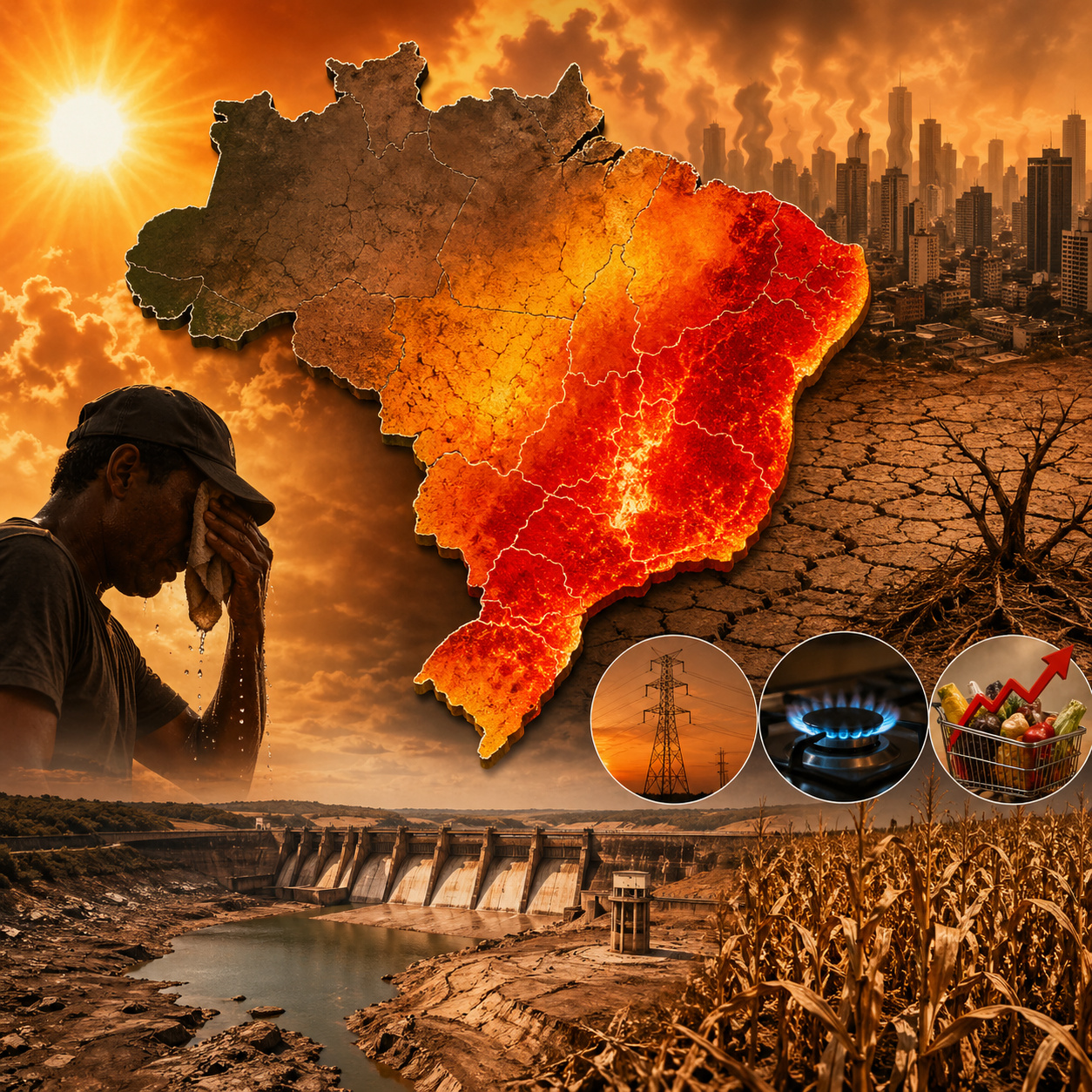


Cemaden Note Warns of Extreme Heat, El Niño, and Risk of Simultaneous Water and Energy Crisis in Brazil in 2026.
According to the National Center for Monitoring and Alerts of Natural Disasters (Cemaden), a technical note sent to the Civil House in April 2026, with the participation of climatologist José Marengo, describes a scenario that combines two simultaneous and interdependent crises in Brazil: extreme heat, which increases electricity consumption, and water scarcity, which reduces the capacity to produce it. According to the document, the El Niño phenomenon has about an 80% probability of establishing a thermal disaster between August and October 2026. If it evolves to a strong or very strong intensity — a scenario indicated by about 25% of climate models — the country could surpass 2024 as the hottest year in recorded history.
“It will happen, it will be very hot, and we will feel it more from September,” stated Marengo when presenting the document. “More than that is speculation.”
What is not speculation are the recent data: Brazil recorded 10 heatwaves in 2024, eight in 2023, and seven in 2025, with a clear trend of increasing frequency, duration, and intensity. The critical point is that the El Niño of 2026 does not start from scratch — it forms over an already warmed climate base, significantly amplifying its effects.
-
New Discovery Suggests Prehistoric “Hobbits” May Have Survived on Komodo Dragon Remains

-
Tiny 10-centimeter fish in Brazilian reservoirs may play a surprising role in reducing methane emissions, scientists find.
-
ChatGPT Creator Bets Big on Fusion Energy Machine Promising Unlimited Power for Microsoft by 2028, But Physicists Skeptical

-
Time Travel Proven Possible by Science, Yet a Mystery Still Challenges Einstein, Quantum Physics, and Top Scientists


What is a Thermal Disaster and Why the Concept Goes Beyond an Isolated Heatwave
The term thermal disaster is not rhetorical. It is a technical classification used by Cemaden to describe extreme heat events that exceed the simultaneous response capacity of essential systems such as health, energy, water supply, agriculture, and infrastructure.


The central distinction is in the scale and cumulative effect. A heatwave is defined as a period of at least three consecutive days with temperatures above a certain climatic threshold. This type of event, in isolation, can still be absorbed by adaptive systems: hospitals expand care, power plants activate complementary sources, and farmers adjust production cycles.
A thermal disaster occurs when this event is more intense, more prolonged, and coincides with existing structural weaknesses. Reservoirs below the ideal level, power grids operating at the limit, pressured health systems, and reduced agricultural stocks create an environment where multiple systems enter simultaneous stress. This is exactly the scenario described by Cemaden for the second half of 2026.
How El Niño Intensifies Extreme Heat and Reduces Nighttime Thermal Recovery
El Niño does not create heatwaves from scratch but acts as a climate amplifier. In the Southeast and Midwest, regions where its effects are more direct, the phenomenon reduces cloud formation, decreases precipitation, and increases the incidence of direct solar radiation.
One of the most critical effects is on minimum temperatures. During intense heat events, the problem is not just the daytime highs but the lack of nighttime cooling. When nights remain warm, the human body cannot dissipate the heat accumulated during the day.

This factor is central to public health. Epidemiological studies indicate that mortality associated with extreme heat is strongly linked to the persistence of high temperatures during the night, not just daytime peaks.
The Energy Risk Increases with Less Water in Reservoirs and More Demand for Electricity
The Southeast and Midwest concentrate about 70% of Brazil’s installed hydroelectric generation capacity, making these regions especially vulnerable to the combination of drought and heat.
The reservoirs depend on summer rains to maintain adequate levels throughout the year. However, in 2026, this cycle did not occur ideally. Climatempo recorded that the summer was marked by irregular rains, with intense episodes interspersed with dry periods, compromising the continuous recharge of the reservoirs.
When autumn begins with levels below ideal, the system enters the second semester already weakened.
El Niño exacerbates this scenario in two simultaneous ways:
First, it further reduces precipitation in the hydrographic basins, decreasing the capacity for hydroelectric generation.
Second, it raises temperatures, increasing energy consumption by households and industries, mainly due to the use of air conditioning and refrigeration systems.
This imbalance between supply and demand is the core of the energy risk identified by Cemaden. CNN Brasil, in an analysis published in December 2025, pointed out that if the pattern of rains remains irregular, the application of the red tariff flag during winter cannot be ruled out, with an additional charge of R$ 7.877 per 100 kWh consumed — an unusual scenario, as winter historically presents lower consumption and greater recovery of reservoirs.
Recent history shows that the impact of El Niño depends on the already heated climatic base
Recent history reinforces the concern. The El Niño of 2015-2016 was intense and coincided with one of the largest water crises in Brazil’s recent history, especially in São Paulo, where the Cantareira system reached critical levels.
The El Niño of 2023-2024 was not classified as extreme but occurred on a warmer planet. Its effects were amplified by this elevated thermal base.
The result was a set of simultaneous extreme events:
- The floods in Rio Grande do Sul in May 2024, with more than 150 deaths and hundreds of thousands displaced.
- The historic drought in the Amazon, with the Rio Negro reaching record low levels.
- Extensive fires in the Pantanal.
Cemaden points out that the El Niño of 2026 will form over an even warmer base. The years 2023, 2024, and 2025 are among the hottest ever recorded globally. This means that even a moderate intensity event can produce severe effects.
Pantanal, Cerrado, and southern Amazon enter critical fire zone with drought advancement
The technical note identifies the Pantanal as one of the most vulnerable regions in the second half of 2026. In El Niño years, the combination of below-average rainfall, intense heat, and low humidity creates ideal conditions for large-scale fires.
In 2024, the biome had already recorded one of the worst recent scenarios, with dried vegetation and normally wet areas becoming flammable.
If the climate pattern repeats or intensifies, the risk of fires significantly increases from August, when the dry season reaches its peak.
These fires are not restricted to the location where they occur. The smoke can travel thousands of kilometers, affecting air quality in large urban centers and altering the atmospheric radiation balance.
Furthermore, deforestation amplifies the problem by reducing evapotranspiration, decreasing cloud formation, and worsening the scarcity of rains.
Extreme heat already affects food and may pressure prices in Brazil in 2026
The impact of extreme heat quickly reaches the real economy, especially through food prices.

Horticultural crops are highly sensitive to high temperatures. Prolonged periods above 35°C can compromise plant development, reduce productivity, and directly affect supply.
Producing regions in the Southeast have already recorded losses associated with heatwaves in recent years, and the trend is for intensification.
In livestock, thermal stress reduces milk production and cattle weight gain from about 27°C, which pressures costs and decreases productive efficiency.
The animal protein chain also suffers indirect impacts, as corn and soy — main inputs — are affected by adverse climatic conditions.
The result tends to appear to the end consumer in the form of price increases and greater volatility in supply.
Cemaden note connects climate, energy, health, and food into a single systemic risk
The use of the term thermal disaster by Cemaden is not casual. It appears associated with a diagnosis that integrates multiple critical systems.
- Extreme heat directly affects health.
- Water scarcity compromises energy generation.
- Pressure on the electrical system increases costs and risks of instability.
- Agriculture suffers losses that impact supply.
These factors do not act in isolation. They reinforce each other, creating what experts classify as a systemic risk.
The El Niño of 2026 does not create this scenario alone. It acts on an already altered base, with elevated global temperatures, pressured reservoirs, and systems operating close to the limit.
What is still not possible to determine precisely is the exact level of intensity that the phenomenon will reach. As José Marengo himself highlighted, more specific projections still depend on the evolution of the system in the Pacific.
What do you think of this scenario of extreme heat and systemic risk in Brazil in 2026
The second half of 2026 may mark a critical point in how Brazil deals with extreme climatic events. The concept of thermal disaster highlights not only the heat but the interaction between different systems that sustain the country’s functioning.
The combination of climate, energy, water, food production, and public health shows that extreme events are no longer isolated phenomena but complex processes that require integrated reading.
In light of this scenario, it is worth observing how these projections will be confirmed in the coming months and what measures will be adopted to reduce risks that, according to Cemaden, can no longer be treated as exceptional events.