Portuguese
  Spanish


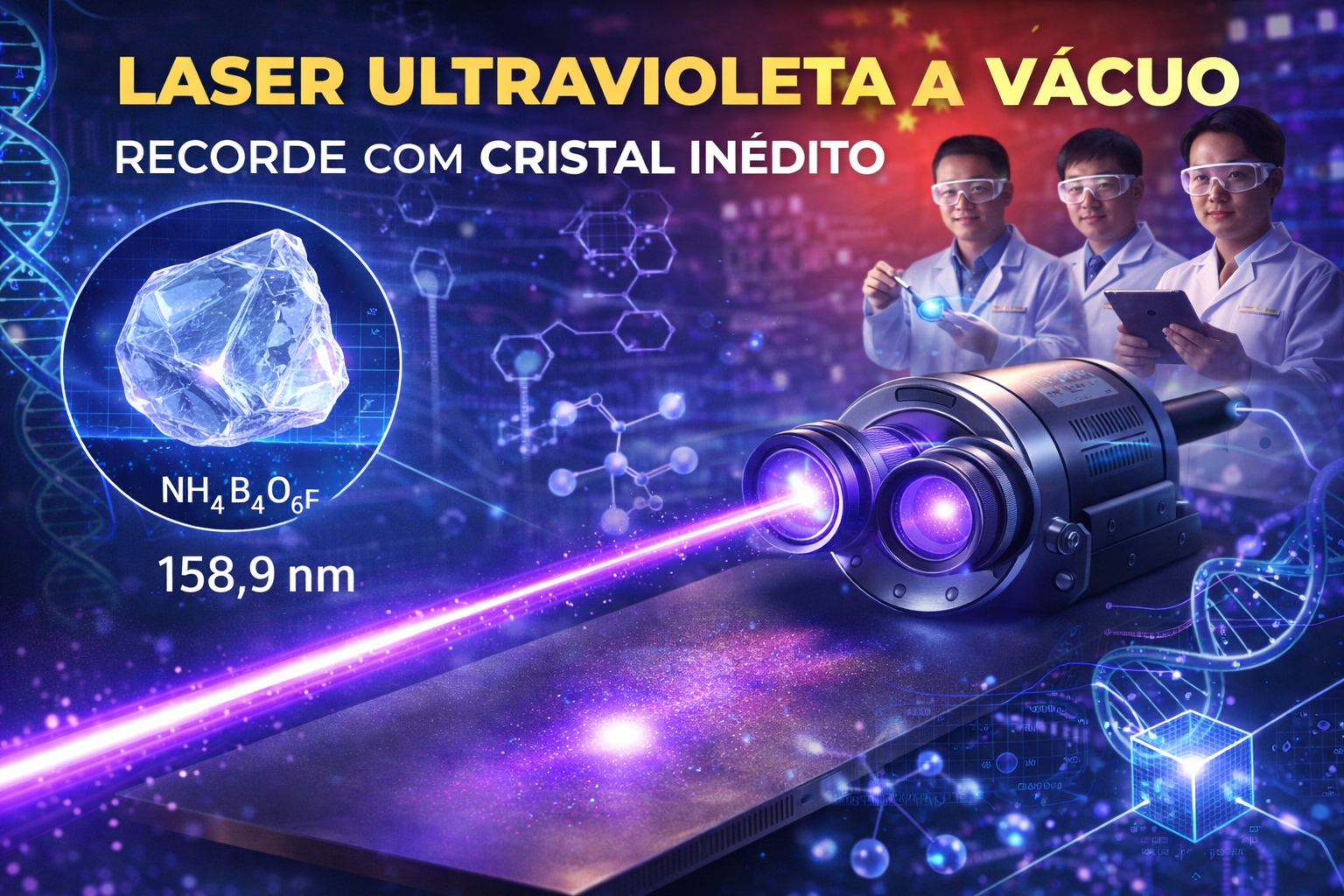


A New Crystal Helped Chinese Scientists Generate a Vacuum Ultraviolet Laser at 158.9 Nm, a Type of Light Hard to Produce and Highly Sought After for Chips, Advanced Research, and Precision Technologies.
Vacuum ultraviolet laser, the so-called VUV created by China, is the type of light that exists in a tough range to produce and maintain. We are talking about very short wavelengths, between 120 and 240 nanometers, where any loss in the pathway becomes a major problem. This is why, in practice, much in this range depends on large, expensive, and less “portable” solutions for the industry reality.
When a group announces that they have achieved 158.9 nm with a solid-state laser, they are basically saying the following: “we managed to generate VUV with an optical path that tends to be more compact, more efficient, and more friendly for becoming a product.” It’s not just a pretty number. It’s a new piece on the board.
This type of light is desired because it opens doors for advanced spectroscopy, manufacturing processes that require absurd precision, and mainly research that depends on fine control of energy states, such as experiments with atoms and ions.
-
A Japanese governor single-handedly stalled the construction of the world’s fastest train for nine years, and only now has he agreed to allow a tunnel excavated at a depth of 1,400 meters.

-
Almost 1 billion euros, two gigafactories, and a million-dollar public investment, Chinese company aims to turn Spanish city into Europe’s new battery hub.

-
Advancement in the industry: Brazilian company creates ultralight material comparable to steel and paves the way for hydrogen cylinders up to 70% lighter, with a direct impact on logistics, the energy industry, and national competitiveness – learn about Forza Composites

-
In Brazil’s backyard: Tesla, by Elon Musk, announces official operations in Uruguay, where electric vehicles already make up 20% of new cars but still leaves out the largest market in the region.






What Changed: The ABF Crystal Turned the Game Where Almost Nobody Had a Piece
The leap in this story is a nonlinear optical crystal called ammonium fluorooxoborate, also referred to as ABF. It is the “tool” that allowed reaching the record wavelength using direct frequency doubling, which is a form of nonlinear optical conversion to shorten the wavelength of the beam.
Here comes a significant point: for a long time, one of the bottlenecks of VUV was the lack of suitable crystals. There was one crystal that was treated as a practical solution to generate emission below 200 nm through direct frequency doubling, but it came with very real limitations, the type that hampers material growth and device fabrication at scale.
The ABF emerges as an alternative because it combines, in the same package, things that rarely go together: high transparency in the VUV range, a strong nonlinear response, and sufficient birefringence to allow phase matching at very short wavelengths. In layman’s terms, it “can handle” the job and still delivers the optical alignment that the process requires.
In the midst of the buzz, the most comprehensive description of the advancement came in the report from Interesting Engineering, which ties together the context, numbers, and why this matters for future applications.
Numbers That Matter and What They Suggest for the Real World
The cited record is the beam at 158.9 nm. In addition, the team reported pulse energy in the range of 4.8 millijoules in a nanosecond regime and a conversion efficiency close to 6%. In VUV, these numbers are not “technical details”; they signal that it’s not just a spark in the lab.
They point to performance with a platform-like appearance, something that can be refined.
There’s another detail that stands out: this crystal didn’t appear out of nowhere. The material was synthesized years ago and went through a long development path to reach useful dimensions and optical quality sufficient to come off the drawing board.
The implicit message is that there was work to turn a promising compound into a crystal that can actually be used in a device.
And, as always, when a group manages to create a material with this combination of properties, they are not just thinking about today’s “final product.” They are creating a design strategy for future crystals, as if to say: “now we know what type of crystalline architecture works to push VUV further down.”
Where This Might Hit First: Chips, Space, and Quantum
In the manufacturing of chips, shorter wavelengths mean the potential for finer, high-energy processes, something that connects with precision manufacturing and metrology steps.
It’s not a magic promise that “will revolutionize tomorrow,” but it’s the kind of advancement that enhances the toolbox for those who want to control matter at the most detailed possible level.
In space communications and orbital platforms, the idea of more compact and efficient lasers is tempting because everything in space is limited by mass, energy, and reliability. A more “domesticable” solid-state VUV laser can become a viable component where only very large solutions once fit.
In quantum research, the appeal is the precise control of atomic and ionic transitions and energy levels. This type of light can allow more refined manipulation in experiments targeting next-generation quantum computing, especially where the short wavelength and higher energy make a difference.
The study associated with the advancement was published in Nature, which helps lend scientific weight to the announcement and signals that the details of the method and results have undergone formal scrutiny.