






 Portuguese
  Spanish


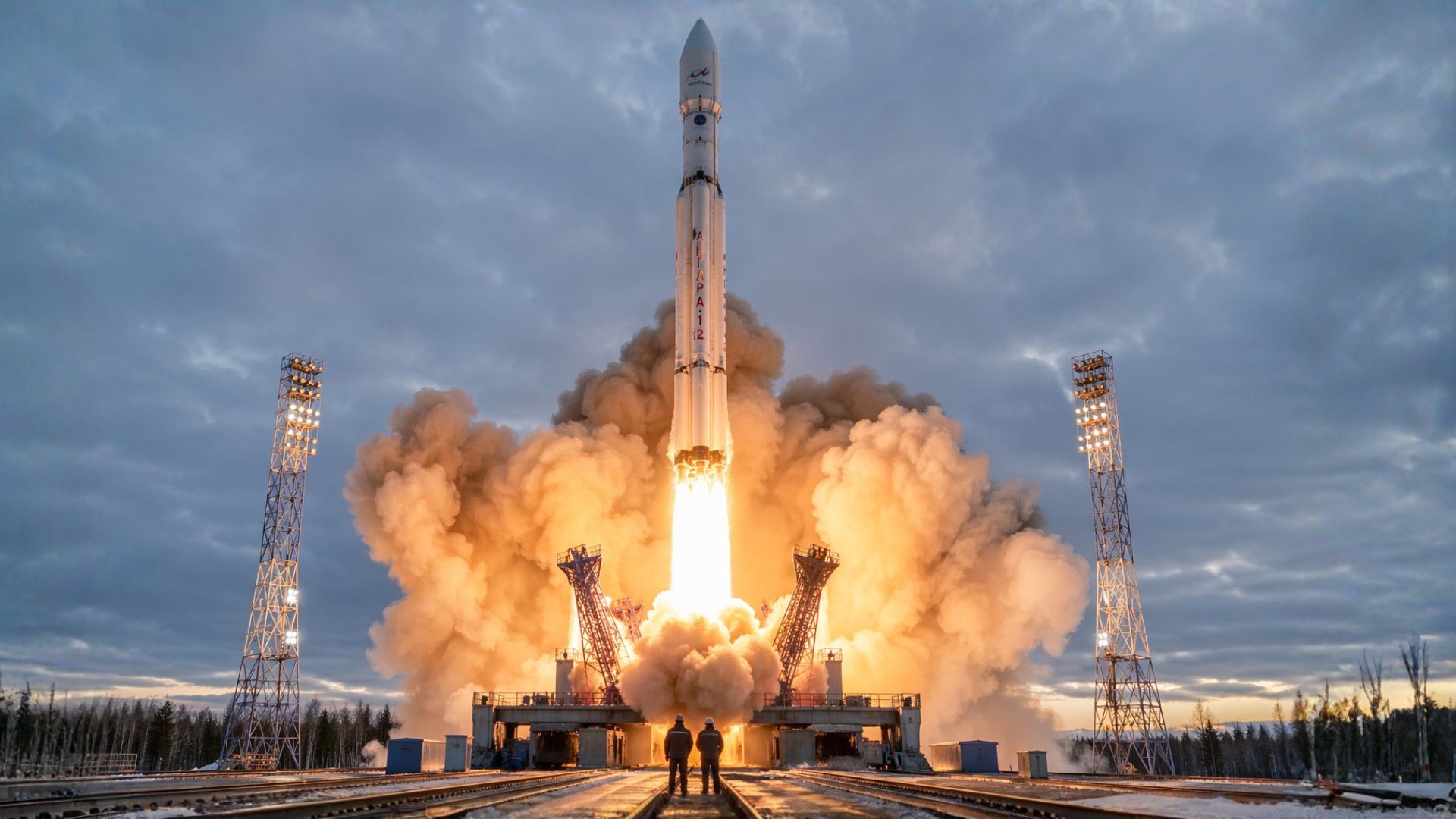

Military launch reinforces Russian space program and strategic use of Plesetsk Cosmodrome, with Angara-1.2 light rocket placing classified payloads in orbit and expanding the country’s technological autonomy amidst recent geopolitical pressures and international restrictions.
Russia successfully launched a light Angara-1.2 rocket from the Plesetsk Cosmodrome in the north of the country, on a military mission conducted by the Russian Aerospace Force and linked to the Ministry of Defense.
The launch occurred on April 23, 2026, at 11:29 AM Moscow time, according to official Russian statements.
The rocket carried classified military payloads into space, with no public details about the quantity, specific function, or technical characteristics of the satellites placed in orbit.
-
Brazilian Innovator Transforms 1962 Mercury Comet with Nissan Leaf Electric Motor, Achieving 125 km Range for Under $6,000

-
China Tests Giant 582-Ton Magnets to Contain Plasma Hotter Than the Sun’s Core, Aiming to Cut Superconductor Costs and Generate First Electricity from “Artificial Sun” by 2030
-
Seventh Grader Builds Nuclear Fusion Machine at Home, Aiming for Guinness World Record

-
Ancient Ritual Circle, Hidden for 5,000 Years, Discovered in Scotland’s Machrie Moor Using Sensors, Revealing a “Phantom Stonehenge”



Angara-1.2 launch and military operation at Plesetsk
The mission reinforces Plesetsk’s role as one of Russia’s main bases for military space operations.
Located in the Arkhangelsk region, the cosmodrome has been used since the Soviet era and remains strategic for launches under the control of the Aerospace Forces.
Developed as part of a new generation of Russian launchers, Angara was created to expand the country’s space autonomy after the dissolution of the Soviet Union.

The rocket family aims to reduce dependence on facilities and technologies inherited from old Soviet structures outside Russian territory.
Rocket capacity and Angara technical characteristics
The Angara-1.2 is the light version of the family.
It is a two-stage vehicle, powered by kerosene and liquid oxygen, designed to transport small and medium-sized payloads to low Earth orbit.
According to available technical data, the launcher can carry about 3.5 tons to low Earth orbit.
In more demanding orbits, such as sun-synchronous orbit, the payload capacity is lower, which limits the type of satellite transported.
As the equipment sent on this mission is military in nature, Russia has not released complete information about its purpose, onboard instruments, or expected lifespan.
In similar operations, payloads of this type are usually designated “Kosmos” after orbital insertion.
Military satellites and secrecy of Russian space missions
Generic identification is a recurring practice in Russian military missions.
It allows the space object to be registered without making operational details public, especially when it comes to reconnaissance, communication, or support satellites for protected navigation systems.
Space activity experts monitor these missions through orbital data, air and maritime traffic warnings, and subsequent registration of objects in orbit.
Still, without official confirmation, the exact function of the satellites remains classified.

The launch also maintains the sequence of Angara-1.2 use in defense missions.
Public records indicate that this was the seventh flight of the light version of the rocket, not the eighth, since its introduction in orbital tests last decade.
Angara program and replacement of old rockets
The Angara family holds an important position in the Russian space program.
The heavier, more powerful Angara-A5 model was successfully launched in April 2024 from the Vostochny Cosmodrome in the Russian Far East, after two aborted attempts.
This heavy version is seen by Moscow as a gradual replacement for the Proton-M, a rocket developed during the Soviet era and used for decades in large-scale missions.
The Angara-1.2, on the other hand, serves another segment, aimed at lighter payloads and specific missions.
The difference between the versions is central to understanding the program.
While the Angara-A5 can carry much larger payloads into space, the Angara-1.2 was designed for smaller launches, with lower operational costs and frequent use in classified missions.
Geopolitical context and Russia’s role in BRICS
In the geopolitical context, the mission takes place amidst Russia’s effort to preserve its own space capabilities despite sanctions, technological restrictions, and isolation in areas of international cooperation.
The space sector remains linked to civilian, military, and strategic interests.
Russia, a member of BRICS alongside Brazil, China, India, and South Africa, as well as the new members incorporated into the bloc, uses the Angara program as a showcase for technological autonomy.
The country also seeks to maintain influence in a sector dominated by the United States, China, and private companies.

Plesetsk remains an especially relevant base for military launches due to its location in northern Russia and its ability to provide suitable trajectories for satellites in polar or highly inclined orbits.
These orbits are useful for broad observation of the Earth’s surface.
Although Moscow has confirmed the success of the operation, the publicly available data does not allow for stating which systems the satellites will integrate.
There is also no official confirmation regarding use in navigation, optical reconnaissance, electronic intelligence, or secure communications.
The lack of details is consistent with the secrecy standard adopted in military space missions.
Generally, Russian Ministry of Defense communiqués are limited to reporting the time, launch site, rocket type, and successful payload separation.
The Angara’s progress occurs in parallel with Russia’s attempt to consolidate Vostochny as a center for strategic launches within national territory.
Nevertheless, Plesetsk continues to be the main starting point for military operations and tests under the responsibility of the Aerospace Forces.


