Portuguese
  Spanish


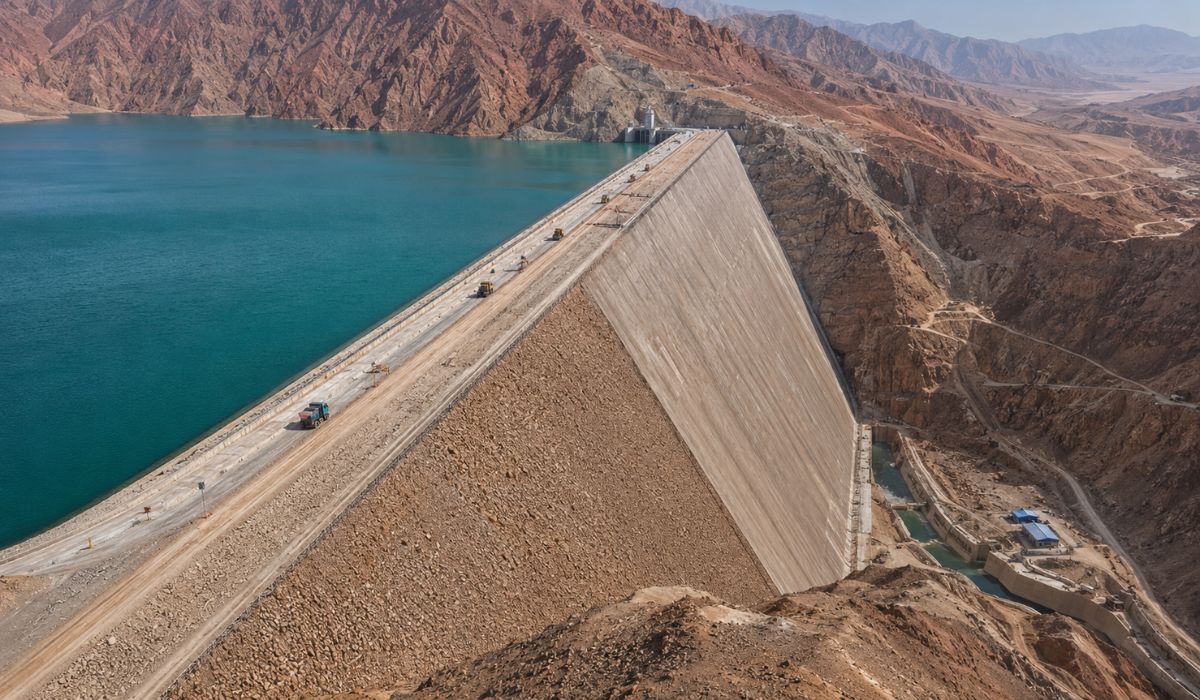

Project in Xinjiang brings together record-breaking dam, billion-dollar reservoir, and digital technologies in a Chinese project focused on water, energy, irrigation, and water control in an extreme climate region.
The Dashixia Dam in Xinjiang has once again attracted attention outside China after entering the water storage phase and nearing hydroelectric operation.
The project features a structure 247 meters high, a reservoir exceeding 1.1 billion cubic meters, the use of artificial intelligence, operator-free equipment, and digital technologies applied to construction.
Located in the middle and lower course of the Kumarak River, in the Aksu region, the project is part of the Dashixia Water Control Project, aimed at supply, irrigation, flood control, power generation, and ecological water supply to the Tarim River.
-
The large jar blender has a rival: Oster Ultra Power bets on 1,000 W, six stainless steel blades, and two portable cups with leak-proof lids.

-
Tesla injected an additional $250 million into the German factory, doubled the battery cell target, and opened its own production line for startups.

-
No more TV stuck on the wall: Samsung The Freestyle+, the new projector with over 400 lumens projects on walls, floors, and ceilings, bringing cinema to any corner of the house.
-
A Japanese governor single-handedly stalled the construction of the world’s fastest train for nine years, and only now has he agreed to allow a tunnel excavated at a depth of 1,400 meters.



According to Chinese sources, the reservoir began storing water in September 2025, a stage following the crowning of the main dam.
The crowning was completed on December 30, 2024, eight months ahead of the scheduled timeline, according to China Gezhouba Group Co., a subsidiary of China Energy Engineering Corporation.
The company reported that the structure is the tallest in the world in the sand and gravel model with a concrete face.
In total, the dam consumed 18.9 million cubic meters of materials, a volume that, according to the company responsible for the investment, would be enough to fill 7,560 standard pools.
The project was initiated in September 2021 and received an estimated investment of nearly 9 billion yuan, equivalent to about US$ 1.2 billion at the exchange rate reported by the Chinese press.
Dashixia Dam combines supply, irrigation, and energy
The Dashixia Project is part of the list of major water projects approved by the Chinese government for water conservation and supply.
SASAC, the State Council of China’s agency overseeing state-owned enterprises, classifies the project as one of the 172 national water economy and supply projects.
The dam is expected to contribute to the water supply of the Tarim River and irrigated areas of the Aksu River basin.
According to China Gezhouba, the project was designed to reduce water scarcity in the spring and benefit more than 533 thousand hectares of agricultural land.
In power generation, the plant associated with the project will have 750 thousand kilowatts of installed capacity.
The forecast released by the company indicates an annual production close to 1.9 billion kilowatt-hours when the system is in operation.
The operational schedule shows variations among the sources consulted.
The China Daily reported that all generation units were scheduled to be operational in July 2026, while the specialized platform Seetao published in April 2026 that the first unit would generate power in June and that all three units would be operational in August.
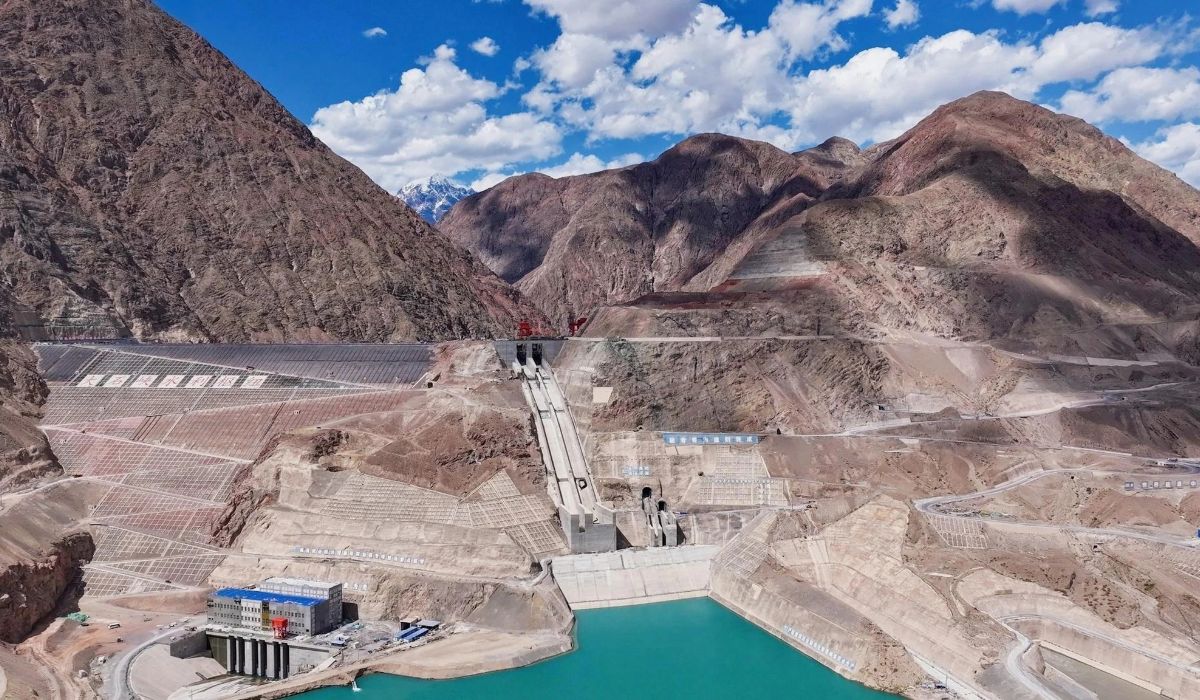
Construction faced extreme temperatures in Xinjiang
The construction took place in an area subject to significant climatic variations relevant to the execution of hydraulic works.
Li Yang, an executive linked to the project, told China Daily that the region frequently experiences hail, temperatures up to 39.5°C in summer, and lows of 22°C below zero in winter.
According to Li, the investment in the dam was close to 9 billion yuan, equivalent to about US$ 1.2 billion according to the conversion reported by the Chinese publication.
The data was presented as part of the construction phase balance released after the crowning.
The environmental conditions require control of stages such as material transport, compaction, and moisture verification.
This relationship was pointed out by Zhong Denghua, an academic from the Chinese Academy of Engineering, when discussing the use of intelligent technology in construction.
In the model adopted in Dashixia, the dam is made of sand, gravel, and compacted materials, with a concrete face upstream.
The function of this surface is to reduce seepage and act as a sealing element of the structure, according to the technical description of the type of dam published in Chinese sources.
Artificial intelligence was applied in field tests
Artificial intelligence was applied in technical control stages of construction, according to Zhong Denghua.
The academic stated that the technology helped to tackle challenges such as rapid field tests to measure moisture content and compaction quality.
The specialist also stated that Dashixia was built with advanced cooperative technology involving unmanned intelligent compactors.
The information was attributed to Zhong in a report published by China Daily and reproduced by Chinese media outlets.
CGTN reported in September 2025 that the project used BIM modeling from the start, as well as a cloud platform for intelligent management and automatic meteorological, hydrological, seismic, and air quality monitoring systems.
These features were presented by the Chinese state broadcaster as part of the digitization of the construction site.
The use of “digital twin” was mentioned in a report by the South China Morning Post published in September 2025, according to which the dam began storing water after being built with the support of artificial intelligence and digital technologies.
The report associates the project with digital twin resources, but this expression does not appear equivalently in all the official sources consulted.


Dashixia Reservoir began storing water in 2025
After the dam’s crowning, the project advanced to new stages of storage, testing, and operational preparation.
In September 2025, Chinese state media reported that the Dashixia Water Control Project had begun storing water.
CGTN published that the project is located at the confluence of Wensu and Wushi counties, in the Grand Canyon of the Kumarak River, in Aksu.
The report described the project as an infrastructure that combines flood control, irrigation, power generation, and ecological management.
In the same report, Huang Jin, a representative of Xinjiang Dashixia Water Conservancy Construction Management Co., Ltd., stated that the project should ensure an annual ecological supply of 3.4 billion cubic meters of water.
The number refers to the volume regulated throughout the year, not the static capacity of the reservoir.
This clarification is necessary because the reservoir’s capacity and the annual volume moved measure different things.
While the former indicates how much the reservoir can store, the latter corresponds to the water released or regulated during the operation period.
Water project reached the final stage in 2026
In April 2026, Seetao reported that the overall progress of the Dashixia Project had reached 98%.
The publication also stated that the dam’s filling volume had exceeded 10 million cubic meters and that the panel concreting area exceeded 120 thousand square meters.
The same source reported that the energy generated by the plant will be sent to the Aksu substation of 750 kV through a new 220 kV transmission line.
The system was described as part of the necessary infrastructure to integrate the hydroelectric plant into the regional grid.
With this configuration, the project came to include a dam of 247 meters, a reservoir exceeding 1.1 billion cubic meters, hydroelectric generation, and automated construction technologies.
All this information was attributed to corporate statements, reports from Chinese state media, and specialized publications.
The sources identify the enterprise on the Kumarak River, in the Aksu region, in Xinjiang, and in the Great Canyon of Kumarak, between Wensu and Wushi.
The scale of the dam and the use of intelligent systems help explain why Dashixia has started to receive attention outside of China.
The technical interest, however, comes from the data released by the sources involved in the project, not from independent assessment presented in the original material.