






 Portuguese
  Spanish
  4 min of reading
  0 comments


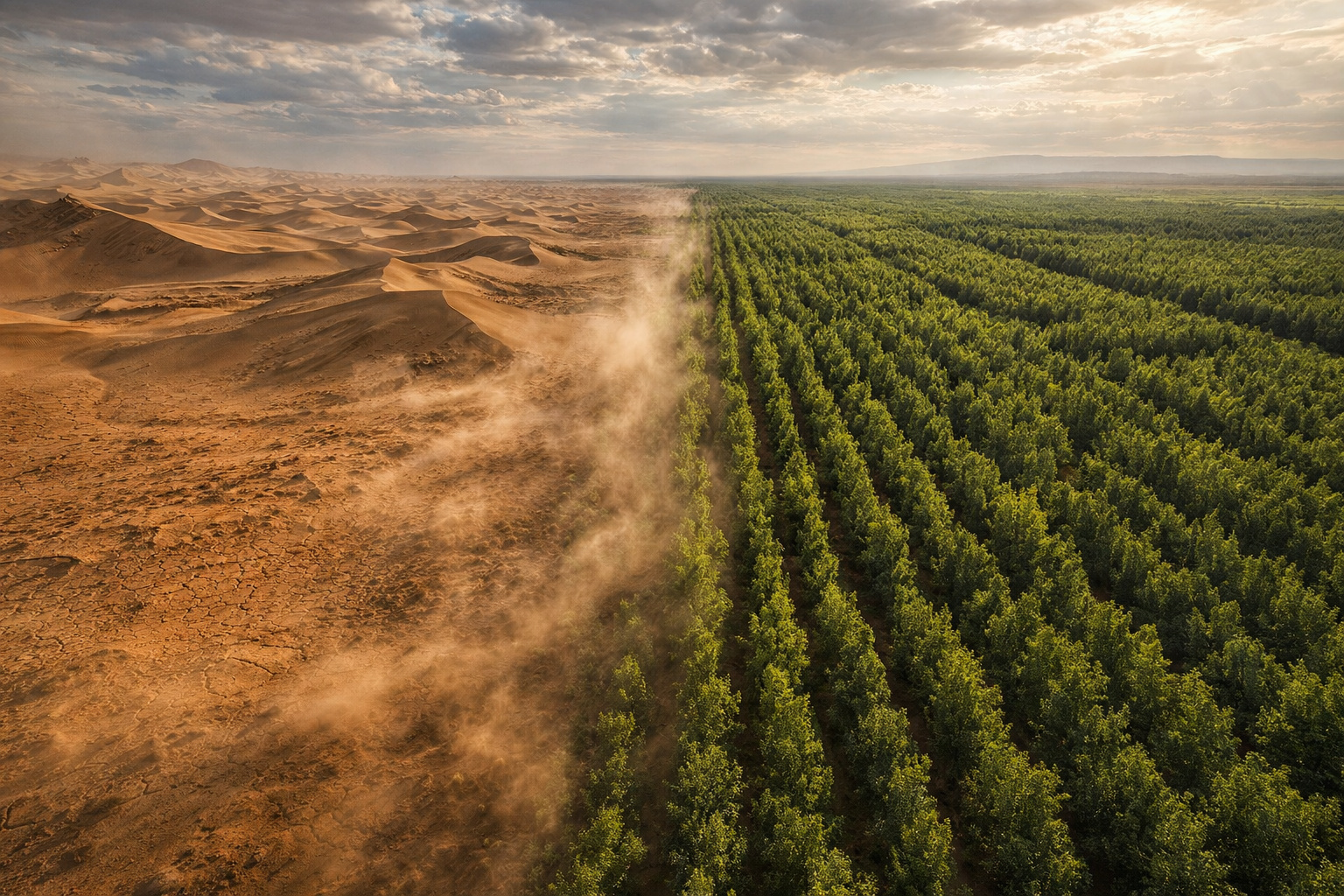
China Implemented One of the Largest Reforestation Projects in Arid Areas of the Planet by Surrounding the Taklamakan Desert with Green Belts Made Up of Millions of Trees and Shrubs Adapted to Extreme Climates.
For decades, the Taklamakan Desert was considered a true “biological desert”. Located in the Xinjiang region of western China, it is one of the most arid and inhospitable deserts on the planet, with extreme temperatures, scarce rainfall, and dunes extending for hundreds of kilometers.
But something began to change in recent decades. After a massive reforestation effort, China achieved something that seemed unlikely: transforming the edges of this extreme desert into a carbon sink, an area capable of absorbing more carbon dioxide (CO₂) than it emits.
From Hostile Desert to Climate Laboratory
The Taklamakan has always been known for its severe aridity. Frequent sandstorms, almost nonexistent vegetation, and unstable soil made the region a permanent challenge for nearby cities and agricultural areas.
-
Survivor of 1966 SS Daniel J. Morrell Shipwreck in Lake Huron Recounts 38-Hour Ordeal in Extreme Cold

-
The Greatest Hoax in World Cup History? The Film That Denied Brazil’s 1958 Victory and Exposed How Fake Evidence Can Seem Convincing on TV
-
Fake South Korean Online Stores Offer Shopping Thrill Without Spending Money or Receiving Products
-
The War of Jenkins’ Ear: How a Severed Ear Sparked One of the 18th Century’s Most Unusual Conflicts


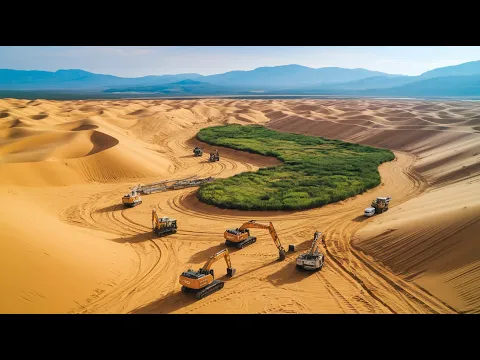

It was in this context that the Chinese government intensified actions related to the Three-North Shelter Forest Program, also known as the “Great Green Wall of China”. The program, started in 1978, aims to combat desertification in the north of the country by planting drought-resistant trees and shrubs.
Over more than four decades, billions of seedlings have been planted to form green belts around vulnerable areas — including the edges of the Taklamakan.
How Trees Can Change the Local Climate
The logic behind the initiative is simple, yet powerful:
- Trees capture CO₂ during photosynthesis
- Roots stabilize the soil and reduce erosion
- Vegetation reduces wind strength and decreases dust storms
- The increase in green cover alters regional microclimates
In the case of the Taklamakan, satellite data analyzed by researchers showed that vegetation in the peripheral areas of the desert has consistently increased in recent decades.
More than that: measurements indicate that these areas have begun to act as liquid carbon sinks, absorbing more CO₂ than they release.
The Role of Satellites in Discovery
The transformation was not only perceived with the naked eye. Researchers used satellite remote sensing to monitor:
- Vegetation indices (NDVI)
- Atmospheric carbon concentration
- Changes in land cover
The data revealed that regions previously classified as high emitters — due to lack of vegetation — began to register positive carbon capture balance.
This means that the green belt around the desert not only prevents the advance of sand but also contributes to mitigating climate change.
An Arid Area That Now Helps Fight Global Warming
The concept of a “carbon sink” is generally associated with tropical forests or large wetland areas. What makes the case of the Taklamakan so impressive is that it involves an extremely arid environment, traditionally seen as incapable of playing a relevant climatic role.
With the increase of drought-adapted vegetation, the desert’s border has begun to serve an active ecological function. Besides carbon capture, the project helps to:
- Protect highways and cities from sandstorms
- Improve agricultural conditions in nearby areas
- Create ecological corridors that favor biodiversity
Not Everything Is Simple
Despite the positive results, experts warn that reforestation in arid areas requires rigorous planning.
It is necessary to select native or highly adapted species to water scarcity. Otherwise, planting could put pressure on already limited water resources.
In the Chinese case, the focus has been on drought-resistant species and controlled irrigation techniques during the initial growth phase.
A Replicable Model?
The case of the Taklamakan reinforces a global discussion: Is it possible to restore degraded ecosystems on a large scale?
Although each region has unique characteristics, the success observed on the edges of the Chinese desert suggests that well-planned interventions can change the fate of areas considered unrecoverable.

It’s not about “turning the desert into a tropical forest,” but about creating zones of strategic vegetation capable of stabilizing the environment and contributing to the climate balance.
A Transformation That Defies Expectations
The Taklamakan Desert remains one of the most extreme environments on Earth. Its giant dunes and hostile climate remain virtually intact within. But around it, a silent transformation is underway.
What was once called a biological desert now helps capture carbon. What once represented the advance of desertification has now become a green barrier against it.
At a time when the world seeks solutions to curb global warming, the green belt around the Taklamakan stands out as an example that nature-based interventions can produce measurable impacts — even in the most unlikely environments.





-

-

2 people reacted to this.