Portuguese
  Spanish


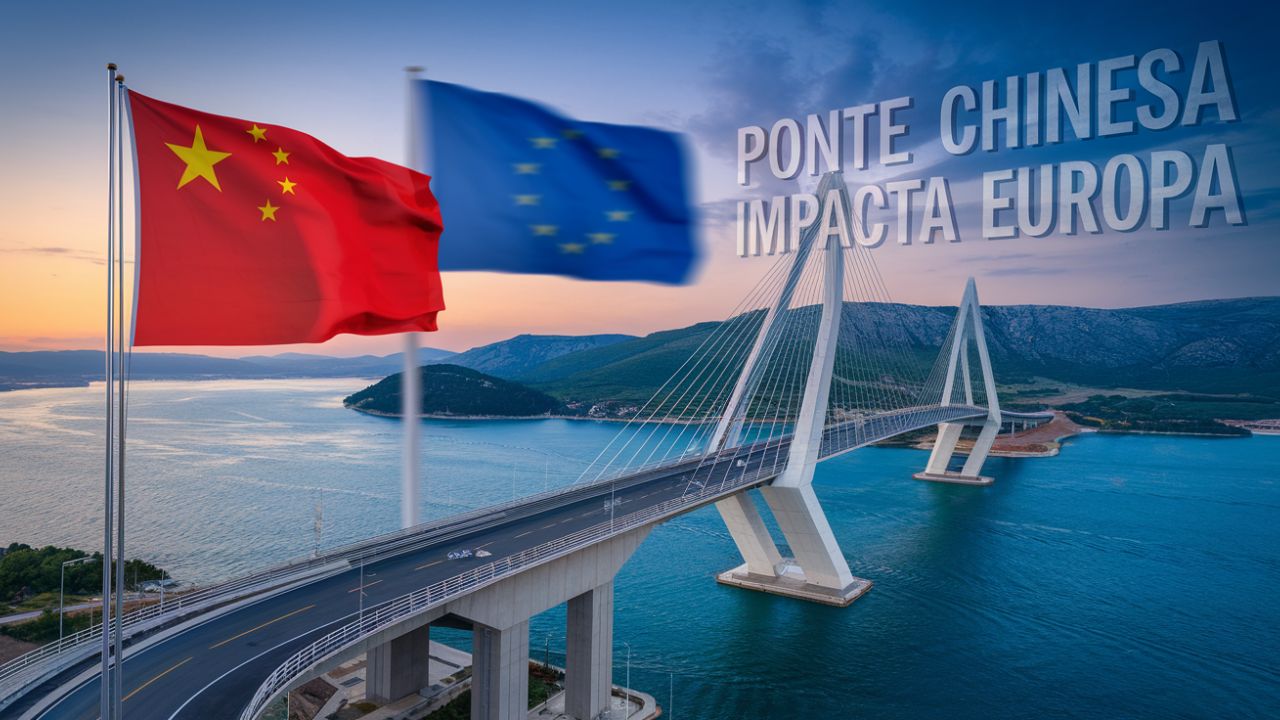

With £ 358 million Invested, the Pelješac Bridge Connected Croatia and Eliminated Borders, but It Was China, Not the European Union, That Took the Credit. This Megaproject Reveals How Beijing Is Expanding Its Influence in the Balkans and Challenging European Hegemony in Its Own Backyard.
In the stunning landscape of southern Croatia, an imposing bridge rises over turquoise waters, connecting lands that have been separated for centuries. But the Pelješac Bridge is not just an extraordinary feat of engineering; it also symbolizes a shift in the European geopolitical landscape. Built by a Chinese state-owned company with funding from the European Union, its inauguration in 2022 sparked a debate about China’s growing influence in the Balkans. After all, while the money came from the EU, the credit for the work largely went to Beijing.
The Pelješac Bridge, a Landmark of Engineering and Geopolitics
The Pelješac Bridge, with its impressive 2.4 kilometers in length, solves a long-standing logistical problem for Croatia. Before its construction, access to the south of the country, including the popular tourist destination of Dubrovnik, required crossing a short stretch of Bosnian territory, with border controls that delayed goods and travelers. Now, the bridge provides a direct route, eliminating barriers and boosting the regional economy.
The project was funded with € 420 million (£ 358 million) from the European Union, but its execution was entrusted to the China Road and Bridge Corporation (CRBC), a Chinese state construction giant. This detail did not go unnoticed. BBC journalist Katya Adler described the bridge as a landmark of China’s growing presence in the Balkans, raising the question: Is Europe losing influence in its own backyard?
-
Architect Converts 1955 Grain Silo into 31m² Home with Full Amenities, Including Kitchen, Bathroom, Curved Living Room, and Loft Bedroom

-
Egypt Partners with China to Build 2 GW Wind Turbine Factory and 2,000 MW Wind Farm in Gulf of Suez, Aiming to Export Across Africa

-
Family of Six Leaves Georgia to Live in a $300,000 Cold War-Era Underground Bunker Since 2020: Unlikely 557 m² Home with 60 cm Concrete Walls
-
Self-taught Brazilian Mechanic Builds 10-Ton Aluminum Sailboat in Backyard, Now Navigates the Brazilian Coast at 50



Chinese Premier Li Keqiang emphasized the project as a symbol of friendship between China and Croatia, and by extension, between China and the EU. Beijing saw the project as an opportunity to strengthen strategic ties in the region, reinforcing its Belt and Road Initiative, an ambitious infrastructure investment plan aimed at expanding China’s global presence.
The Balkans and China’s Strategy

The Balkans have been a key point in China’s strategy for economic expansion. From highways to railways and power plants, Beijing has invested billions to consolidate its presence. The region, historically regarded as a “forgotten frontier” of Europe, has become a central piece in China’s long-term plans to increase its commercial and diplomatic influence.
Chinese involvement divides opinions in Europe. For some, projects like the Pelješac Bridge represent welcome investment and infrastructure modernization opportunities. For others, they raise alarms about growing dependence on Chinese funding and technology, which could compromise European autonomy in strategic sectors.
Brussels, for its part, walks a fine line. On one hand, it wants to boost development in the Balkans to ensure stability in the region; on the other, it fears that Beijing’s influence may grow to the point of diluting European control over its own economies.
Economic and Strategic Impacts of the Bridge
According to Express Co, the opening of the Pelješac Bridge has already transformed the Croatian economy. Tourism companies, hotels, and restaurants have seen an increase in visitor flow, now that Dubrovnik has become more accessible. Agricultural products from the Pelješac Peninsula, famous for its vineyards and seafood, now reach markets in Croatia and beyond more quickly.
The bridge has also boosted the real estate sector of the peninsula, making it more attractive to investors and residents, as well as making life easier for workers who previously faced long commutes.