






 Portuguese
  Spanish


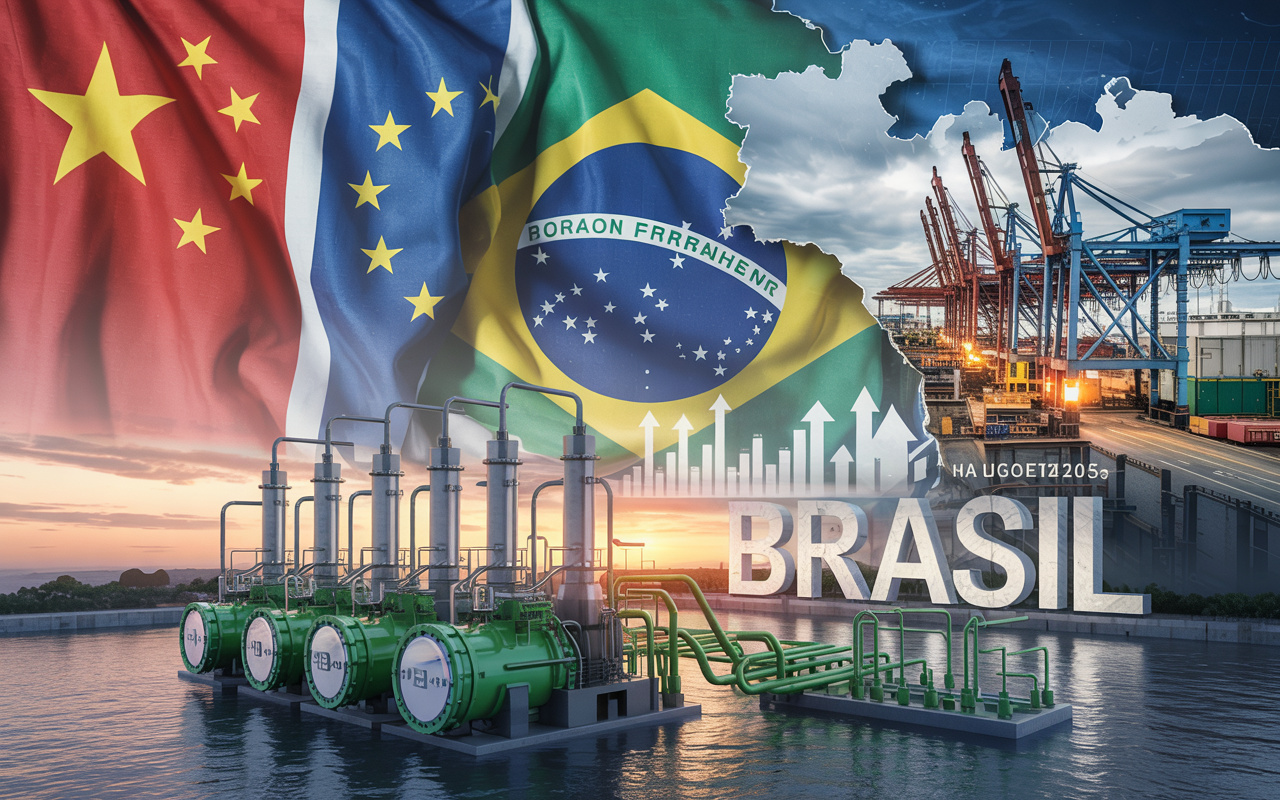


China and European Union Clash for Leadership in Brazil’s Green Hydrogen. Europe Funds Ports, Chinese Supply Electrolyzers, and Both Aim for Trillions by 2050.
In 2025, Brazil returns as a key player in a geopolitical dispute that promises to redefine the global energy matrix. This time, the clash is not about pre-salt oil or soybeans from the Midwest, but rather a new asset considered the “fuel of the future”: green hydrogen.
With the potential to replace fossil fuels in hard-to-decarbonize sectors like steelmaking, heavy transport, and the chemical industry, green hydrogen could generate trillions of dollars by 2050, according to projections from the International Energy Agency (IEA). It is precisely in this context that China and the European Union compete for leadership in Brazil, seen as a natural powerhouse for producing clean energy at scale due to its abundant sunlight and consistent winds in the Northeast.
Europe Bets on Green Financing and Diplomacy
The European Union is positioning itself as the main financier of the infrastructure needed to transform Brazil into an exporter of green hydrogen and derivatives. The Port of Pecém in Ceará already has support from the World Bank and Germany through programs like H2Brazil, managed in partnership with GIZ (German Agency for International Cooperation).
-
Brazilian Steel Giant Partners with USP to Develop 40% Stronger Rebar for World’s Tallest Residential Building in Brazil’s Senna Tower

-
Oil Prices Drop to $72 as 20 Million Barrels Pass Through Strait of Hormuz in 24 Hours, Easing Supply Fears but Regional Tensions Keep Market on Edge

-
Brazil’s Ministry of Justice Investigates CazéTV for Betting Ads During World Cup Broadcasts

-
Brazilian Retail Giant Americanas Faces $10 Billion Asset Freeze Amid Investigation into Hidden Debts


In practice, this means resources and expertise to adapt piers, create exclusive areas for ammonia storage — the main hydrogen derivative for maritime transport — and establish long-term contracts with European importers. Additionally, The Netherlands, through the Port of Rotterdam, already maintains direct agreements with Pecém, establishing export corridors that could link Brazilian Northeast to the largest logistics hub in Europe.


The European strategy is clear: to ensure, from now on, the supply of clean energy to meet carbon neutrality targets by 2050 while also securing energy independence from the Russian gas crisis.
China Steps In with Technology and Equipment
If Europeans bet on financing and long-term contracts, China advances with technology and industrial scale. Chinese companies like Envision and Mingyang have already signed memorandums to supply large-scale electrolyzers — equipment responsible for transforming water into hydrogen from renewable energy.
Furthermore, Chinese state-owned giants, such as SPIC (State Power Investment Corporation), already have projects in the Brazilian Northeast that integrate solar, wind, and hydrogen plants. One example is the 500 MW mega-complex at the Port of Pecém, aimed at producing green ammonia, which targets both the domestic market and overseas clients.
The Chinese strategy is to dominate the supply chain by offering cheaper equipment than Europeans, thereby consolidating its presence as a key supplier for the expansion of green hydrogen in Brazil.
Pecém and Suape: The New Frontier of Energy Transition
The main stage of this dispute is the Northeast, especially the ports of Pecém (Ceará) and Suape (Pernambuco). Both are undergoing transformation to become hubs for exporting green hydrogen and derivatives.
- Pecém (CE): has partnerships with the World Bank, Germany, and China. It has already attracted dozens of memorandums of understanding with multinationals.
- Suape (PE): hosts e-methanol production projects, with investment exceeding R$ 2 billion, along with memorandums signed with European and Asian companies.
These complexes are seen as outlets for Brazilian green hydrogen to the world, with the potential to transform the region into the epicenter of the new global energy race.
The Silent ‘War’ of Contracts and Diplomacy
As Europe and China advance, Brazil needs to balance interests. The European Union offers access to its premium market, willing to pay more for certified clean energy. China, on the other hand, brings lower-cost equipment and direct investments, accelerating the construction of the first industrial plants.
This is a silent war of contracts and diplomacy, where each memorandum signed by a Brazilian state can mean billions in future exports. This dispute also reflects each bloc’s attempt to approach Brazil not only as an energy supplier but as a strategic ally in an increasingly divided world among powers.
The Risk of Being Just a Raw Material Exporter
Despite the excitement over the announcements, experts warn of a real risk: Brazil may repeat the historical mistake of iron ore and oil, becoming merely a exporter of cheap raw materials without adding value to the production chain.
Producing ammonia and sending it abroad is profitable but generates much less value than investing in green steel, sustainable fertilizers or synthetic fuels within the national territory. In this regard, both the European Union and China seek to secure their own added value outside Brazil, leaving the country as a basic supplier of clean energy.
Brazil Facing a Historic Opportunity
This moment is decisive. With US$ 30 billion in projects announced by 2030, Brazil can choose to be just the “energy farm” of the world or establish itself as a global leader in green innovation. This requires robust public policies, incentives for the national industry, and agreements prioritizing technology transfer and local development.
If it knows how to negotiate, Brazil will not only have billion-dollar exports but also a new productive matrix based on low-carbon steel, clean transport, and sustainable fertilizers. Otherwise, it may remain trapped in the role of a peripheral supplier in a chain dominated by China and the European Union.
The competition for green hydrogen shows that Brazil has again become a key player on the global geopolitical chessboard. China and the European Union see the Brazilian Northeast as an opportunity to secure clean and safe energy for their economies by 2050.
What is at stake is not just a new fuel but the future of industry, trade, and Brazil’s strategic position in the 21st century. Amid billion-dollar promises and exploitation risks, the country needs to decide: will it be a leading force in the energy transition or just another supplier of inputs in a market dominated by others?


Já passou da hora dos estados nordestinos se aproximarem mais e aproveitarem esse capital energético limpo de que dispõem com fartura. Seria a chance de saírem de um patamar subalterno na economia brasileira e de, talvez, atingirem um protagonismo que nunca tiveram.
Para tanto, precisam se livrar das famílias tradicionais da política que sempre procuraram tolher o avanço da região como forma de domínio político e administrativo desses estados.
Quando é que o Ceará vai deixar de ser submisso em tudo por tudo, senao vejamos, o Hidrogênio verde está consolidado no Nordeste, saímos na frente e tudo para aqui, enquanto o Piaui, Pernambuco, R. Gde do Norte saíram atrás e hoje as suas estações já estão na frente do nosso estado, acorda Ceará, esses políticos do Ceará só querem levar casquinha no bolso.
O pessoal desse portal já tomou conhecimento que enquanto os outros estados negociam a instalação de usinas de hidrogênio verde o Piauí já está construindo, em Parnaiba, uma mega Usina da solation energia!