






 Portuguese
  Spanish
  4 min of reading
  0 comments


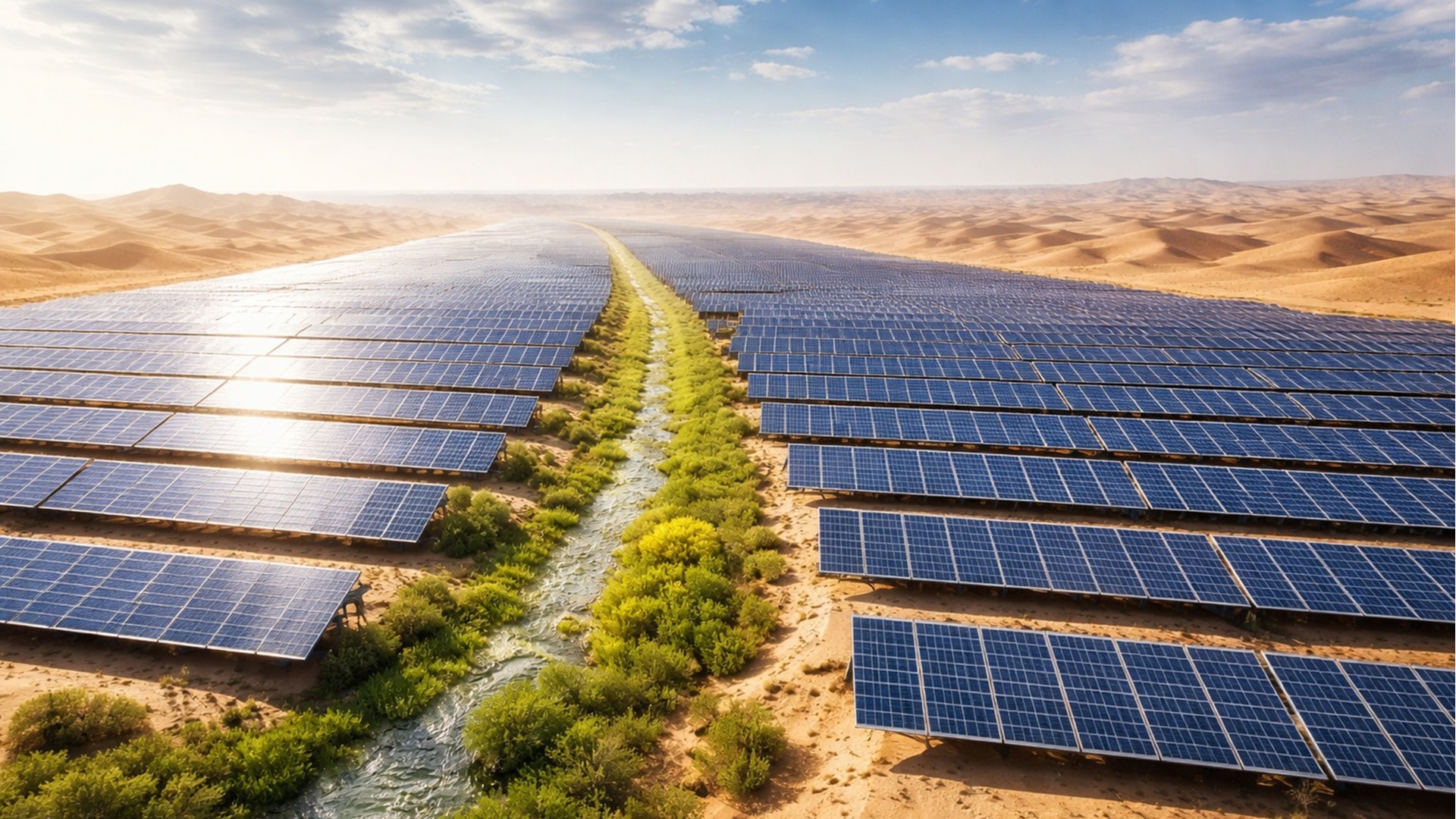
With a Goal of Reaching 100 GW by 2030 and More Than 5.4 GW Already Installed Along 400 Kilometers in the Kubuqi Desert, the Great Solar Wall Combines Annual Generation of 100,000,000 kW with an Increase of 15% to 20% in Soil Moisture and a Reduction of Up to 10°C on the Sandy Surface
The 100,000,000 kW photovoltaic plant that forms the Great Solar Wall in the Kubuqi Desert in Inner Mongolia projects 100 GW annually by 2030, already has 5.4 GW installed, and records an increase of 15% to 20% in soil moisture.
The global transition to electric mobility requires large-scale clean generation infrastructure. In this context, China is conducting a mega project in the Kubuqi Desert that supports the expansion of electric vehicles while simultaneously tackling regional desertification.
The success of electric vehicles depends on zero-emission electricity. The photovoltaic complex under construction fulfills this function by replacing fossil sources and establishing an energy base capable of supporting the growing demand for charging.
-
Helicopter Drops 180 Tons of Sand and Gravel on Swedish River to Revive Ecosystem Damaged by Decades of Exploitation

-
Brazilian Company Launches Retro Smartphone with 48 MP Camera, T9 Keyboard, and Privacy Features for Social Media-Free Use

-
Self-Taught Chinese Farmer Builds 5-Ton Submarine from Scrap, Launches It in Anhui River
-
Invisible Induction Technology Enables Wireless Power for Blenders, Coffee Makers, and Air Fryers, Reducing Countertop Cables





Great Solar Wall Achieves the Goal of 100 GW by 2030 and Extends 400 Kilometers in the Desert
The total expected capacity is 100 GW of clean energy by 2030. The project’s size provides the necessary energy base to ensure that electromobility is effectively green and sustainable.
The endeavor has been nicknamed the Great Solar Wall. The name refers to a strategic protective structure on a national scale aimed at energy security and future environmental risk mitigation.
The structure will stretch over 400 kilometers, with an average width of 5 kilometers, crossing the Kubuqi Desert. The goal of reaching 100 GW surpasses the total installed capacity of several developed countries.
So far, more than 5.4 GW have been installed in the initial phases. The deployments are concentrated in areas such as the Junma Solar Power Plant and the New Energy Base in Central-North Ordos.
China accounts for more than 50% of the solar installed capacity in the world. The project’s advancement reinforces this position by rapidly expanding photovoltaic infrastructure in desert territory.
The choice of location was strategic. Unlike regions where solar parks compete for arable land, the project has been implemented in arid areas such as Kubuqi and the arid alpine desert of Qinghai.
This decision eliminates social tensions related to agricultural land use. At the same time, it converts areas with no productive value into energy and ecological assets.
Microclimate Under the Panels Raises Soil Moisture by 15% to 20% and Reduces Temperature by Up to 10°C
Initially, the panels were intended to produce energy and stabilize dunes. However, scientists identified an additional environmental effect: the infrastructure has begun to act as an agent of ecological restoration.
The partial coverage created by the modules reduces the direct incidence of solar radiation on the sand. This shade lowers the surface temperature by up to 10 degrees Celsius.
The thermal reduction directly impacts evaporation. By lowering soil temperature, water loss from rain or effluent is decreased.
Studies show that water retention increases soil moisture by 15% to 20% in the shaded areas. The effect creates a cooler and wetter microclimate under the panels.
This environment favors the establishment of vegetation resistant to water stress. Species that previously would not survive extreme heat begin to thrive.
Researchers have observed a substantial increase in vegetation cover, including shrubs and grasses, in the areas protected by photovoltaic shade.
The expansion of vegetation generates secondary ecological benefits. The presence of plants stimulates microorganisms and enhances biodiversity in areas previously considered arid.
The induced vegetation improves the soil’s ability to retain water and nutrients. It also prevents wind erosion, reducing dune mobility.
Area of 230,000 mu Dedicates 15,300 Hectares to Photovoltaic Sand Control
The sand control associated with the project covers 230,000 mu, equivalent to approximately 15,300 hectares dedicated to the photovoltaic management of desertification.
The primary mission of the initiative remains the generation of clean energy. At the same time, mitigation of desertification is being consolidated as a measurable result.
The combination of electric production and environmental restoration characterizes a dual impact. The project integrates energy and ecological goals within the same territorial structure.
The energy produced in Kubuqi supports the electrification of vehicles in Asia and influences global markets through the technology adopted.
Energy Engineering Integrates Electric Sovereignty and Local Climate Mitigation
The scale of 100 GW ensures supply compatible with the expansion of electric mobility. This capacity reduces dependence on fossil fuels and mitigates associated emissions.
By transforming a barren area into an energy hub, the initiative establishes a foundation for energy sovereignty. Human intervention, in this case, reverses observed environmental degradation.
The experiment in Kubuqi demonstrates that photovoltaic infrastructure can alter the local microclimate. The shade created provides favorable conditions for plant life.
The increase in moisture and the thermal reduction consolidate a regeneration cycle. The revegetation strengthens the soil, enhances water retention, and reduces erosion.
With 100,000,000 kW projected by 2030, the Great Solar Wall establishes itself as both an energy and ecological axis simultaneously.
The project articulates electric mobility, clean generation, and desertification control on a broad territorial scale.
The integration between energy engineering and environmental restoration defines the scope of the Great Solar Wall, which combines 400 kilometers of infrastructure with goals of 100 GW.
The initiative maintains a focus on clean generation while producing measurable environmental effects under the installed panels in the desert.
Thus, the Great Solar Wall combines projected electric capacity, sand control, and microclimatic alteration within the same photovoltaic complex.





-

-

-

-

-

18 people reacted to this.