






 Portuguese
  Spanish
  5 min of reading
  0 comments


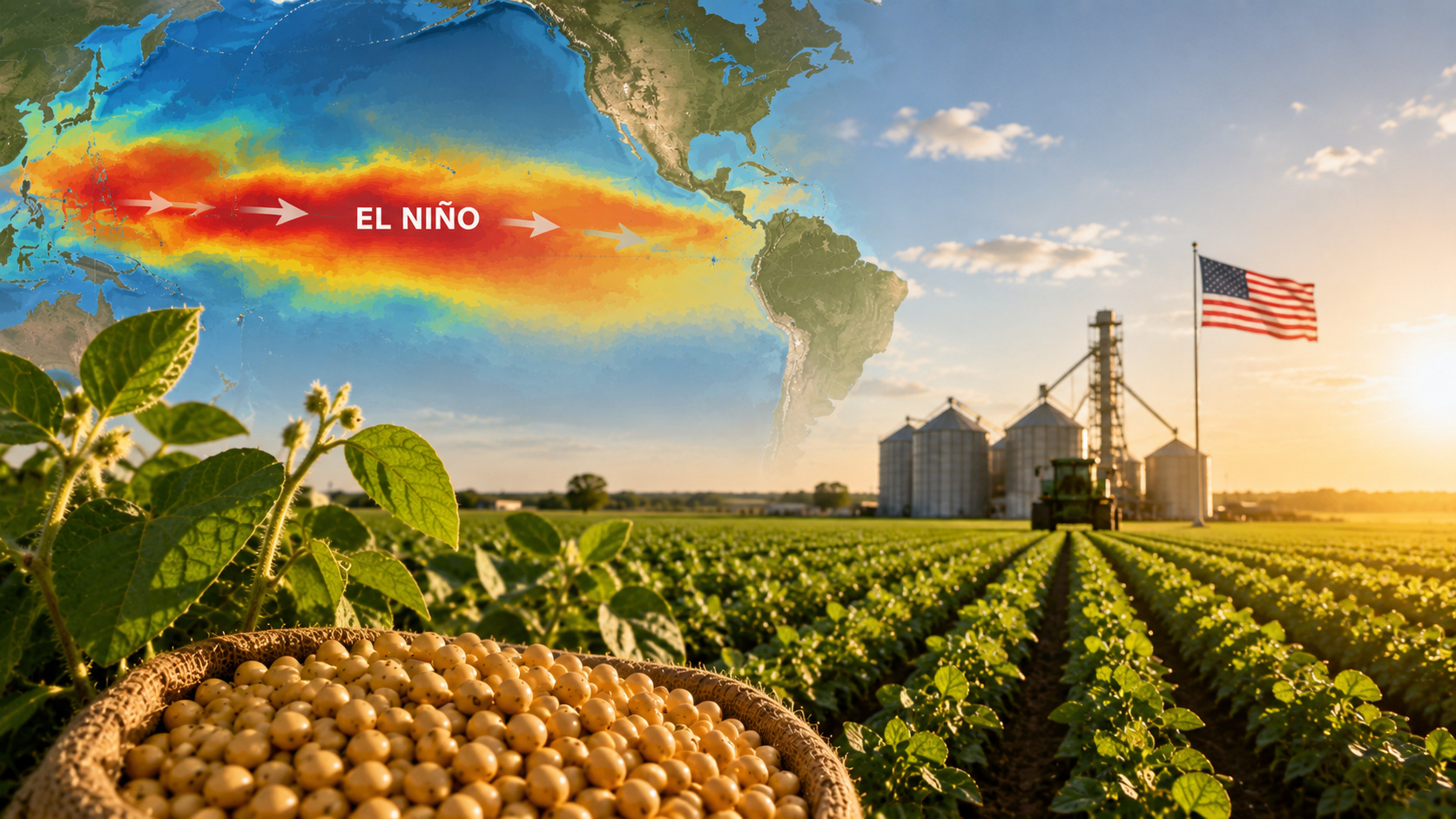
Study points to El Niño’s advance in the Pacific, impacting U.S. soybeans and posing climate risk for Brazilian crops in 2026.
The advance of El Niño in the Pacific Ocean has once again raised concerns in the international agricultural market after new projections indicated a high probability of the phenomenon forming in 2026. According to the United States National Oceanic and Atmospheric Administration (NOAA), there is an 82% chance of occurrence between May and July and a 91% probability between June and August.
According to information from Globo Rural on May 26, the new study analyzed by Biond Agro consultancy shows that the phenomenon may benefit soybean production in the United States in the short term, while increasing climate risks for Brazil during the planting of the next crop. The scenario is already drawing attention from producers, exporters, and investors due to the potential impact on global prices and agricultural exports.
El Niño in the Pacific alters expectations for the global soybean crop
El Niño is characterized by the abnormal warming of the surface waters of the Equatorial Pacific Ocean. This phenomenon changes atmospheric patterns and directly interferes with the rainfall regime in various agricultural regions of the planet.
-
Invasive weed that withstands extreme heat advances with climate change, threatens crops on several continents, and raises a global alert about a silent plant capable of dominating soils, suffocating native species, and reshaping entire ecosystems.

-
While other coffees escape the American tariff hike, Brazilian instant coffee is excluded, raising an alert in the sector and may become up to 37.5% more expensive in the United States.
-
Degraded lands could become São Paulo’s new asset to expand planted forests, strengthen wood, cellulose, and biomaterials, as well as keep the state competitive in the international market.
-
Iran and Russia announce that they are working on creating a grain exchange for BRICS countries, with support from Moscow, one of the world’s largest grain producers, and call on central banks to simplify payments to boost agricultural trade.



In practice, this means that some countries may receive more favorable conditions for production, while others face droughts, excessive rain, and climate irregularities. The market follows these movements because soybeans and corn are among the commodities most sensitive to climate.
According to the Biond Agro study, the effects of El Niño tend to differ among the main agricultural producers in the Americas:
- United States: trend of increased productivity
- Argentina: moderate improvement in moisture conditions
- Brazil: higher risk of losses due to drought and irregular rainfall
The consultancy highlights that years of strong El Niño have already caused significant changes in the dynamics of the global agricultural market.


Study shows productivity advance in the United States
The planting of the 2026/27 crop in the United States is already underway, and weather forecasts have become even more significant in the Chicago Board of Trade negotiations.
Data analyzed by Biond Agro indicates that, in years of strong El Niño, the United States recorded gains of over 120% in agricultural productivity. This scenario usually occurs when the weather favors critical phases of the crop, such as flowering and grain filling.
Analyst Isabella Pliego, a specialist in intelligence and strategy at the consultancy, explains that the market is mainly monitoring climate development in the coming weeks. If conditions remain favorable, the expectation is for a larger soybean and corn crop.
This could generate some immediate effects:
- Pressure on international soybean prices
- Increase in global grain supply
- Greater competitiveness of U.S. exports
- Fluctuations in the Chicago futures market
In addition to soybeans, corn may also benefit from the predicted weather conditions for the United States.
Brazil on alert for irregular rain and extreme heat
While the United States may gain productivity, Brazil emerges as the main concern for the agricultural market in the second half of the year.
According to the study, the climate risk increases precisely during the period when Brazilian soybean planting begins, between September and October. The central problem lies in the irregular distribution of rainfall.
Biond Agro’s analysis indicates that the South may experience excess moisture, while Mato Grosso, Matopiba, and part of the Midwest may face:
- Prolonged dry spells
- Irregular rainfall
- High temperatures
- Delays in crop development
The data presented by the consultancy show that, in years of strong El Niño, Brazil records an average drop of 9% in agricultural productivity.
This scenario is particularly concerning because Mato Grosso holds a strategic position in the national agribusiness. The state leads Brazilian soybean production and has a significant influence on exports and global supply.
Brazilian soybeans may influence global prices in the coming months
Even with the possibility of a large crop in the United States, the international market still watches Brazil as a central piece for the global balance of soybeans.
This happens because the country holds a dominant position in global exports of the commodity, mainly to Asian markets. Any significant climate threat can quickly alter the behavior of international quotations.
According to Isabella Pliego, delays caused by drought or irregular rainfall in Mato Grosso can generate a so-called “climate premium” on the Brazilian crop. In practice, this means an additional appreciation in prices due to increased production risk.
The market usually reacts quickly to scenarios such as:
- Productivity breakdown
- Reduction in exportable supply
- Delay in planting
- Logistical problems caused by the climate
Therefore, even if the initial scenario pressures prices in Chicago, a worsening climate in Brazil can reverse this trend throughout the season.
Argentina may gain space with El Niño
Argentina emerges as one of the countries that can partially benefit from the climate phenomenon in 2026. Unlike Brazil, El Niño usually increases humidity in important Argentine producing regions.
The Biond Agro study points to an average increase of 2% in Argentine agricultural productivity during years of strong El Niño. Although the growth is smaller than observed in the United States, the scenario is seen as positive after recent periods of severe drought.
Argentine planting occurs between October and December, a period when the warm Pacific can favor the recovery of soybean and corn crops.
If Argentine production advances, part of the Brazilian losses can be offset by the greater regional supply. Still, Brazil remains the main influencing factor on the global market.
El Niño reinforces concern with extreme climate events
The advance of El Niño reinforces a trend that has already concerned agribusiness specialists for some years: the intensification of extreme climate events.
Severe droughts, excessive rain, and heatwaves have started to cause increasingly significant impacts on productivity, logistics, and operational costs in the field.
In this scenario, farmers have been increasing investments in:
- Precision agriculture
- Climate monitoring
- Smart irrigation
- Climate-resistant management
- Strategic crop planning
Specialists also advocate for strengthening rural insurance and logistics infrastructure to reduce losses during periods of climate instability.
What the market expects for the coming months
The upcoming climate updates from NOAA are expected to continue directly influencing the behavior of the international agricultural market.
If El Niño maintains strength in the Pacific and favors U.S. crops, the initial trend is for a greater global supply of soybeans and pressure on international prices. However, the scenario may change quickly if Brazil faces more severe problems during the crop planting.
The study by Biond Agro shows that climate behavior in 2026 will have a decisive impact on exports, prices, and agricultural competitiveness in the Americas.
For producers and investors, the coming months will require constant attention to weather conditions and the impacts they may have on one of the most important commodities on the planet.
With information from Globo Rural





-

1 person reacted to this.