Portuguese
  Spanish


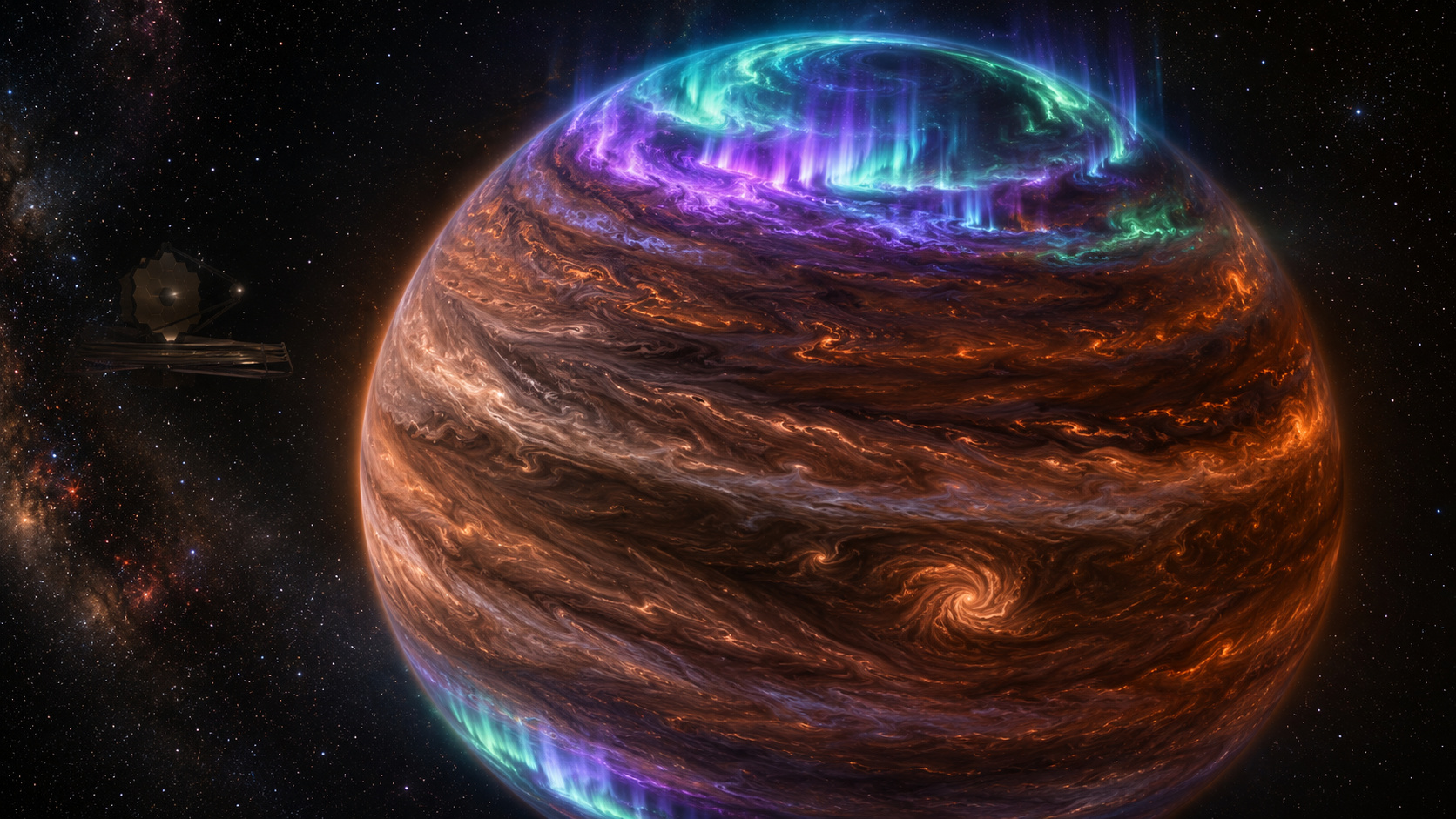


James Webb reveals extreme weather on SIMP 0136, a wandering world with silicate clouds, giant auroras, and 2.4-hour rotation.
The James Webb Space Telescope has begun to reveal one of the strangest worlds ever observed by modern astronomy. The object is called SIMP 0136, is about 20 light-years from Earth in the constellation Pisces, and does not orbit any star. It roams alone through the Milky Way while displaying extreme weather, clouds of superheated minerals, and auroras capable of altering the very thermal structure of the atmosphere.
Most impressively, the object completes a full rotation in just 2.4 hours, an absurd speed for a body with approximately 13 times the mass of Jupiter. This extremely rapid rotation allowed James Webb to observe atmospheric changes practically in real-time, revealing a wandering planet or possible brown dwarf with a much more complex climate dynamic than scientists imagined.
SIMP 0136 does not orbit any star and roams alone through space
SIMP 0136 belongs to a rare category of objects known as wandering worlds or free-floating planetary-mass objects.
-
Scientists Convert Food Waste into Aviation Fuel, Successfully Test 50% Blend with Conventional Kerosene to Cut Emissions and Promote Sustainable Flights

-
OnePlus N6 Smartphone to Launch in India with 8,000mAh Battery and 45W SuperVOOC Charging, Lasting Up to Three Days
-
Scientists Plan to Release Air Bubbles Underwater to Protect Antarctica’s “Doomsday Glacier” from Melting

-
Chinese R6000 Drone Combines Airplane and Helicopter Features, Carries Up to 12 People for Multiple Missions




Unlike Earth, Jupiter, or any planet in the Solar System, it does not orbit a star. This causes scientists to still debate its exact classification: it could be a gigantic planet ejected from a planetary system or an extremely small brown dwarf.
According to observational data, SIMP 0136 has about:
- 13 Jupiter masses
- approximately 1.2 Jupiter radii
- estimated age of about 200 million years
The object is relatively young on an astronomical scale and extremely bright in the infrared, which made it an ideal target for James Webb.
James Webb detected giant clouds made of sand-like minerals
The Webb’s infrared instruments revealed that the atmosphere of SIMP 0136 is dominated by multiple layers of extremely hot and irregular clouds. According to the published studies, the object possesses:
- silicate clouds
- clouds rich in evaporated iron
- atmospheric regions with variable chemical composition
- turbulent structures that change with rotation
The detected silicates are mineral compounds similar to the sand found on terrestrial beaches, but in a superheated environment that easily exceeds 1,500 °C.


Researchers even identified clouds of forsterite, a magnesium-rich mineral that typically only appears in extremely hot environments.
Rotation of just 2.4 hours creates extremely chaotic weather
One of the factors that most impressed researchers was the rotation speed. While Earth takes almost 24 hours to rotate on its own axis, SIMP 0136 completes a full turn in about 2.4 hours.
This extreme rotation produces rapid changes in brightness and temperature observed by Webb at different wavelengths.
Scientists discovered that:
- different atmospheric layers rotate in a complex manner
- the clouds constantly change
- hotter regions come into and out of view
- atmospheric chemistry varies throughout the rotation
According to the researchers, no single explanation can reproduce all the observed variability. The object’s weather seems to be simultaneously controlled by:
- clouds
- atmospheric waves
- thermal differences
- chemical processes
- giant auroras
Giant auroras may be heating the atmosphere of the wandering planet
Another surprising detail observed by Webb was the presence of strong signs of auroral activity. The auroras on SIMP 0136 seem to be so intense that they may be directly heating the object’s stratosphere.
Models published in 2025 indicate a possible thermal inversion of approximately 250 °C caused by the deposition of auroral energy in the upper layers of the atmosphere.
On Earth, the temperature normally decreases with altitude in part of the atmosphere. On SIMP 0136, Webb detected something different: upper regions warmer than areas below them.
Researchers believe that electrons accelerated by the object’s magnetic field are producing gigantic auroras capable of directly heating the upper atmosphere.
Atmosphere shows strange chemistry and carbon changes
The observations also revealed signs of chemical imbalance in the atmosphere. According to the studies, scientists detected variations associated with:
- methane
- carbon monoxide
- carbon dioxide
- hydrogen sulfide
Webb showed that different compounds appear in varying intensities depending on the observed region and the moment of rotation.
In some areas, methane seemed to decrease precisely in regions associated with auroral heating, suggesting extremely complex chemical processes happening simultaneously.
Wandering world became a natural laboratory to study extreme exoplanets
Although not officially classified as a traditional exoplanet, SIMP 0136 has become one of the best natural laboratories to study alien atmospheres.
Since the object does not have a nearby star interfering with observations, Webb was able to analyze atmospheric details with unusual precision.

Researchers state that studying SIMP 0136 helps prepare future direct imaging missions of giant exoplanets, including projects like the Nancy Grace Roman telescope.
In practice, the object functions as a preview of how distant gas giants in other stellar systems might be observed.
James Webb showed that alien atmospheres can be much more complex than previously imagined
For decades, many models treated the atmospheres of gas giants as relatively simple systems of clouds and temperature. SIMP 0136 destroyed this idea.
Webb revealed a world where:
- metallic and mineral clouds coexist
- auroras heat the atmosphere
- chemistry changes with rotation
- giant storms alter brightness and temperature
- multiple atmospheric layers interact simultaneously
The researchers themselves state that no single variable can explain the observed behavior.
The “starless planet” has become one of the strangest worlds ever seen by astronomy
SIMP 0136 has no sunrise, does not orbit any star, and wanders alone through the galaxy enveloped in overheated mineral clouds.
Even so, it exhibits dynamic weather, giant auroras, complex atmospheric chemistry, and weather patterns that resemble extreme versions of Jupiter and Saturn.
And perhaps this is the most unsettling aspect of the discovery: an object isolated in the interstellar void, without a star to illuminate it, has become one of the most complex climate laboratories ever observed by humanity.