Portuguese
  Spanish


On July 19, 2025, Premier Li Qiang inaugurated the works of the Motuo Project on the Yarlung Tsangpo River in Tibet — a Chinese dam that will cost US$167 billion and have 70 GW of capacity, three times more than Three Gorges, currently the world’s largest power plant. Operation expected in the 2030s.
The Chinese dam on the Yarlung Tsangpo River is the largest hydroelectric project ever attempted. According to the Brazil Journal and Exame, construction officially began in July 2025.
The Chinese dam on the Yarlung Tsangpo River will produce 300 billion kWh per year — equivalent to the total electricity consumption of the United Kingdom in 2024.
Therefore, the project surpasses everything ever built. Three Gorges, currently the world’s largest power plant, generates 22.5 GW and produces about 100 billion kWh per year.
-
Brazil Unveils Innovative Monitoring System to Prevent Abandonment of Public Works, Boosting Efficiency and Reducing Waste in Infrastructure Projects

-
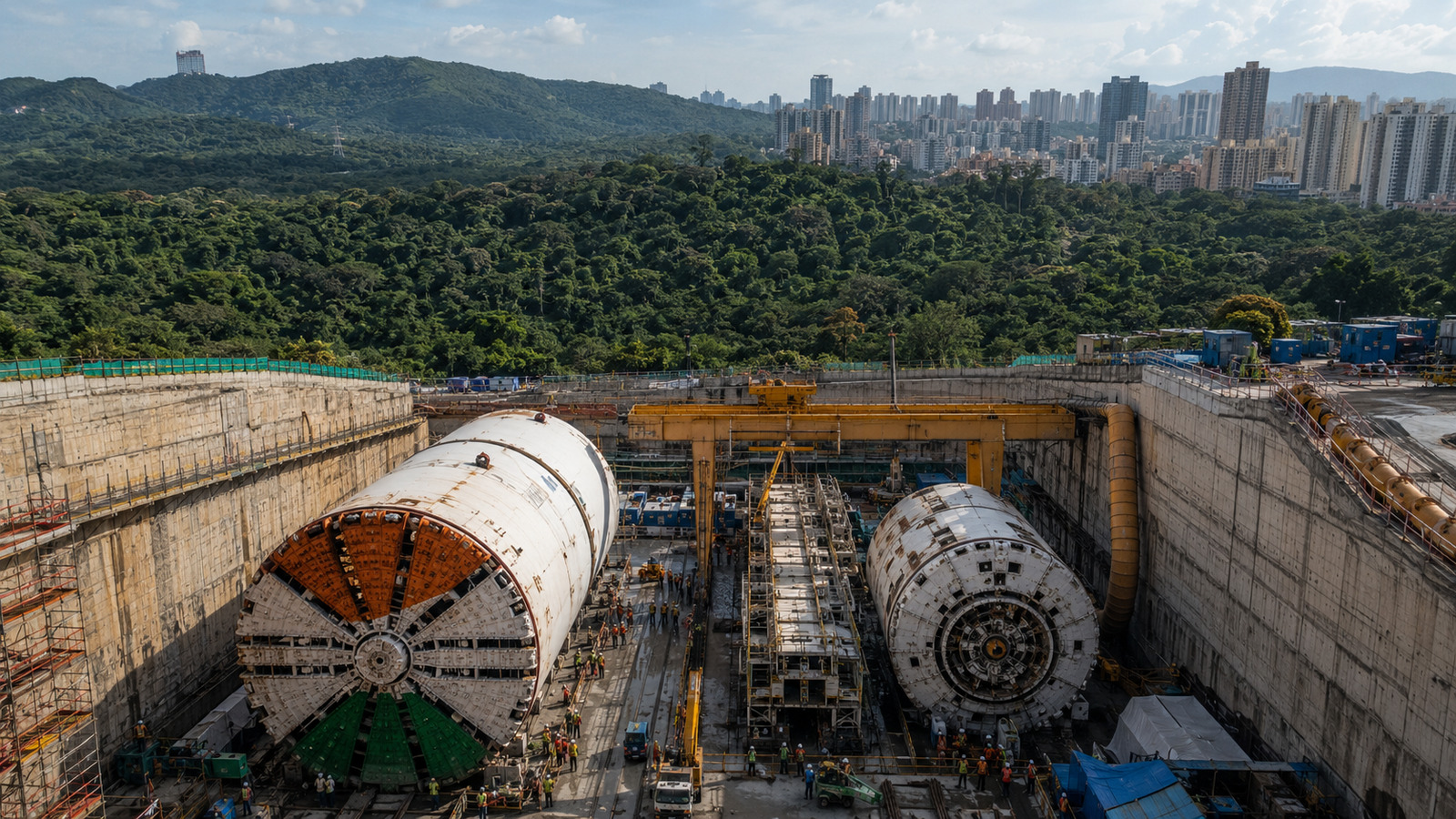
India Begins Drilling Massive Twin Tunnel Under National Park to Cut Mumbai Commute by 12 km and Save Up to 1 Hour

-
Detroit Microhouse Village Offers Former Homeless Residents Ownership After 7 Years: First 3 Tenants Receive Deeds

-
Brazilian Factory in Ivoti Produces 500 Modular Steel and Fiberglass Concrete Homes Following 2024 Floods, Securing $13 Million Contract



The Motuo Project will have 70 GW and will triple that number.
However, the colossal size brings proportional risks. The region is highly seismic, located on the Tibetan-Himalayan Plateau.
Furthermore, the project increases tensions with India and Bangladesh, countries that depend on the same river — the Brahmaputra — in its lower stretch.
Why the Yarlung Tsangpo River is unique in the world for a Chinese dam

The Yarlung Tsangpo is a river with unique characteristics.
With a length of 2,900 km, it originates in the Himalayas and drops 2,000 meters in just 50 km as it crosses the Great Yarlung Tsangpo Canyon — the deepest terrestrial canyon in the world.
This dizzying drop represents one of the planet’s greatest hydraulic potentials. According to Climainfo, no other river stretch in the world combines this elevation difference with this volume of water.
Therefore, five cascading power plants will harness every meter of this descent. The complex will form the Motuo Complex, supervised by China Yajiang Group, a state-owned company created exclusively to manage the project.
The Motuo Project numbers: what US$167 billion buys
The total cost of the project is US$167 billion — more than the United States invested to build the entire International Space Station (US$150 billion).
According to Brazil Journal, funding will come from state resources, with future energy revenues as a guarantee of return.
Furthermore, the scale of generation is difficult to imagine. The 300 billion kWh annually that the Motuo Project will produce is equivalent to:
- 3 times the annual production of Three Gorges (100 billion kWh/year)
- The total electricity consumption of the United Kingdom in one year
- About 70% of the total installed hydroelectric capacity in Brazil (~110 GW)
- Energy to power hundreds of millions of homes for decades
Similarly, the 70 GW capacity far exceeds that of Itaipu — Brazil’s largest, with 14 GW. Therefore, the Motuo Project will generate energy equivalent to 5 Itaipus operating simultaneously.
Three Gorges HAS ALREADY slowed down the Earth — what can Motuo do?

NASA confirmed that Three Gorges caused two measurable physical effects on the planet. The first: it slowed down the Earth’s rotation by 0.06 microseconds per day.
The second: it shifted the planet’s axis by 2 centimeters. This occurred because 40 billion tons of water were redistributed on the Earth’s surface.
In this sense, the Motuo Project is an unknown. With 3 times more capacity, the volume of dammed water will be proportionally larger.
However, researchers have not yet published confirmed models on the specific geophysical impact of the new complex.
Still, the precedent exists.
In comparison, the Motuo Complex will operate at an even higher altitude — Tibet is about 3,500 meters above sea level, which amplifies the gravitational effects of mass redistribution.
Tensions with India and environmental risks
The Yarlung Tsangpo turns into the Brahmaputra River upon entering India and Bangladesh.
According to Exame, India’s Ministry of External Affairs stated in January 2025 that the country “will monitor and take necessary measures to protect our interests”.
Furthermore, the region where the works are taking place is highly seismic. The Tibetan-Himalayan Plateau is one of the planet’s zones of greatest tectonic activity.
Consequently, tunnels excavated through mountains increase the risk of accidents on an unprecedented scale.
Similarly, the project threatens the ecosystem of the Great Yarlung Tsangpo Canyon, which is China’s largest nature reserve. Environmentalists warn of “irreversible damage” to the gorge, according to Climainfo.
On the other hand, China states that “the project will not have any negative impact downstream” and promises constant communication with India and Bangladesh. Independent verification of these guarantees has not yet been possible.
What the Motuo Project reveals about China’s energy strategy

The Motuo Project fits into a larger strategy: China has committed to carbon neutrality by