Portuguese
  Spanish


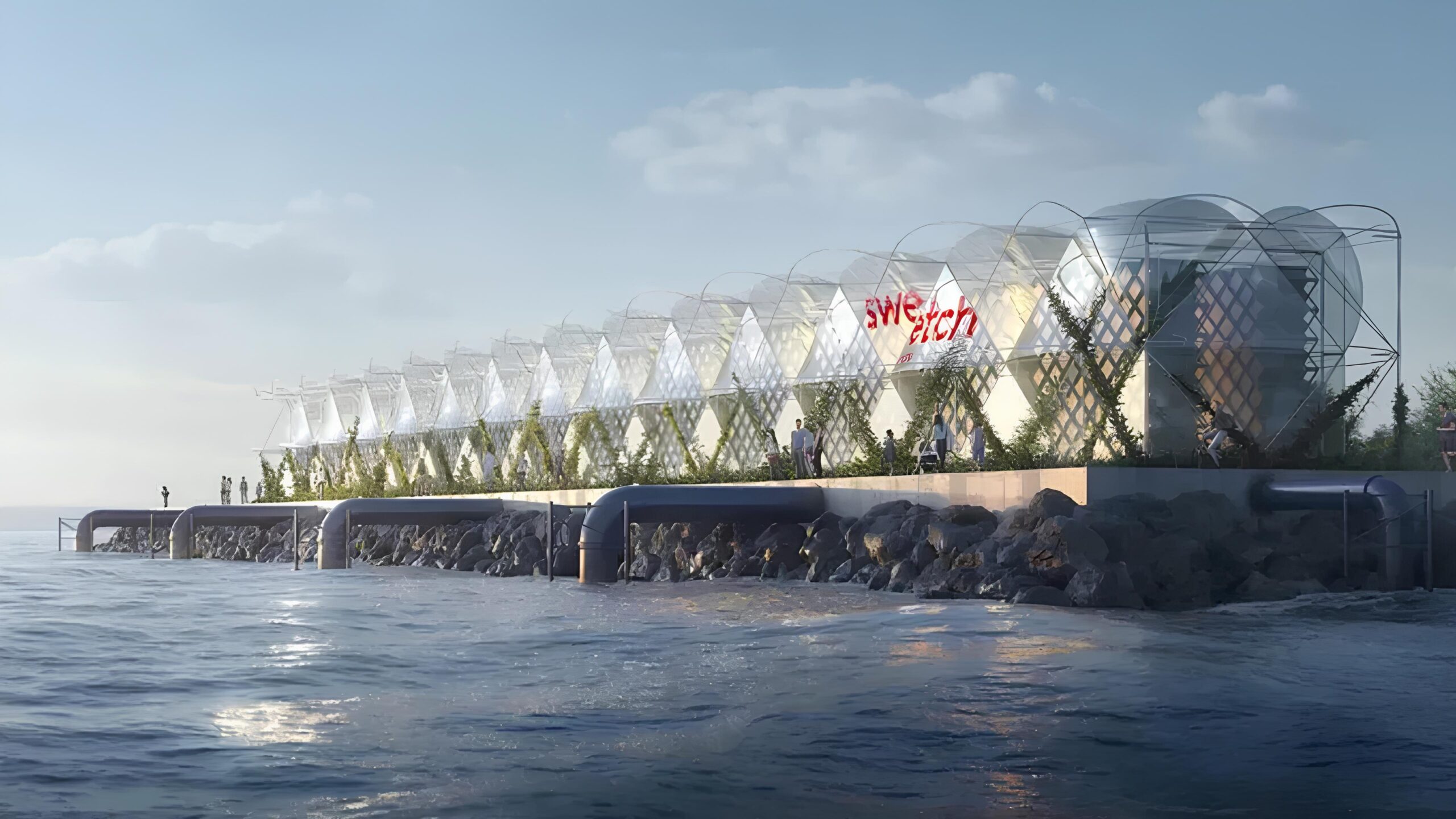

Osmotic technology uses fresh and saltwater to generate continuous electricity 24 hours a day without relying on sun or wind.
While the world competes for space to install solar panels and wind turbines, a French startup is betting on an almost invisible energy source little known outside scientific circles: electricity produced when rivers meet the ocean. The technology, called osmotic energy or “blue energy,” attempts to transform the natural salinity difference between fresh and saltwater into continuous energy generation.
The company behind the project is the French Sweetch Energy, which claims to have developed the first industrial technology capable of producing osmotic electricity on a large scale using nanotechnological membranes called INOD®. According to the company, the system can operate 24 hours a day, regardless of wind, sun, or weather conditions.
The technology attempts to capture energy released when rivers meet the sea
The principle behind osmotic energy has been known to science for decades, but only recently began to gain technological viability.
-
Brazilian scientists are simultaneously advancing two research projects on clean hydrogen and driving solutions that could transform the energy matrix, enhance industrial competitiveness, and accelerate large-scale emission reduction targets.

-
Advancement in renewable energy: A R$ 150 million project launched by Petrobras and Finep aims to create state-of-the-art electrolyzers for green hydrogen, strengthening national research and preparing Brazil to compete in a billion-dollar energy market.
-
Illiterate or semi-literate grandmothers were trained to repair solar systems, open rural workshops, and light up homes that still depended on kerosene.
-
The world has bet on green hydrogen as the fuel of the future, but now faces the side effect: producing 1 kilogram requires about 9 liters of ultrapure water, and the largest projects on the planet are precisely in the driest regions of the Earth, where water is already scarce for people.




When fresh and saltwater come into contact, a natural process called osmosis occurs, in which water molecules tend to cross membranes towards the saltier environment. This concentration difference creates a form of chemical energy known as salinity gradient.

According to Sweetch Energy, its technology uses extremely selective nanotechnological membranes to convert this ionic movement into electric current. The company claims that hundreds of these membranes are stacked inside modular osmotic generators to produce continuous electricity.
In practice, the plant takes advantage of something that already naturally occurs in estuaries, deltas, and river mouths in oceans.
System operates without solar panels, wind turbines, or giant dams
One of the most striking aspects of the technology is precisely the fact that it does not depend on the weather. While solar energy stops working at night and wind turbines depend on wind intensity, osmotic energy can operate continuously as long as there is a constant flow between fresh and saltwater.
Sweetch claims that:
- the system generates electricity continuously
- can be quickly modulated
- occupies relatively little space
- does not require large dams
- does not depend on combustion
- does not produce direct carbon emissions
This has transformed the technology into one of the emerging bets in the renewable energy sector.
France has already started real tests in the Rhône River delta
The technology is no longer just a laboratory theory. According to Sweetch Energy and energy sector publications, the demonstration installation called OPUS-1 began testing at the end of 2024 in the Rhône River delta, in southern France. The project is developed in partnership with the Compagnie Nationale du Rhône (CNR).


The idea of the demonstrator is to validate the technology’s operation under real conditions using fresh water from the Rhône meeting saltwater from the Mediterranean.
According to the World Economic Forum, if similar projects were expanded along the Rhône estuary, they could reach up to 500 megawatts of clean generation, enough to supply a population equivalent to the metropolitan area of Marseille.
Company claims that osmotic energy can supply up to 15% of global demand
The estimates released by the startup are ambitious. According to the company, deltas and estuaries around the world release nearly 30,000 TWh of potential osmotic energy annually, a volume higher than the current global electricity consumption.
Analyses cited by the World Economic Forum indicate that osmotic systems could theoretically reach close to 20% of the world’s electricity if the technology reaches industrial maturity.
Researchers claim that the great advantage lies in predictability:
- rivers keep flowing
- oceans remain salty
- generation does not depend on the time of day
- production does not fluctuate like wind or solar radiation
Nanotechnological membranes are the heart of the technology
The biggest historical obstacle of osmotic energy has always been the efficiency of the membranes. Previous attempts failed because the available membranes produced little energy and were costly.

Sweetch claims to have drastically increased efficiency using recent advances in:
- nanofluidics
- biomimetic materials
- nanotubes
- electrodes with high ionic selectivity
According to industry publications, the company claims its technology can be almost 20 times more efficient than previous osmotic projects.
Technology can also be used in desalination and water treatment
Osmotic energy is not only for traditional power grids. Sweetch claims the technology can also operate in:
- desalination plants
- water treatment stations
- isolated coastal communities
- islands
- industrial facilities
In regions where saltwater and freshwater naturally coexist, the system can transform desalination waste and water flows into continuous energy generation. This makes the proposal especially interesting for arid countries and coastal regions.
Scientists warn that environmental and economic challenges still exist
Despite the enthusiasm, the studies themselves highlight that the technology still faces significant obstacles.
Among the challenges cited are:
- cost of membranes
- need for industrial scale
- durability of materials
- ecological impact of brackish water discharge
- economic efficiency compared to solar and wind
Researchers also warn that artificial changes in salinity in aquatic environments need to be monitored to avoid impacts on river, mangrove, and coastal ecosystems.
In other words: the technology has not yet become a dominant solution, but it has already started to emerge from the laboratory.
Osmotic energy tries to become the next frontier of renewables
The most curious thing is that osmotic energy has existed in nature since forever. Every time a river meets the sea, a huge amount of chemical energy is naturally released and dissipated without human use.

Now, startups, researchers, and energy groups are trying to transform this invisible phenomenon into a new category of continuous electricity generation.
And perhaps that is precisely what makes the technology so impressive: while the world looks to the sky for wind and sun, part of the next energy revolution may be quietly happening at the meeting between rivers and oceans.