






 Portuguese
  Spanish
  5 min of reading
  0 comments


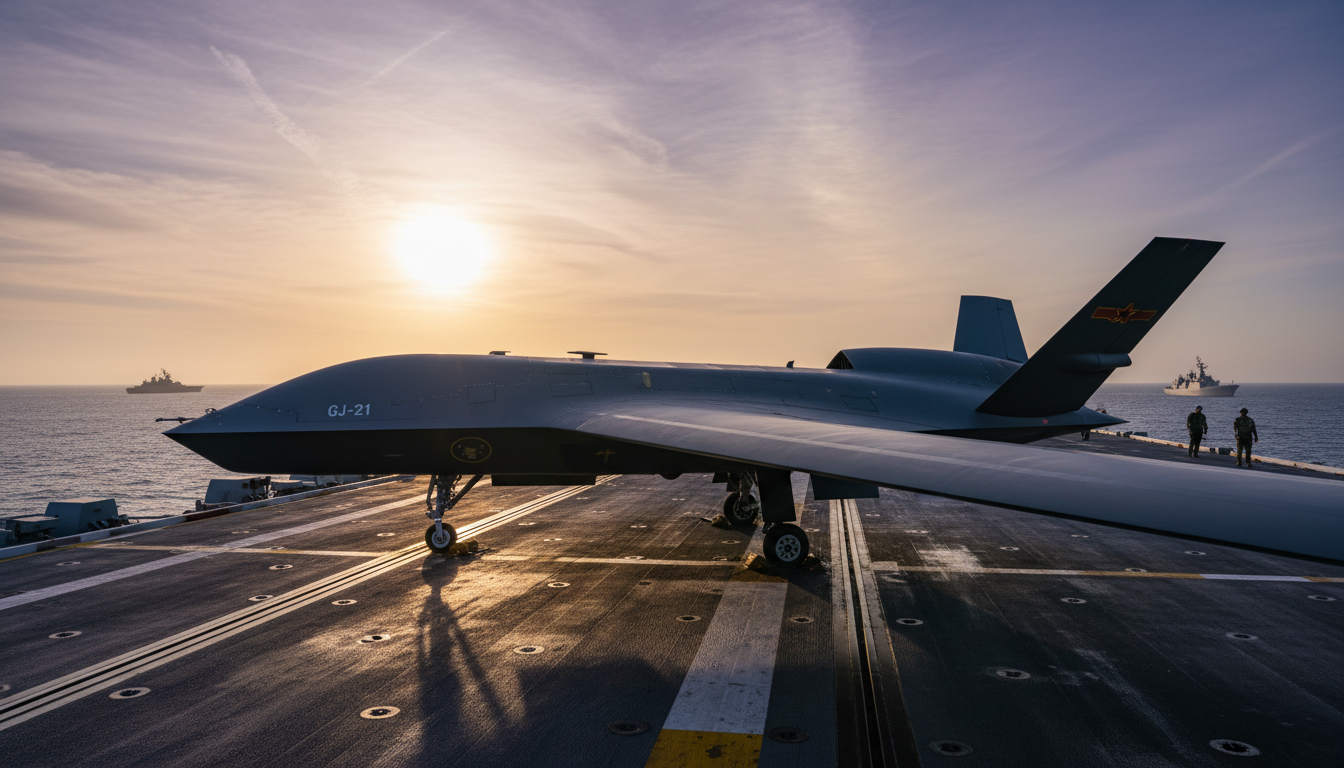
While the United States Navy has been operating the MQ-25 Stingray with an electromagnetic catapult since 2021, new images reveal the Chinese stealth drone GJ-21 for the first time with a naval launch bar on its landing gear.
According to The Aviationist, photographs released on April 30, 2026, indicate compatibility with the Chinese EMALS system.
In fact, China would be the second country in the world to operate a stealth UCAV from a naval catapult. Only the United States has had this capability since 2021.
-
The military spaceplane that almost took the Cold War into orbit: Boeing X-20 Dyna-Soar was designed to re-enter above Mach 20, fly for up to 40 hours, land like a plane, and transform Titan rockets into a gateway to a new era of orbital warfare.

-
FAB bets on national drones and increases investments to strengthen the Brazilian aerospace industry

-
Six times, a luminous crescent the size of the Moon startled the Soviet sky at dusk: it seemed like a wave of UFOs, but it was a secret orbital weapon created to attack the United States via the South Pole and evade Cold War radars.

-
The United States government approved a potential sale of 100 portable Stinger anti-aircraft missiles to the Brazilian Army, in a package estimated at around 330 million dollars that still depends on negotiations between the two countries.





The aircraft is the navalized evolution of the GJ-11 Sharp Sword, a stealth combat drone developed by AVIC. The original version was operated only from land-based runways.
Indeed, the “Sharp Sword” first flew in 2013. It entered limited operational service in 2017, according to analyses from the Asian defense sector.
This naval version represents almost a decade of adaptation work. Every component had to be resized to withstand aircraft carrier landings and takeoffs.
What changed to become a naval stealth drone with a catapult
The major technical innovation is the launch bar integrated into the front wheel. This component engages with the EMALS shuttle and transmits acceleration to the aircraft during its run on the deck.
Additionally, the reinforced landing gear must absorb the impact of tailhook-assisted landings. Aircraft carrier operations impose structural loads far greater than conventional runways.
For this reason, the aircraft’s central structure also receives reinforcements. Naval requirements change the entire weight and resistance equation.
- Stealth flying wing — GJ-11 family geometry, radar cross-section reduction
- EMALS catapult — launch bar visible in images from April 30, 2026
- Type 003 Fujian compatibility — aircraft carrier already equipped with EMALS
- Type 076 Sichuan compatibility — amphibious assault ship with up to 19 units
- Joint operation with J-15T and J-35 — embarked manned fighters
According to analysis by Defence Security Asia, integration with EMALS places China in an exclusive club.
Currently, only the United States operates stealth UCAVs from naval catapults. The MQ-25 Stingray entered service in 2021 aboard the USS George H.W. Bush.
Type 076 Sichuan: the ship that can embark the GJ-21 stealth drone
Images from January 2026 already showed a mockup of the drone on the deck of the Type 076 Sichuan, China’s new amphibious assault ship.

According to analysis by Defence Security Asia, the Type 076 reinforces its role as a drone-centric warship.
Indeed, the Type 076 is the world’s first amphibious assault ship equipped with an electromagnetic catapult. This unprecedented combination expands the range of embarkable aircraft.
Therefore, the ship can operate drones, helicopters, and potentially light fighters. No comparable American LHD does this today.
As a result, the Chinese fleet gains tactical flexibility that was previously exclusive to nuclear supercarriers. This changes the naval balance calculation in the Pacific.
Combined operation with Fujian, J-15T, and J-35
In April 2026, social media analysts reported that the aircraft had operated alongside fighters from the Fujian aircraft carrier.
This would be the first record of the drone’s operational use with manned fighters in a real naval environment.
According to a report by Zona Militar, the aircraft reportedly flew in conjunction with J-15T and J-35.
As a result, China would be testing the concept of manned-unmanned cooperative combat in a naval environment. This is the same doctrine pursued by the US with the MQ-25 and the future F-47.
Likewise, sea trials of the Type 076 Sichuan have been progressing since December 2025. Integration has matured at an accelerated pace.
The Chinese GJ-21 stealth drone program in the context of the AVIC family
The GJ-21 is just the most visible face of a rapidly expanding family. There are the GJ-11, the WZ-7 Soaring Dragon, and the CH-7 — each with a distinct mission.
According to the South China Morning Post, sea trials with the Type 076 Sichuan are reportedly at an advanced stage.
On the other hand, the Chinese navy has been investing in the automation of offshore operations. As reported by the coverage on Chinese hybrid drones, the pace of adoption is intense.
Long-range drones allow for the patrolling of submarine pipelines and energy assets. Thus, the technology has dual applications — military and critical infrastructure protection.
The GJ-21 and the naval balance in the Indo-Pacific
The entry of the aircraft into service accelerates strategic competition in the Indo-Pacific. The region concentrates 30% of global maritime trade in oil and natural gas.
According to military analysts, the pace of Chinese testing has exceeded Western expectations in the last 18 months. Beijing’s naval air doctrine has changed.
For this reason, programs such as the WZ-7 Soaring Dragon and the stealth CH-7 entered production in parallel. Each responds to a distinct mission — patrol, attack, reconnaissance.
Likewise, Western military equipment suppliers are already reporting increasing orders from Asian allies. Japan, the Philippines, and South Korea revised defense budgets in 2025 and 2026.

According to Interesting Engineering, the Chinese advance puts pressure on the American fleet in the Western Pacific.
As a result, military hull insurance premiums in the region have been rising since 2024. The final costs are passed on to the freight of oil and gas tankers operating on Asian routes.
Therefore, the impact goes beyond pure defense — it affects energy supply chains linked to Brazil, which imports LNG via Pacific routes.
Caveats — what has not yet been confirmed
However, China has not disclosed the number of units in production, confirmed operational range, or armament capacity. All estimates come from image analysis and Western sources.
Nevertheless, experts from The Aviationist warn that the presence of the catapult bar does not mean immediate combat operation.
However, catapult tests without an embarked aircraft have already been observed since 2025. The actual launch of the aircraft from the deck will be the next milestone to confirm.






Be the first to react!