






 Portuguese
  Spanish


Brazil has developed the country’s first military drone equipped with a 100% national jet turbine. The Albatroz Vortex, created in partnership between the Brazilian Air Force, Stella Tecnologia, and AERO CONCEPTS, has a flight autonomy of 24 hours and the capacity to carry up to 150 kilograms of payload. According to information published by Revista Fórum, the ATJR15-5 turbine, manufactured in São José dos Campos, generates 500 Newtons of thrust and places Brazil alongside the United States, United Kingdom, France, Israel, and China in the group of nations capable of producing jet engines for military drones.
Brazil has just achieved a technological capability that only a handful of countries in the world possess: manufacturing a national jet turbine for military drones. The Albatroz Vortex is the country’s first unmanned aerial system to fly with propulsion entirely developed and produced in Brazilian territory, resulting from a partnership between the Brazilian Air Force, Stella Tecnologia, and AERO CONCEPTS, with financial support from Finep and technical contributions from the Institute of Aeronautics and Space. The drone operates with 24-hour autonomy, carries up to 150 kilograms of payload, and lands on runways less than 150 meters long, including aircraft carrier decks of the Navy.
The first test of the technology was conducted in 2025 to validate the integration between the platform developed by Stella Tecnologia and the ATJR15-5 turbine from AERO CONCEPTS. The turbine, manufactured at the company’s headquarters in São José dos Campos, generates around 500 Newtons of thrust and is part of a family of engines in development for use in drones, missiles, and small aeronautical systems. For a country that historically depended on foreign suppliers for strategic systems, mastering this manufacturing technology is a milestone for the autonomy of the Armed Forces.
What the Albatroz Vortex does and where the drones will operate

image: fab
The Albatroz Vortex will be used in intelligence, surveillance, and reconnaissance missions by the Brazilian Army. The drones will also assist in the Navy’s embarked operations for monitoring maritime borders and coastal area infrastructure, operating from aircraft carriers that function as floating air bases.
-
A fossil kept for years in a small museum in Montreal concealed 450-million-year-old soft tissue, a discovery that has only happened once before in history.

-
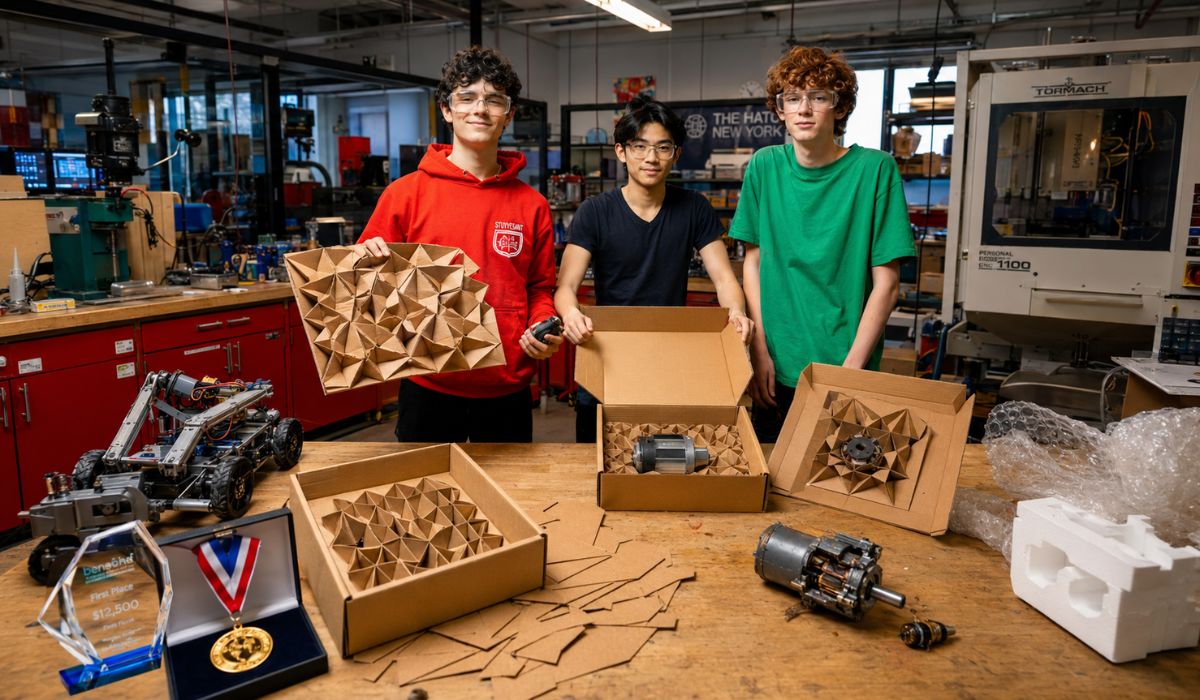
Three teenagers transform cut cardboard into Japanese origami-style packaging that promises to retire styrofoam and bubble wrap, win a $12,500 prize, and target giants like Amazon, FedEx, and Home Depot after a robot motor arrived broken.

-
The large jar blender has a rival: Oster Ultra Power bets on 1,000 W, six stainless steel blades, and two portable cups with leak-proof lids.

-
Tesla injected an additional $250 million into the German factory, doubled the battery cell target, and opened its own production line for startups.



The versatility of the drones lies in the combination of extended autonomy with significant payload capacity. With 24 hours of continuous flight, the Albatroz Vortex can cover vast stretches of land and maritime borders without refueling, carrying sensors, cameras, and communication equipment weighing up to 150 kilograms. Operation on short runways of less than 150 meters allows the drones to take off and land in remote locations of the Amazon or in advanced bases without conventional airport infrastructure.
The turbine that changes the technological level of Brazilian drones
The development of aeronautical turbines requires highly resistant metal superalloys, capable of operating under extreme temperatures, in addition to mastering FADEC control, a computerized system that automatically manages fuel, ignition, and engine protection. AERO CONCEPTS mastered these technologies and plans to build, in the medium term, a national chain of aeronautical turbines with critical components manufactured in Brazil.
Until now, Brazilian monitoring drones depended on imported components, especially turbines and navigation systems. This dependency created strategic vulnerabilities: in scenarios of sanctions or trade restrictions, supply could be interrupted without notice. The ATJR15-5 turbine eliminates this vulnerability for the category of drones where it will be employed, ensuring that Brazil can produce, maintain, and evolve its systems without relying on foreign authorizations.
Drones in the FAB modernization strategy
The project is part of the “Air Force 100” strategy, which establishes the modernization axes of the FAB until 2041. Among the objectives are the development of autonomous aerospace systems and the expansion of Brazilian scientific capacity in partnership with universities, research centers, and private companies in the defense sector.
One of the most strategic projects in this context is the Aerospace Industrial and Technological Park of Bahia, a cooperation between the Ministry of Defense, the state government, and SENAI CIMATEC, focused on research on drones, artificial intelligence, quantum computing, and advanced aerospace systems. The Aeronautics Institute of Technology will also receive a new campus at the Fortaleza Air Base to train aeronautical engineers capable of working on the development of drones and defense systems.
What is needed for drones to enter production
The Albatroz Vortex needs to be transformed from a technological demonstrator into a consolidated operational platform. Certification tests will be conducted to ensure that the drones can be produced on an industrial scale, focusing on the validation of engines, sensors, and embedded electronic components under real military operation conditions.
The Center for Strategic and International Studies highlights that drones have come to play a fundamental role in modern warfare by replacing manned monitoring with low-cost, real-time surveillance systems capable of operating for 24 hours or more.
For Brazil, with more than 16,000 kilometers of land borders and an equally extensive Atlantic coast, the ability to produce 24-hour autonomy drones with its own technology is not just a military issue, but a matter of technological sovereignty that the Brazilian Air Force classifies as a priority within the Air Force 100 strategy.
Did you know that Brazil now manufactures a national jet turbine for military drones? Do you think the Albatroz Vortex puts the country on a different defense level, or is there still a long way to go to compete with the USA and China? Share your thoughts in the comments.


This brightened my whole week