Portuguese
  Spanish


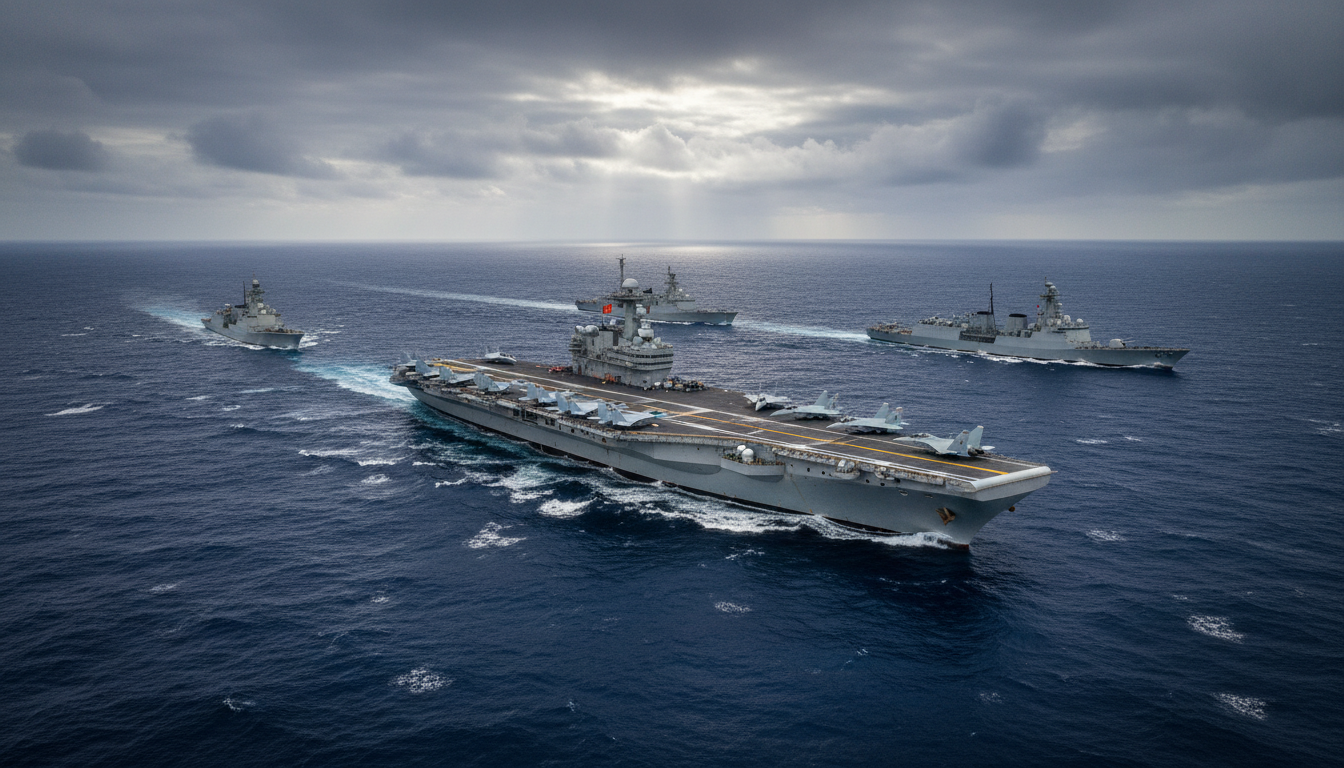

The aircraft carrier Fujian was incorporated into the Chinese Navy in a ceremony presided over by Xi Jinping, it is 316 meters long, has three electromagnetic catapults and capacity for more than 50 aircraft, including fifth-generation stealth fighters
On November 7, 2025, President Xi Jinping presided over the ceremony that officially incorporated the aircraft carrier Fujian into the People’s Liberation Army Navy of China. With 80,000 tons of displacement and 316 meters in length, the ship entered the supercarrier category.
The Fujian is the third Chinese aircraft carrier and the first designed entirely in China. Its predecessors, the Liaoning and the Shandong, used ski-jump ramps to launch aircraft. The Fujian abandoned this system.
Instead of ramps, China installed three electromagnetic catapults known as EMALS. This technology allows heavier fighters to be launched, with full fuel tanks and maximum weapon loads.
-
U.S. Military Intervention Risk in Brazil Raises Alarm, Highlights National Sovereignty Amid Tensions Over Washington’s Terrorist Designation of PCC and Comando Vermelho

-
Brazilian Air Force’s Sole KC-30 Aircraft Completes Strategic Mission to Spain for 105mm Anti-Tank Ammunition for Leopard 1A5 Tanks

-
Brazilian Air Force Seeks to Acquire More Gripen Fighter Jets
-
U.S. Air Force Launches Air-to-Air Missile Project with Range of Up to 1,850 km for Indo-Pacific Operations




According to Força Aérea, the aircraft carrier Fujian represents a new era for Chinese naval aviation.
Fujian aircraft carrier’s electromagnetic catapults surpass American launch rate
The Fujian’s three EMALS catapults can perform 12.5 aircraft launches per hour. This number exceeds the average of 10 launches per hour of American Ford-class aircraft carriers.
This difference may seem small, but in combat operations it represents 25% more aerial sorties in the same period. More aircraft in the air mean more projection power.
The Fujian is only the second aircraft carrier in the world to use electromagnetic catapults. The first was the USS Gerald R. Ford, commissioned in 2017 by the United States Navy.

Unlike the steam catapults used for decades on American ships, EMALS cause less stress on aircraft, occupy less space, and require less maintenance.
Pentagon reports cited by Opera Mundi indicate that the Chinese version of EMALS has demonstrated superior reliability to the American one. This assessment worries US military analysts.
The Fujian’s air wing can accommodate more than 50 aircraft. Among them are J-35 fighters, which feature stealth technology, J-15T heavy combat aircraft, J-15D electronic warfare aircraft, and the KJ-600 early warning aircraft.
Aircraft carrier Fujian versus USS Gerald Ford: how China compares to the world’s greatest naval power
The Fujian weighs between 80,000 and 85,000 tons. The USS Gerald R. Ford reaches 100,000 tons. The difference exists because the American ship uses nuclear propulsion, while the Chinese one operates with conventional steam turbines.
In length, the Fujian measures 316 meters against the Ford’s 337 meters. In width, both are similar: 76 meters for the Chinese.

The Ford carries 75 aircraft against the Fujian’s 50, but the Chinese launches more fighters per hour. While the American fleet has 4 EMALS catapults, the Fujian operates with 3.
The Fujian’s crew consists of 2,500 members. The ship reaches a maximum speed of between 29 and 31 knots, propelled by engines with a total power of 280,000 horsepower.
Other warships that China has built in recent years include giant 400-meter cargo ships, consolidating the country’s position as the largest naval construction power on the planet.
The name Fujian is no coincidence: the province is on the other side of the Taiwan Strait
The Chinese government named the aircraft carrier after Fujian province. This choice carries symbolic weight. Fujian province is located exactly on the other side of the Taiwan Strait.
Construction of the ship began in 2018 at the Jiangnan Shipyard, a subsidiary of China State Shipbuilding Corporation. The assembly of the main hull blocks occurred in mid-2020.
The official launch took place on June 17, 2022. The first sea trials occurred in May 2024, in the Yangtze River estuary.

With full operational capability expected by 2026, the Fujian alters the balance of forces in the Indo-Pacific. China will have an aircraft carrier capable of operating far from its coasts, projecting power in disputed waters.
According to Global Military, the ship features Type 1130 CIWS defense systems and HQ-10 surface-to-air missiles for close protection.
As reported by BE Horizon, the Fujian represents “a new era for Chinese naval aviation,” with the ability to operate a diversified air wing that includes light drones launched by electromagnetic catapults.
The USS Gerald Ford recently faced a fire in the Red Sea that left injuries and exposed operational vulnerabilities. Meanwhile, the Fujian advances without public incidents.
However, it is important to note that the Fujian’s conventional propulsion limits its autonomy compared to nuclear-powered ships like the Ford. Furthermore, the full capability dates are projections — actual combat tests have not yet occurred, and the capacity of 50 aircraft is an estimate that may vary in practice.
The aircraft carrier Fujian transforms China from a coastal naval power into a force capable of operating in distant oceans. For the coming years, analysts expect the ship to conduct training in distant waters, validating its operational capability and consolidating China’s position as the second largest navy in the world.