Portuguese
  Spanish


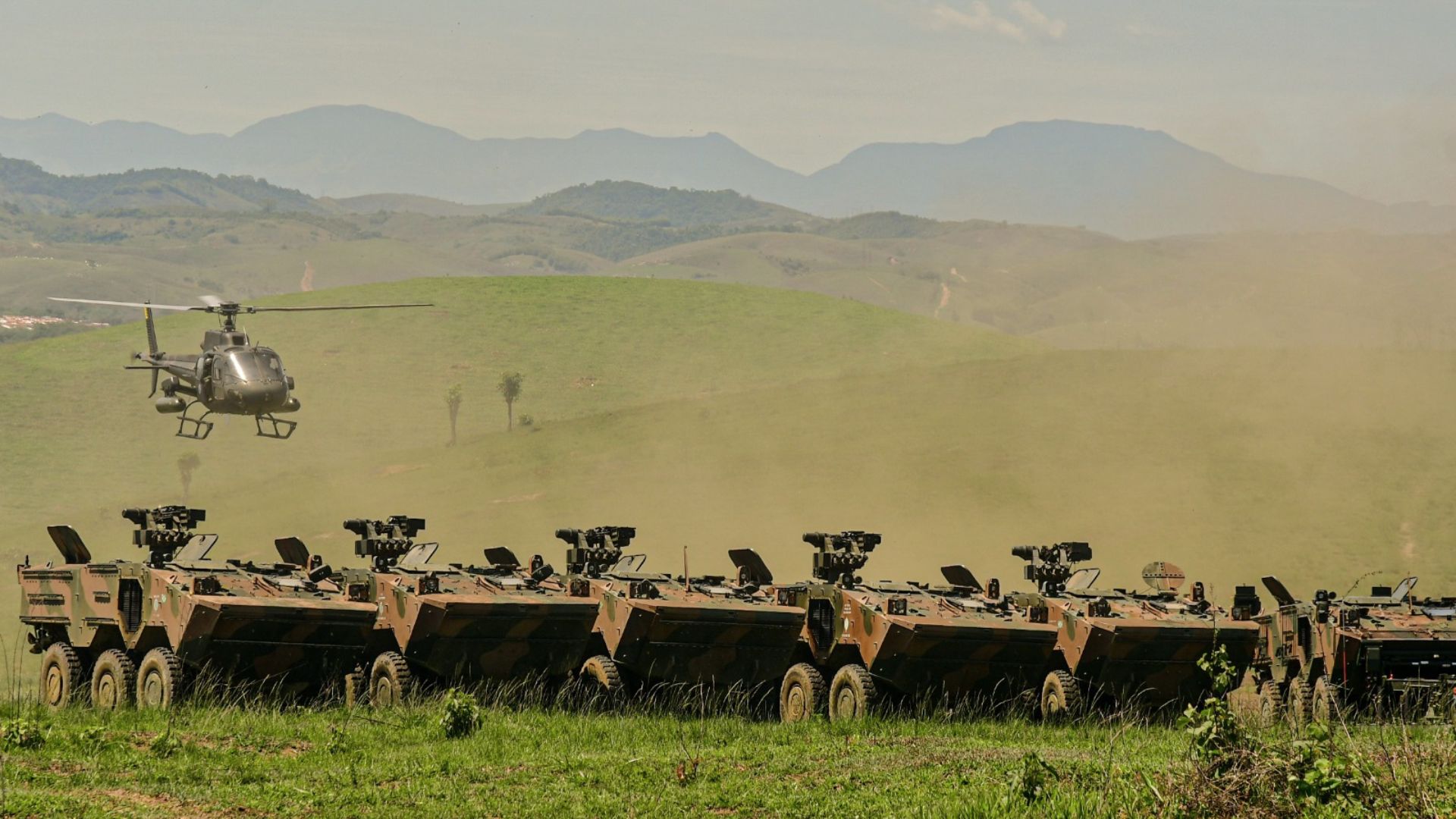

New Brazilian Army program bets on advanced military technology, multi-domain integration, artificial intelligence, and strategic reorganization to prepare the country for hybrid threats and 21st-century conflicts
The Brazilian Army has taken a decisive step towards the future of national defense by officially presenting the Force 40 program, a comprehensive military transformation strategy that aims to prepare the Land Force for the geopolitical, technological, and operational challenges expected by the year 2040. The information was released following the approval of the Brazilian Army Transformation Policy (EB10-P-01.031), formalized by Ordinance C Ex nº 2.662, dated April 9, 2026.
According to information released by the Brazilian Army (EB) itself, Force 40 is not just an update of military equipment. The project emerges as a profound structural overhaul, involving doctrine, technology, personnel, military intelligence, and new ways of operating on the modern battlefield.
The initiative comes at a time of rapid changes in the international scenario. Currently, hybrid wars, cyberattacks, disinformation campaigns, and electronic operations have become part of the dynamics of contemporary conflicts. In this sense, the Brazilian Army seeks to adapt its structure to operate in increasingly complex, hyperconnected environments marked by the integration of different operational domains.
-
U.S. Military Intervention Risk in Brazil Raises Alarm, Highlights National Sovereignty Amid Tensions Over Washington’s Terrorist Designation of PCC and Comando Vermelho

-
Brazilian Air Force’s Sole KC-30 Aircraft Completes Strategic Mission to Spain for 105mm Anti-Tank Ammunition for Leopard 1A5 Tanks

-
Brazilian Air Force Seeks to Acquire More Gripen Fighter Jets
-
U.S. Air Force Launches Air-to-Air Missile Project with Range of Up to 1,850 km for Indo-Pacific Operations




Modern warfare and artificial intelligence change the concept of national defense
As published by the Brazilian Army, the concept of Force 40 arises from the need to face a new model of warfare, in which traditional combat is no longer the only strategic focus. The modern operational environment involves hybrid threats that combine conventional military actions with digital operations, electronic warfare, artificial intelligence, and informational attacks.
Furthermore, the program foresees integrated action in the so-called multi-domain environments. This means that military operations will simultaneously consider terrestrial, aerial, maritime, space, and electromagnetic-cyber-cognitive scenarios.
Another central point of the transformation involves the massive use of autonomous and unmanned systems. Military drones, intelligent sensors, autonomous vehicles, and platforms connected by artificial intelligence will play a strategic role within the operational structure of the Land Force.
According to the document presented by the Army General Staff (EME), technological advancement has made the battlefield more transparent, fast, and lethal. In this new scenario, information superiority and the ability to make quick decisions become decisive factors for operational success.
Therefore, Force 40 prioritizes military capabilities focused on protection, sustainment, rapid response, informational superiority, and advanced command and control. The goal is to ensure that Brazil is prepared to respond quickly to modern threats and crisis situations.
Transformation Policy defines the four pillars of Force 40
The backbone of the project was structured around four major strategic axes defined by the Transformation Policy of the Brazilian Army.
The first of these is the so-called Institutional Design. In this model, the Army intends to reorganize its troops to increase strategic mobility, interoperability, and operational modularity. The new structure envisions troops highly connected by intelligent command and control systems.
Within this reorganization, different operational employment groups were created:
• Immediate Employment Forces (FEI): responsible for rapid responses in strategic regions, especially near borders and areas of potential crisis.
• Readiness Employment Forces (FEP): units prepared to operate in any region of the national territory with high offensive power.
• Continued Employment Forces (FEC): intended for prolonged territorial defense, strategic presence, and formation of mobilizable reserves.
• Multidomain Employment Forces: units specialized in integrated operations in various modern operational environments.
• Expanded Support Modules: structures aimed at logistical and operational support of the Land Component Force (FTC).
The second axis is Capabilities, which foresees the accelerated incorporation of emerging technologies and disruptive systems. The goal is to ensure operational advantage in the face of new global threats.
The third axis involves Military Doctrine. According to the Army, there will be an acceleration in the processes of experimentation and doctrinal adaptation, allowing new military capabilities to be incorporated more quickly and efficiently.
Finally, the Personnel axis places the human factor as a strategic priority. The program foresees strengthening military leadership, advanced technological training, and development of decision-making autonomy at lower echelons.
Strategic programs and defense industry will be fundamental for the new phase of the Army
The Operational Concept of the Brazilian Army (COEB – 2nd edition) also began to guide the Institution’s strategic priorities. Among the capabilities considered most important for the coming years are:
• Information Superiority
• Protection
• Rapid Response
• Command and Control
• Engagement
• Sustainment
• Power Projection
• Support to State Actions
According to the Army General Staff, the Strategic Programs of the Brazilian Army Portfolio will be the main instruments responsible for the practical implementation of Force 40.
Furthermore, the Defense Industrial Base (BID) will have an essential role in this process. The Army intends to expand integration with the national industry to stimulate the development of dual-use technologies — those that can be used in both the military and civil sectors.
In practice, this means encouraging national technological innovation, strengthening Brazilian strategic autonomy, and stimulating the economy linked to the defense sector.
Meanwhile, the Army General Staff is working on the development of the Brazilian Army Transformation Strategy, a document that should detail the next stages of implementing Force 40.
The expectation is that the program will function as a true passport to the future of national defense, placing Brazil in a more prepared position in the face of 21st-century threats.
Sustained by technological innovation, operational integration, and troops in permanent readiness, Force 40 emerges as the desired final state for the Brazilian Land Force by 2040. The proposal is to ensure deterrence capability, strategic presence, and protection of national sovereignty in the face of an increasingly unstable and technologically advanced international environment.
Original news source: Exército Brasileiro (EB)