






 Portuguese
  Spanish
  4 min of reading
  0 comments


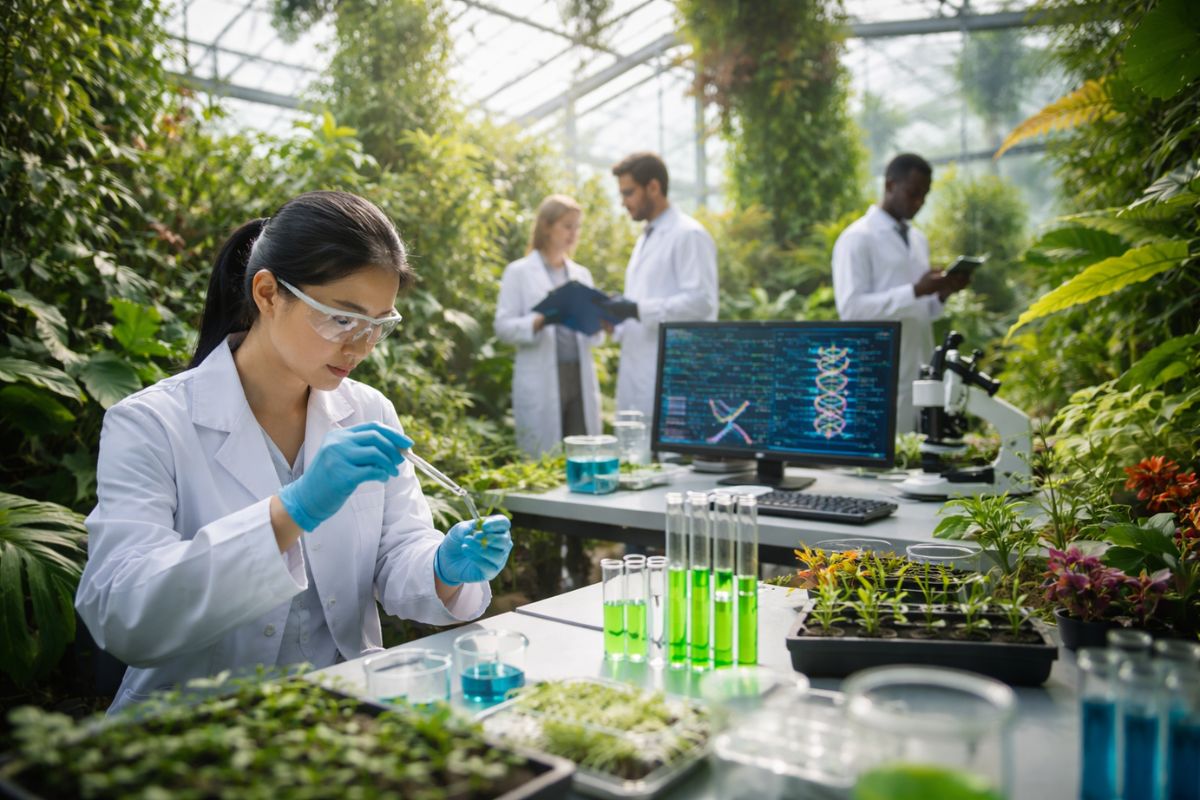
In The City Of Beijing, Chinese Scientists Launched The PLANeT With More Than 40 Institutions From 15 Countries And Regions To Map Genomes Of Terrestrial Plants, Seek Food Security And Accelerate Conservation, Catching The Attention Of Science Worldwide.
The announcement took place in Beijing and caught attention because it deals with something that almost no one sees, but everyone feels in their pocket and on their plate: plants.
They want to read the “instruction manual” that exists within plants, the DNA, and organize it into a great tree of plant life.
The contrast is what holds the attention. Even with so much technology, there is still a lack of a good map for almost everything that grows on land.
-
FBI builds secret city with hospital, market, station, and data center to simulate hacker attacks capable of disrupting essential services

-
More than 100 scientists warn of a new era of persistent droughts in India, China, the United States, the Mediterranean, and parts of Africa, with rivers under stress and the risk of continuous water shortages.
-
Solar buoys with ultrasound arrive at the Tietê River to try to curb the advance of algae, monitor water quality, and protect areas used by tourists, fishermen, and residents.
-
3D printers become a business in the hands of two students from Manaus and reveal early talent for entrepreneurship



What Happened In Beijing And Why The PLANeT Became A Thing
Chinese scientists announced the PLANeT as a large-scale international project. The goal is to decipher the genetic heritage of the main lineages of terrestrial plants.
This stood out because, when we better understand how plants work internally, it becomes easier to protect fragile species and also improve agricultural crops.
What seemed impossible here is the amount of things that have not yet been done. And that is precisely what the PLANeT aims to tackle.
Who Is Behind It And Why 15 Countries Joined Forces Together
The project is led by the Shenzhen Agricultural Genomics Institute, affiliated with the Chinese Academy of Agricultural Sciences. It works alongside the Botanical Society of China, Peking University, and an international network.
The number is impressive: more than 40 institutions from 15 countries and regions. There are enough people to divide the work, standardize methods, and accelerate results.
When a project brings together so many people, the signal is clear. It was not designed to be small or to remain confined to a single laboratory.
The Plan In Practice, Mapping Plant Families That Have Not Yet Appeared In Databases
The proposal provides for the systematic sequencing of orders and families of plants that are still absent from genomic databases. In other words, they want to map what is still in the dark.
Why does this matter? Because, without a high-quality reference genome, comparing species becomes a puzzle with missing pieces.
With more good references, scientists can connect dots that are currently left hanging. And this can change the way we understand the history and potential of plants.
The Numbers That Show The Size Of The Gap, 99%, 450 Thousand Species And 470 Million Years
According to the coordinators, more than 99% of the approximately 450 thousand estimated species of terrestrial plants still lack high-quality reference genomes. It’s almost everything.
And there is another detail of scale. The PLANeT aims to clarify evolutionary relationships among the main plant groups over the past 470 million years.
It’s like trying to piece together the family tree of all the flora on Earth, with little reliable documentation. The project aims to create this documentation.
Artificial Intelligence And Patterns In DNA, The Shortcut To Find What Repeats In Plants
The PLANeT intends to use phylogenomic methods and artificial intelligence algorithms to identify conserved patterns in DNA. In simple terms, it wants to find pieces of DNA that repeat similarly among plants and use this to understand relationships and functions.
This is noteworthy because it accelerates the work. Instead of relying solely on slow manual comparison, the analysis can be expanded with tools that recognize patterns in large volumes of data.
If important patterns are found, what currently seems unknown could become practical clues for conservation and agriculture.
The Impact That Matters Outside The Laboratory: Conservation And Food On The Table
Researchers highlight two applications that make a difference in the real world. The first is to help identify vulnerable species using genomic indicators, which can support conservation policies.
The second is related to food security. The analysis of genes associated with resistance to diseases, drought, and salinity can contribute to developing agricultural crops more resilient to climate change.
The impact can be significant because it is related to risk. Increased resistance in the field tends to reduce losses, especially when the climate becomes harsh and pests change behavior.
In the end, the PLANeT draws attention because it attempts to close a massive gap on an international scale, using DNA data and artificial intelligence to understand plants internally and transform this into more resilient conservation and agriculture.
Now it’s worth asking: what surprises you the most? The size of the gap, with more than 99% of species lacking quality references, the union of 15 countries and more than 40 institutions, or the focus on genes linked to drought and salinity?







-

-

-

5 people reacted to this.