Portuguese
  Spanish


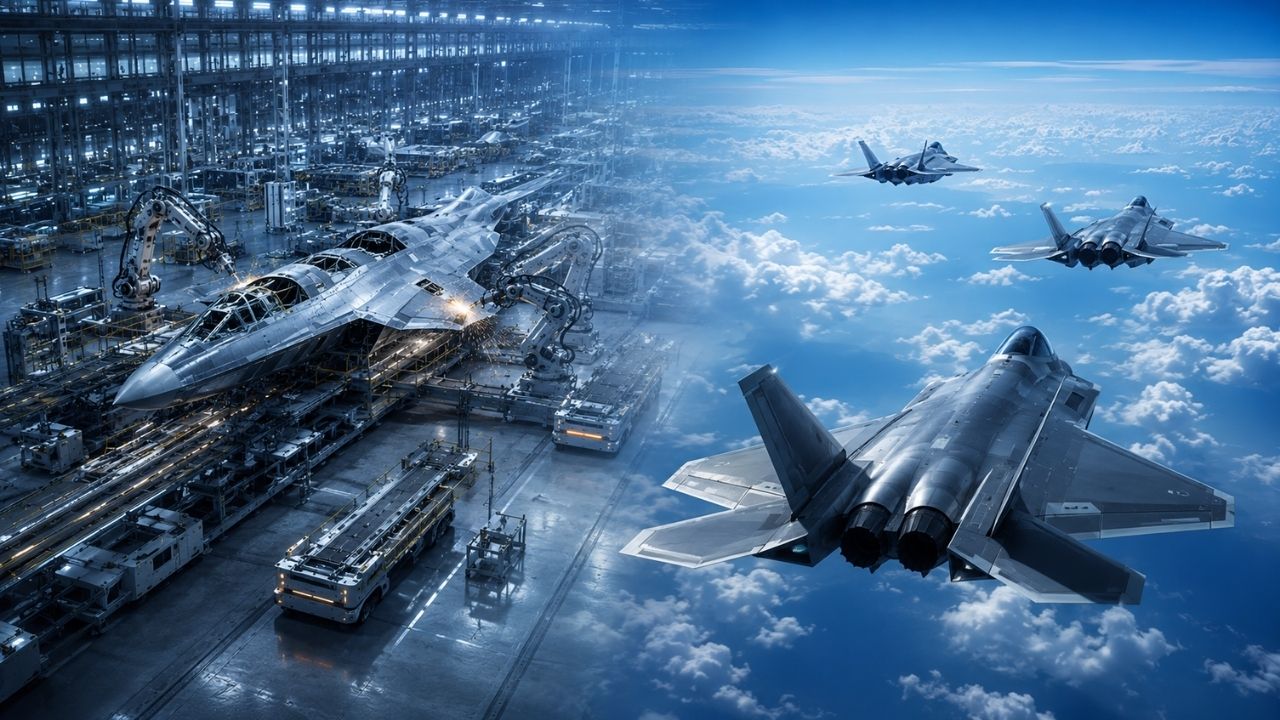


In China, the production of structural components for the J-20 fighter advances in a factory almost without humans, with artificial intelligence, robots, and autonomous vehicles reducing more than 80% of the work. The model exposes a shift in the military industry, where speed, precision, and automation weigh as much as modern aircraft.
The China has once again caught the attention of the industry by using a highly automated factory to produce structural components for the stealth fighter J-20. The line operates with almost no humans, supported by artificial intelligence, robots, and autonomous vehicles capable of reducing more than 80% of manual work.
According to information from Xataka, the advancement does not mean that people have completely disappeared from production, but it shows a significant shift in military manufacturing. Instead of relying solely on large teams on the line, the process now combines machines, sensors, digital coordination, and continuous operation for much of the day.
Factory almost without humans changes the logic of military production
The image of a military factory operating with few humans seems like science fiction, but the case of the J-20 shows a concrete change in how defense equipment can be manufactured. The production of structural parts becomes less dependent on the direct presence of workers at each stage.
-
Abandoned Factory in Rio’s North Zone Becomes Urban Hazard with Standing Water and Debris

-
The U.S. Navy Conducts Submarine Tests in Idaho Lake to Detect Underwater Noises Hidden by the Ocean

-
British Factory Transitions from Mechanical Parts to Producing 420,000 Electric Power Units Annually, Supplying 70% of Ford’s Electric Cars Sold in Europe
-
France Launches Network to Recycle 20 Million Cookware Pieces by 2027, Accepting All Brands for Aluminum and Coating Separation


The main impact is on the automation of the line. Robots perform repetitive tasks, autonomous vehicles transport materials, and artificial intelligence systems help coordinate stages that previously required more human intervention.
This type of factory changes the logic of time and scale. Machines can work for long periods, maintain high standardization, and reduce bottlenecks related to the availability of specialized labor.
In the military industry, this difference can be strategic. The more automated the production, the greater the capacity to maintain pace, correct processes, and manufacture complex components with less dependence on large teams.
J-20 reinforces the weight of automation in combat aviation
The J-20 fighter is considered one of China’s main stealth platforms. Therefore, any change in its production chain draws attention, especially when it involves structural components and intensive use of automation.
The production of parts for military aircraft requires high precision. Small failures can compromise performance, durability, and safety, which makes automation attractive when it can deliver controlled repetition and consistent quality.
In this scenario, AI does not appear as a mere technological detail. It becomes part of a productive system capable of organizing tasks, reducing interferences, and supporting decisions within the factory.
The use of robots and autonomous vehicles also indicates that the military aerospace industry is advancing towards a more integrated model. It is not just about an isolated machine, but a connected line.
More than 80% of the work can be taken out of human hands

The most striking data is the reduction of more than 80% of human work in production. This number points to a profound change in the distribution of tasks within the factory.
Instead of operators directly participating in much of the process, many stages are now taken over by automated systems. Human work tends to shift towards supervision, programming, maintenance, control, and decision-making.
This does not eliminate the importance of technicians and engineers. On the contrary, it increases the need for professionals capable of understanding machines, sensors, software, and complex industrial processes.
The difference is that the central force of the factory is no longer the number of people on the line but the ability to integrate technology, precision, and operational continuity.
Robots and autonomous vehicles accelerate the assembly line
Industrial robots are especially useful in tasks that require repetition, strength, stability, and precision. In the production of structural components, they can assist in stages of handling, positioning, assembly, and material processing.
Autonomous vehicles complete this logic by moving parts and supplies within the factory. When internal transport is also automated, the line gains a more constant pace and reduces interruptions.
This detail is important because military production does not only depend on manufacturing the part. It also depends on moving materials, organizing stages, and synchronizing processes without delays.
Automation creates a factory less like a traditional line and more like a coordinated system. Each part needs to communicate with the other for the flow to work.
Alert is not only military but industrial
China’s advancement raises an alert because it involves more than a specific fighter jet. It shows how industrial capability can become a strategic advantage in defense.
Producing advanced weaponry does not only depend on design, engine, or embedded electronics. It also depends on speed, scale, standardization, and the ability to maintain production even under pressure scenarios.
A factory almost without humans can reduce vulnerabilities related to labor, increase production predictability, and allow for faster industrial cycles. For competing countries, this changes the calculation.
The competition is no longer just about who has the best plane. It also involves who can produce, adapt, and sustain complex systems more efficiently.
Comparison with science fiction draws attention, but reality is more technical
The image of machines working in military factories resembles science fiction scenarios, especially stories where automated systems produce war equipment. But, in the real case, the central point is industrial.
There is no indication that the factory operates without human control or that machines make autonomous military decisions. What appears is advanced automation applied to component manufacturing.
This difference is important to avoid exaggerations. The issue is not about robots deciding conflicts, but about the modernization of a military production chain.
Even so, the symbolic impact is strong. When AI, robots, and autonomous vehicles enter a factory linked to the J-20, the boundary between industry, technology, and defense becomes more evident.
China shows a new stage of technological competition
China has been heavily investing in automation, artificial intelligence, and industrial modernization. In the case of the military industry, the application of these technologies gains additional weight because it directly affects the ability to produce strategic systems.
The model of a factory almost without humans suggests a larger trend: more digital lines, more controlled processes, and less dependence on repetitive manual tasks.
For combat aviation, this could mean faster and more standardized production of critical components. For the global industry, it is a sign that heavy automation may redefine competitive advantage.
The case of the J-20, therefore, should not be seen merely as a technological curiosity. It shows how modern air warfare also begins long before the plane takes off: it begins in the factory.
Military industry enters the era of the smart factory
The production of J-20 parts in a factory almost without humans shows how the military industry is entering a more automated phase. AI, robots, and autonomous vehicles become part of the production line, reducing direct human labor and increasing process integration.
The warning for other countries lies in the combination of technology and scale. Those who can manufacture complex equipment more quickly, accurately, and with fewer bottlenecks may gain an advantage even before the battlefield.
China, in this case, shows that the race for military superiority also involves the ability to transform factories into intelligent systems.
And you, do you think factories almost without humans will make the military industry more efficient or increase the risks of a technological race that is difficult to control? Share your opinion.