






 Portuguese
  Spanish


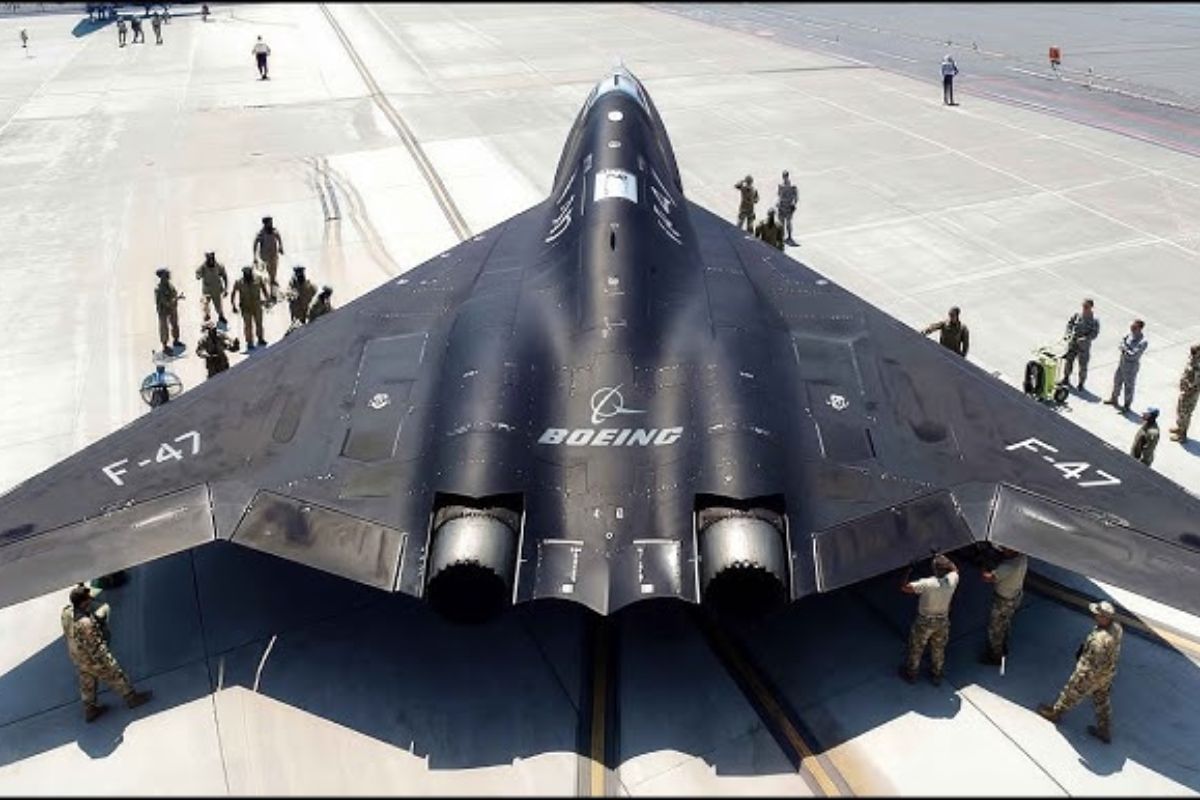
The Chinese state media launched an offensive against the F-47, the sixth-generation fighter that the US is developing with a budget of $5 billion and the first flight scheduled for 2028, questioning the unit cost of $300 million, Boeing’s capacity to deliver the project, and American dependence on rare earths controlled by China.
The official press of China has intensified in recent months a coordinated campaign to undermine the credibility of the F-47, the sixth-generation fighter that the United States Air Force is developing under the NGAD program. The escalation came shortly after the American military budget for 2027 revealed an allocation of around $5 billion for the project, and among the preferred targets of the Chinese narrative are Boeing, responsible for the aircraft, and the US dependence on rare earths controlled by Beijing. A survey produced by the China Aerospace Studies Institute identified that the coverage follows a repeated script: attacking the cost of the program, questioning the technical specifications announced by Washington, and raising doubts about the American industrial capacity to manufacture the aircraft in a relevant quantity.
The mechanism of this campaign is both military and communicational. Western analysts interpret the initiative as a strategy designed to target three different audiences at the same time: to internally reinforce confidence in Chinese technology, influence the perception of regional allies in Asia, and sow questions in American political and defense decision-making circles. The American sixth-generation fighter, therefore, has already surpassed the technical sphere and has become a piece of a narrative dispute between the two largest powers on the planet.
The price argument: $300 million for each sixth-generation fighter

Among the points most explored by the Chinese media is the unit cost of the F-47. Analysts linked to the Beijing government argue that the sixth-generation fighter could become the most expensive ever built, with values exceeding $300 million per aircraft. This line of attack seeks to create the perception that the program is doomed to face budgetary constraints that would compromise both the number of units ordered and the operational viability of the project.
-
Oil Company Robots Discover 3,300-Year-Old Canaanite Shipwreck in the Mediterranean, Proving Ancient Mariners Navigated Open Seas Using Stars Long Before Historians Thought

-
Helicopter Drops 180 Tons of Sand and Gravel on Swedish River to Revive Ecosystem Damaged by Decades of Exploitation

-
Brazilian Company Launches Retro Smartphone with 48 MP Camera, T9 Keyboard, and Privacy Features for Social Media-Free Use

-
Self-Taught Chinese Farmer Builds 5-Ton Submarine from Scrap, Launches It in Anhui River




The strategy is not new. During the development of the F-35, both internal and external critics also used cost as a tool to question the relevance of the program. What differentiates the Chinese approach to the sixth-generation fighter is the systematization: the China Aerospace Studies Institute documented that the same arguments are simultaneously reproduced by multiple state-run media, creating an orchestrated narrative rather than just independent analyses.
Boeing as a Target: Industrial Problems Become Ammunition Against the F-47

Another axis of the Chinese campaign directly targets Boeing, the company responsible for developing the sixth-generation fighter. The state media has highlighted recent difficulties faced by the company, including delivery delays, budget overruns, and issues in programs like the KC-46, trying to associate these weaknesses with the F-47. The logic is simple: if Boeing cannot meet deadlines on existing projects, how could it ensure the delivery of a fighter of unprecedented complexity?
This line of attack finds some resonance because Boeing’s problems are real and widely documented by the Western press. However, what the Chinese coverage omits is that the NGAD program is under direct oversight from the Air Force and operates under different control parameters than the company’s commercial projects. American officials state that the timeline for the sixth-generation fighter remains on track, with the first flight scheduled for 2028.
The Specifications of the F-47 That China Tries to Discredit
The U.S. Air Force has announced that the sixth-generation fighter will have a speed exceeding Mach 2, a combat range of over a thousand nautical miles, and stealth technologies that surpass those of the F-22 Raptor and the F-35 Lightning II. Chinese commentators contest these numbers, suggesting that the specifications would be overly optimistic and difficult to realize in the real world. The attempt is to reduce the psychological impact that the announcement of these capabilities has on U.S. regional allies in Asia.
Part of the Chinese narrative frames the F-47 as a defensive reaction from Washington to Beijing’s technological advancement. Some Chinese experts even draw parallels with the Cold War technological race, calling the situation a “Sputnik moment” for Washington, as if the U.S. were racing to maintain its lead in the aerospace sector. China, in turn, has already revealed the J-36, its own advanced fighter project, although details about its capabilities remain scarce.
Rare Earths as a Weapon: The Card China Plays Against the Sixth-Generation Fighter
One of the most recurring arguments in the campaign involves the supply chain of the F-47. The Chinese media emphasizes that advanced sensors and electronic systems of the sixth-generation fighter depend on rare earth minerals, a sector in which Beijing holds global dominance. The implicit message is that China could strangle American production simply by restricting the export of these inputs.
This point touches on a real vulnerability. The U.S. has been working to diversify its sources of rare earths, including through agreements with Japan and Australia, but has not yet eliminated exposure to Chinese control over the refining of these materials. By turning this dependency into a public argument against the sixth-generation fighter, Beijing signals that it is willing to use mineral dominance as a tool of strategic pressure, and not just as a commercial advantage.
The battle that goes beyond the skies: narrative as a battlefield
The volume and coordination of Chinese criticisms reveal that the F-47 has become more than a military program: it is now a symbol of the dispute between the two largest powers for global influence. China does not need to prove that the sixth-generation fighter will fail; it just needs to sow enough doubts for American lawmakers to question the investment, regional allies to hesitate, and public opinion to start seeing the program as a waste. This dynamic transforms communication into a battlefield as relevant as airspace.
On the American side, the response so far has been to maintain the schedule and reaffirm the project’s capabilities. The F-47 was designed to work in conjunction with combat drones and networked platforms, representing a paradigm shift in aerial warfare. If Washington can deliver the aircraft on time and to the announced specifications, the Chinese campaign will lose its main fuel. Otherwise, Beijing will have managed to turn a communication strategy into a self-fulfilling prophecy.
And you, do you think the American sixth-generation fighter justifies the investment of $300 million per unit, or does China have a point in questioning the program? Leave your opinion in the comments.





Be the first to react!