






 Portuguese
  Spanish


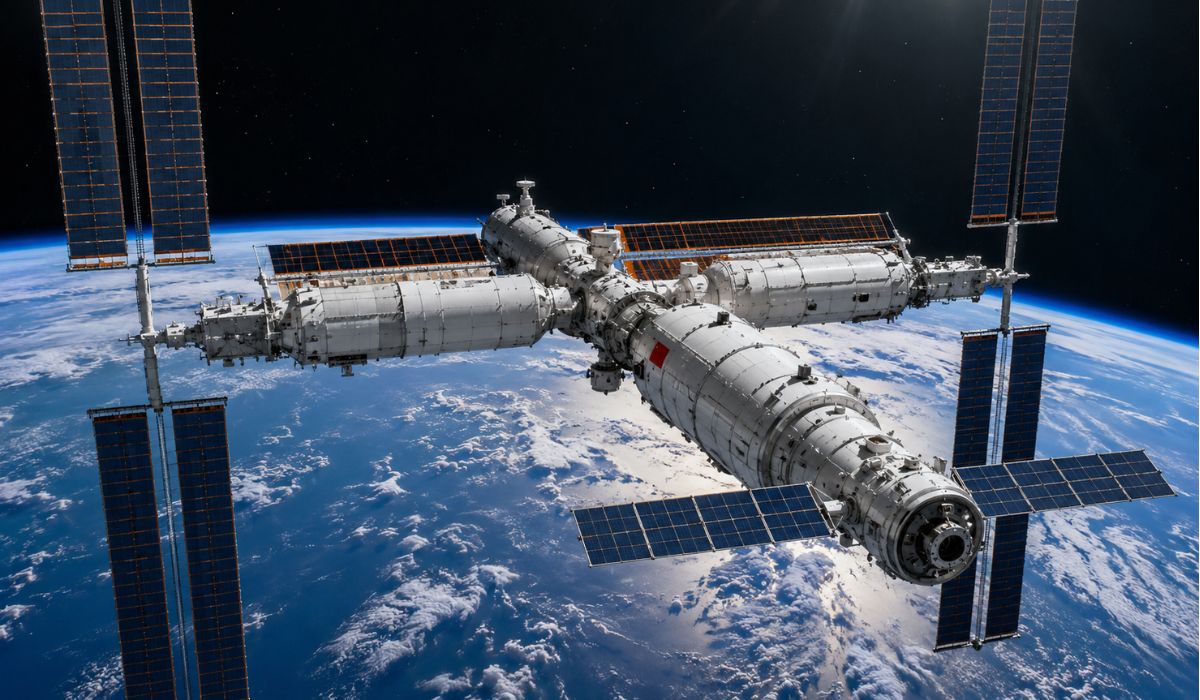


Chinese cargo ship arrived at Tiangong with supplies, fuel, scientific experiments, and a new extravehicular suit, in a mission that is part of the routine resupply of the space station maintained by China in low orbit.
China docked the cargo ship Tianzhou-10 to the Tiangong space station on May 11, 2026, about five hours after launch from the Wenchang Space Launch Center on Hainan Island.
The mission delivered supplies, propellant, scientific equipment, and a new suit for activities outside the station, in a resupply operation linked to the stay of Chinese crews in low orbit.
The launch took place at 8:14 AM Beijing time, with the Long March-7 Y11 rocket.
-
China Develops Custom 140-Ton Electric Mining Truck with 770 kWh Swappable Battery, Deploys 290 Units in Xinjiang’s Largest Zinc Mine

-
Meta to Launch Arena, a New Prediction App Targeting 3.56 Billion Users, Competing with Polymarket and Kalshi

-
Scientist Challenges Famous Human Evolution Theory, Argues Homo Sapiens Evolved Gradually Over Thousands of Years
-
15-Year-Old American Builds Ocean Generator with PVC Pipe and 3D-Printed Propeller for $12, Wins National Prize, Presents at White House, and Makes Forbes 30 Under 30 List




After entering orbit and performing approach maneuvers, the Tianzhou-10 connected to the rear port of the Tianhe module, the core of the Tiangong station, at 1:11 PM the same day, according to information released by the China Manned Space Agency.
Although the title mentions 6.9 tons, statements published by the Chinese state press reported that the delivered cargo was about 6.2 tons, distributed over more than 220 items.
The material includes resources for the station’s routine, equipment for scientific research, and components necessary for the operation of the orbital platform.
Tiangong Resupply Maintains Routine in Orbit
The Tianzhou-10 transported daily use items for the taikonauts, fuel for the station, research payloads, and equipment related to the maintenance of the orbital complex.
It also carried a extravehicular suit, used in activities outside the station, such as inspections, repairs, and installation of external structures.
This type of mission is necessary because Tiangong operates hundreds of kilometers from the Earth’s surface.
In orbit, food, clothing, tools, spare parts, and scientific materials need to be sent by cargo vehicles, as the station does not receive these resources through manned ships in sufficient volume to sustain the entire operation.
The Tianzhou-10 does not transport astronauts.
Its function is to carry cargo, automatically dock with the station, and allow crew members to remove the items sent from Earth.
After the period of use, the cargo ship is to be undocked and destroyed during reentry into the atmosphere, a procedure adopted in previous missions of the same series.
The resupply model allows China to maintain a regular sequence of operations in orbit.
Instead of concentrating all supplies on manned launches, the Chinese space program uses periodic cargo ships to replenish stocks, send experiments, and transport equipment that needs to reach the station at different phases of the missions.
Scientific experiments sent to the Chinese space station
Part of the cargo sent by Tianzhou-10 was intended for scientific experiments.
According to the state agency Xinhua and the broadcaster CGTN, the mission carried materials related to studies with artificial embryos, ultrathin solar cells, and greenhouse gas monitoring.
CGTN also reported that the cargo ship transported 41 scientific experiments to the station.
These researches integrate the use of Tiangong as a microgravity laboratory.
In this environment, fluids, materials, cells, and equipment may exhibit behavior different from that observed on the Earth’s surface.
The absence of dominant gravity allows testing physical and biological processes in specific orbital conditions.
Studies with fluids, for example, investigate how liquids move in closed systems when there is not the same influence of Earth’s gravity.
This type of research can be applied to the development of space technologies, thermal control systems, life support equipment, and industrial processes that depend on the behavior of liquids and gases.
Tests with ultrathin solar cells are linked to the development of lighter panels for use in satellites, stations, and other space structures.
Meanwhile, the greenhouse gas monitoring equipment can assist in the validation of sensors aimed at observing the Earth’s atmosphere, as described in the Chinese mission statements.
Extravehicular suit reinforces activities outside the station
Among the items brought by Tianzhou-10 is a new extravehicular suit.
These suits function as individual life support systems, with pressure, temperature, oxygen, communication, and mobility control.
Without this equipment, astronauts cannot perform activities outside the station.
The delivery completes a set of new extravehicular suits sent to Tiangong.
Two previous units were transported by Tianzhou-9, while the third followed on the Tianzhou-10 mission.
With the new suit, the station now has more resources for external operations scheduled by ground control teams.
Extravehicular activities require detailed technical planning.
During an exit from the station, the crew depends on the suit, the tools brought for the operation, and the monitoring done by the teams responsible for the mission.
Therefore, the replacement or expansion of this set of equipment is part of the regular maintenance of a manned station.
In addition to repairs, spacewalks can involve the installation of scientific instruments, adjustments to external structures, and inspections in areas that are not accessible from the inside of the modules.
The frequency of these operations depends on the station’s needs and the schedule set by the Chinese space program.
How the Tiangong Space Station is Formed
The Tiangong was completed in 2022 and is made up of three main modules: Tianhe, Wentian, and Mengtian.
The Tianhe is the central module, with control systems, life support, work areas, and docking points.
The Wentian and Mengtian modules expand the space available for experiments and scientific activities.
The names of the modules are often translated as “harmony of the heavens” for Tianhe; “quest for the heavens” for Wentian; and “dreaming of the heavens” for Mengtian.
The choice of terms follows the tradition of the Chinese space program of using names associated with the sky in its missions and vehicles.
The station remains in low Earth orbit and receives crews via the Shenzhou spacecraft.
Supply, in turn, is carried out by the Tianzhou cargo ships.
At the time of Tianzhou-10’s arrival, the Shenzhou-21 crew was aboard the station and was expected to begin transferring items according to the mission plan.
The stay of astronauts on the Tiangong depends on a sequence of combined operations.
The Shenzhou spacecraft transport crew members, while the Tianzhou ships transport supplies, propellant, and equipment.
This system separates the functions of human and cargo transport, allowing for better organization of the mission schedule.
Tianzhou Program Began Operating in 2017
The Tianzhou program began operationally in 2017, when the first ship of the series was launched to dock with the Tiangong-2 experimental laboratory.
Since then, the cargo ships have been used as resupply vehicles for Chinese orbital structures.
The name Tianzhou is often translated as “heavenly ship” or “celestial vessel.”
In practice, the ship functions as an automatic cargo vehicle, designed to transport materials between Earth and the space station.
Each mission follows stages of launch, orbital insertion, approach, docking, cargo transfer, and disposal.
In addition to carrying supplies, the Tianzhou can transport propellant.
This feature is used to support orbital maneuvers of the station, which needs periodic adjustments to compensate for effects such as residual atmospheric drag in low orbit.
Without these corrections, the altitude and trajectory of the platform can be affected over time.
The Tianzhou-9 left the station on May 6, days before the arrival of the new cargo ship.
The departure made room for the docking of Tianzhou-10, which took on the role of cargo vehicle connected to the orbital complex.
This short interval between missions shows the sequence planned in the supply schedule released by the Chinese program.
Tianzhou-10 Mission in China’s Space Calendar
The docking of Tianzhou-10 was part of a series of missions aimed at keeping Tiangong supplied and operational.
The operation involved launch, automatic approach, connection with the Tianhe module, and preparation for the removal of supplies by the crew.
In operational terms, such missions allow the station to receive new experiments, replace consumed materials, and maintain safety resources for the crew.
They also enable the delivery of equipment that was not available in previous launches or that needs to be renewed during the platform’s lifespan.
The presence of varied scientific cargo indicates that the station continues to be used for research in areas such as biology, materials, energy, and environmental observation.
The results of these studies depend on the execution of experiments in orbit, data collection, and subsequent analysis by ground teams.
Tiangong is also part of a broader space program, which includes lunar missions, robotic launches, and plans for manned exploration beyond low orbit.
In the case of Tianzhou-10, the immediate goal was logistical: to deliver supplies and equipment to keep the station operating and support the continuity of scientific activities.





