





 Portuguese
  English
  Spanish
  4 min of reading
  0 comments


China Announces Underwater Space Station to Explore Energy, Extreme Life, and Expand Geopolitical Influence in Regions with Cold Seeps and Mineral Wealth.
The China is about to redefine the boundaries of science and technology with a bold project that mixes science fiction with reality: a kind of space station installed on the seabed, two thousand meters deep. The announcement was made by the South China Sea Oceanology Institute, affiliated with the Chinese Academy of Sciences.
Named the Cold Seep Ecosystem Research Center, the underwater laboratory will be divided into three modules and is set to begin operations by 2030. The mission: study extreme forms of life, explore alternative energy sources, and, not least, expand China’s geopolitical presence in disputed deep waters of the Pacific.
An Underwater Space Station
Dubbed by scientists as the “deep-sea space station,” the laboratory will have space for six researchers, who will stay on site for up to a month. They will face extreme conditions: total absence of sunlight, temperatures near zero, and a pressure 200 times greater than at sea level.
-
A former SpaceX engineer left rockets to reinvent home construction and founded a startup that manufactures wall panels from a grass that grows about 15 centimeters per day.

-
He transformed an abandoned plastic water tank into an underground house in the “hobbit hole” style, using only repurposed pallet wood, without heavy machinery or expensive labor.

-
How much does it cost to install gutters in a house in 2026? See the average costs of materials, labor, and the most common extra expenses that may arise during installation.
-
A prefabricated wooden house with 70 m², three bedrooms, and a veranda costs the same as a new car in Brazil, around R$ 140,000, or 24,000 euros, and is for sale in Spain.




To ensure the team’s survival and the smooth operation of the research, a highly efficient life support system will be necessary, as well as a continuous monitoring network for methane, ecological data, and tectonic activity.
Why Are Cold Seeps So Important?
The main focus of the station will be the study of so-called cold seeps, oceanographic phenomena that occur when cold water masses rich in hydrocarbons like methane and hydrogen sulfide emerge from cracks in the ocean floor.
These seeps do not rely on sunlight to sustain life. Microorganisms, such as bacteria and archaea, use the chemical compounds released to generate energy through chemosynthesis.
This form of life serves as the basis for unique ecosystems, with species such as tube worms, mollusks, and crustaceans adapted to extreme environments.
In addition to their scientific value, these zones hide mineral and energy riches of still little-explored proportions.
Energy of the Future: Frozen Methane
Among the most sought-after resources is methane hydrate, also known as “flammable ice.” This compound traps methane molecules in a structure of ice, and when heated or depressurized, it releases the gas — which makes it literally “catch fire.”
The energy potential is enormous. Studies indicate that global deposits of methane hydrate contain more carbon than all the world’s oil, coal, and natural gas reserves combined.
According to Li Chaolun, director of the Institute and project leader, “cold seeps are the keys to understanding Earth’s carbon cycle, life in extreme environments, and the safe extraction of resources like methane hydrates,” he stated to China Daily. He added, “It’s not just about science.”
Despite the excitement surrounding the energy potential of methane, there is an important warning: methane is 80 times more powerful than CO₂ as a greenhouse gas. This means that any leak can have severe environmental consequences if not tightly controlled.
Still, the compound is considered strategic for the energy transition, as it emits 50% less carbon than coal when burned.
China’s Technological Race with the Space Station
The station is part of a larger ecosystem of oceanographic research. The project includes autonomous submersibles, underwater observatories, and the drilling vessel Mengxiang, equipped with a drill capable of reaching depths of up to 11,000 meters.
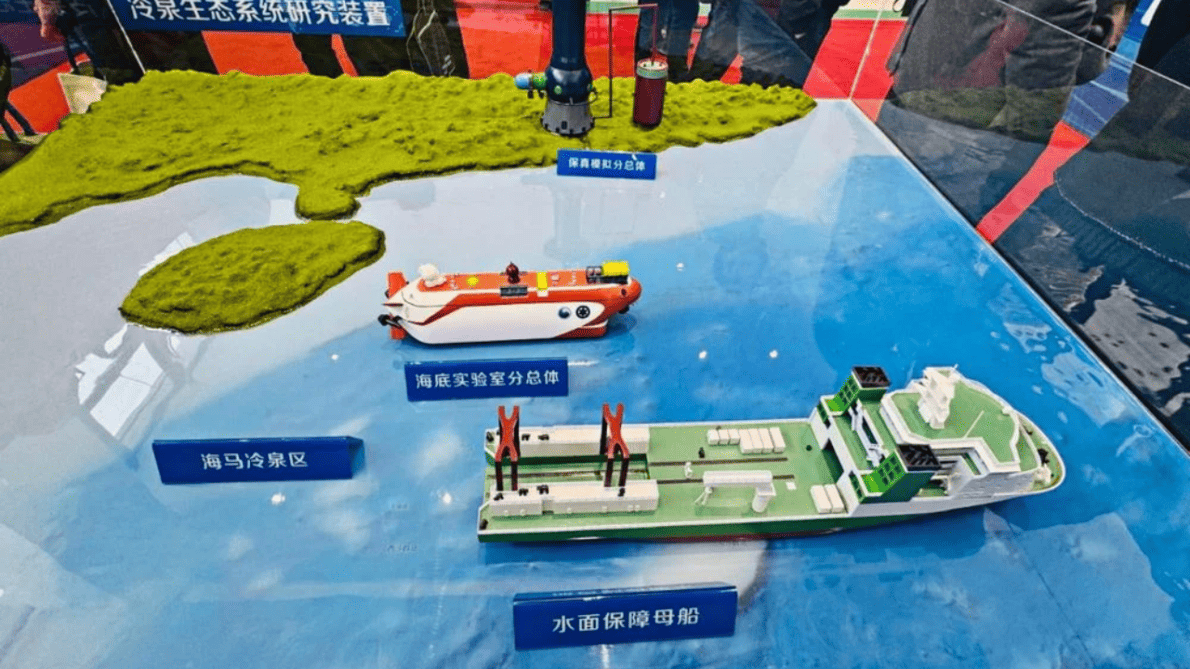
The goal is ambitious: study Earth’s climatic past, investigate deep microbial life forms, and improve the prediction of earthquakes and tsunamis in the South China Sea region.
This initiative also places China more intensely in maritime territorial disputes, reinforcing its technological and scientific presence in contested waters, such as the Spratly and Paracel Islands.
Science, Sovereignty, and the Future
Combining cutting-edge science, geopolitical ambitions, and valuable natural resources, the underwater space station project marks a new chapter in underwater exploration.
This is a strategic move by China, not only to lead research in marine biology and energy but also to strengthen its global position in times of energy transition and international tension.
What to Expect in the Future?
If everything goes as planned, the Chinese underwater station will be one of the deepest and most complex structures ever built by humanity. It will not only expand knowledge about the mysteries of the seabed but could play a crucial role in the energy and environmental security of the coming decades.
And more than that: the “deep-sea space station” reminds us that humanity’s next big leap may not be into space, but rather into the unknown abyss lurking just below us — in the depths of the ocean.







Be the first to react!