Portuguese
  Spanish


Flexible coating solutions promise to speed up construction, reduce site mess, and eliminate traditional civil construction steps, with more uniform application and less rework. Anti-fissure technology and the possibility of painting in just a few hours place the so-called “plaster of the future” among the most discussed alternatives in the sector.
Flexible coating solutions for walls and ceilings have gained traction in civil construction by promising faster execution, less waste generation, and a more uniform finish, especially in projects aiming to reduce manual steps and accelerate the timeline without compromising the final result.
Marketed as the “plaster of the future,” this type of coating combines technical mortars capable of replacing part of conventional finishing in specific applications, provided that the execution follows the manufacturer’s guidelines, the type of base used, and the correct sequence of the constructive system.
While the traditional model relies on a scratch coat to increase adhesion between the wall and the plaster, the latest formulations aim to offer high fixation with simplified application, reducing construction phases and minimizing rework during execution.
-
28-meter, 156-ton titans traveled 20,000 km from China to the port of Santa Catarina: Portonave received 7 fully electric megacranes, part of a R$ 210 million package, to double container handling.

-
They exchanged the idea of a large house for a 35 m² warehouse, spent US$ 12,000 on the structure, and created a tiny house in Colorado with space to live and work.

-
A newly opened terminal in the middle of the Amazon has begun transporting soy and corn through Amapá, eyeing the queue of ships that is congesting the ports in the South.

-
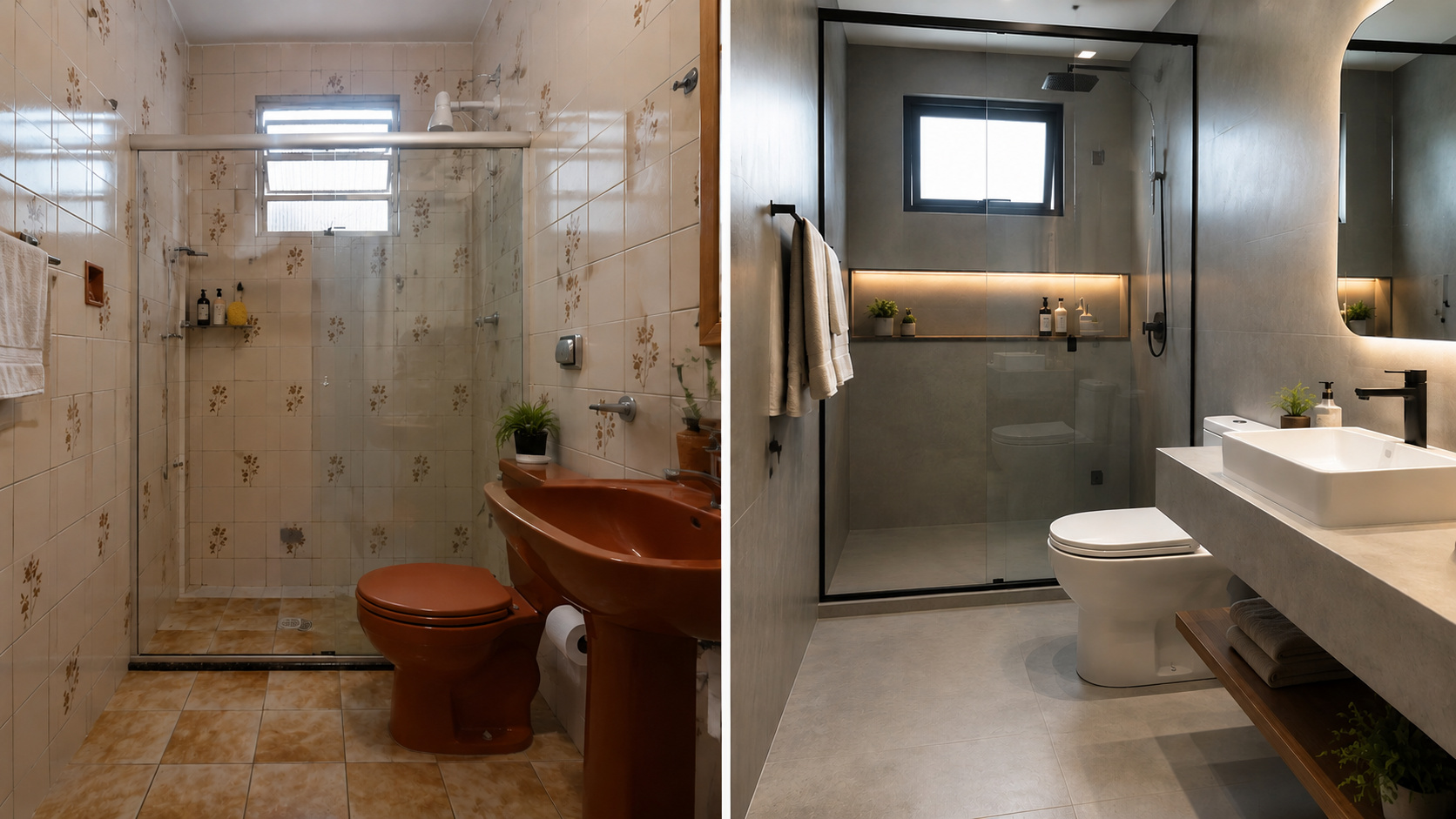
Goodbye to old tiles: renovation technique without construction transforms bathrooms in a few hours, eliminates debris, and reduces costs with coverings using special paints, high-resistance adhesives, and modern finishes that completely renew the space.


Flexible Plaster Gains Space in Modern Construction
Among the most well-known examples in this segment is ICFlex, a line presented as a flexible technical coating developed for applications such as first coat, finishing, and leveling of walls and ceilings in different types of constructive systems.
In addition to aiming for reduced rework, the material’s proposal involves a more uniform and predictable application, as mechanical mixing helps maintain the appropriate consistency during preparation and promotes better distribution over the surface.
Depending on the project’s needs, the product can be applied with a roller or trowel, allowing for a more regular execution and reducing flaws frequently observed in methods performed entirely manually on site.
Another differential lies in the flexibility of the coating, a characteristic considered important for EPS walls and structures subject to minor movements, a factor that contributes to reducing surface cracks and improving the durability of the finish.
Less Mess and Reduced Steps on Site
Much of the interest in this type of solution is linked to the possibility of consolidating functions into fewer construction steps, reducing traditional procedures that typically require more time, greater material consumption, and successive corrections throughout execution.
In certain applications, the system can simplify the process that previously depended on a scratch coat, plaster, fine mortar, and sealer, shortening the path to painting and reducing the volume of waste scattered around the site.
With fewer intermediate phases, water consumption, internal material transport, and dust accumulation during service also tend to decrease, a situation that favors site organization and improves operational control among teams.
Nevertheless, industry experts warn that the elimination of the scratch coat should not be interpreted as a universal solution, as performance depends directly on the constructive system, the absorption of the base, and the technical specifications provided for each application.
How the Plaster of the Future is Applied
During application, the material must achieve the consistency indicated by the manufacturer, without improvised changes in dosage or the amount of water used in the mechanical mixing preparation.
After this step, the surface should receive a continuous and uniform layer, respecting the recommended thickness for each type of finish and avoiding flaws that could compromise adhesion, leveling, or performance over time.
When the system foresees a second coat, it is necessary to wait for the minimum curing interval before continuing the service, a period that in some commercial demonstrations is associated with an approximate timeframe of 6 hours.
Once the time indicated by the manufacturer has elapsed, certain versions allow for direct paint application, a characteristic that draws attention in projects interested in reducing deadlines without losing visual uniformity and quality in the final finish.
Anti-Fissure Technology Improves Finish
The most cited technical differential in this type of coating is its anti-fissure property, achieved by combining a flexible formulation and, in some systems, the use of fiberglass mesh.
The solution seeks to distribute tensions and reduce apparent marks on the surface.
Another relevant point is adhesion to different substrates, provided they are clean, firm, free of dust, oil, loose parts, or incompatible moisture.
Without this minimal preparation, even high-performance materials can show failures, detachment, or irregular finishes.
Standardization also impacts productivity.
When mixing, application, and curing follow the correct procedure, the surface tends to require fewer subsequent corrections, which reduces rework and improves labor utilization on site.
Replacement of traditional plaster depends on the application
Despite the appeal of innovation, the use of the “plaster of the future” requires technical understanding, not just comparison with the traditional method.
Each version can have a different function, such as a first coat, finish, leveling, or composition with other system elements.
In the case of ICFlex Acabamentos, the manufacturer’s own description indicates specific application after previous stages in works meeting certain requirements, including use within its own technical sequence.
Therefore, the total replacement of the scratch coat cannot be generalized for all scenarios.
Product selection must consider design, substrate, environment, curing time, thickness, yield, and compatibility with paint.
In larger projects, guidance from a technical manager helps prevent improper use and ensures that the promised performance is achieved.
Civil construction seeks faster and cleaner solutions
Interest in flexible coatings is growing because civil construction seeks faster, cleaner, and more predictable processes.
Materials that combine functions, reduce steps, and improve productivity find space in residential projects, industrialized systems, and renovations with tight deadlines.
Industry events, such as FEICON, also help increase the visibility of these technologies, especially when manufacturers demonstrate practical application and performance under controlled conditions.
Widespread adoption, however, depends on correct specification and proven performance in real-world use.
With proper substrate preparation, selection of the correct version, and adherence to curing time, flexible plaster can reduce mess, speed up execution, and improve the finish.
The conventional method, however, still remains necessary in situations where the technical system requires traditional steps.