Portuguese
  Spanish


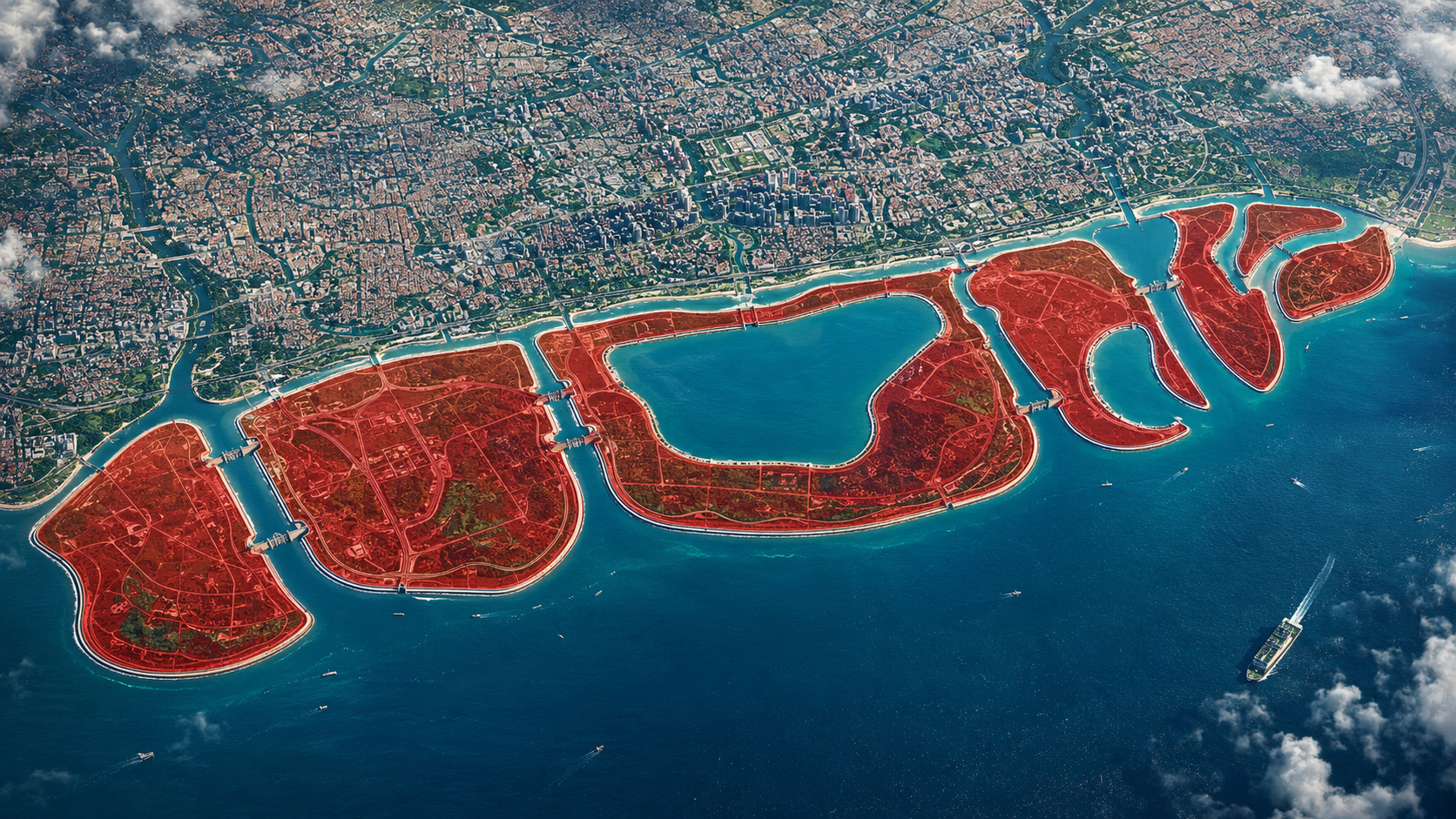


Singapore plans to create an 800-hectare artificial island to curb sea level rise and protect the country’s east coast.
Singapore has advanced in the planning of one of Asia’s most ambitious coastal projects: the Long Island, a project that aims to reclaim about 800 hectares of land from the sea, approximately equivalent to 1,120 football fields, to form a new line of defense against rising sea levels along the country’s east coast. According to PUB, Singapore’s national water agency, on a page published on March 3, 2026, the proposal is still undergoing technical studies and was designed to create a continuous barrier against sea level rise in one of the country’s most vulnerable urban areas.
The proposal goes far beyond simple land reclamation. According to PUB itself, Long Island is expected to integrate two sea barrages, pumping stations, coastal drainage, and a new freshwater reservoir, capable of retaining water from 12 existing canals before it is lost to the sea. In practice, Singapore is attempting to transform a climate threat into strategic infrastructure, combining coastal defense, water security, and territorial expansion into a single mega-project against rising sea levels.
Long Island Project Aims to Create a New Artificial Coastline in the Ocean
Long Island will not be just an ordinary island. According to documents released by Singapore’s national water agency, the proposal envisions the creation of a long artificial strip extending into the sea, acting as a protective barrier for the country’s east coast.
-
Facing high rent, couple transforms parents’ garage into a fully functional apartment, creating a complete home at a fraction of the market cost.

-
MIT Scientists Develop Method to Transform CO₂ into a Construction Ally, Boosting Cement Strength by 13% in 24 Hours for More Sustainable Infrastructure

-
Canadian City Builds 8 Tiny Homes in 72 Hours for Homeless Youth, Plans 40 Affordable Houses for Female-Led Families Amid Housing Crisis

-
45-year-old Brazilian mother of 9 and grandmother of 12 receives 27 m² house made from recycled plastic, built in 15 hours with interlocking blocks and a recycled roof.


In practice, the ocean would hit this new artificial structure first before reaching densely populated urban areas.


The idea is similar to coastal systems used in countries like the Netherlands, but adapted to Singapore’s extremely compact geographical conditions.
In addition to maritime protection, the reclaimed space could open up new areas for infrastructure, recreation, transport, and future urban use.
800-Hectare Area Equivalent to Over a Thousand Football Fields
The project’s figures help explain why Long Island has garnered so much international attention. The planned area for maritime reclamation is around 800 hectares.
For visual comparison, this is approximately equivalent to 1,120 standard football fields.
It is such a large territorial scale that the project could literally alter the design of Singapore’s coastal map. The country already has a history of territorial expansion through land reclamation. Since independence, Singapore has significantly expanded its area using land reclamation from the sea.
Changi Airport itself and important parts of the urban coast were built this way.
Giant Barrages and Sluice Gates to Be Used to Contain Ocean Advance
One of the central elements of Long Island will be the hydraulic coastal defense system. According to official information, the project is expected to include two large sea barrages, control gates, and pumping stations.
These structures will function to control water inflow and outflow, reduce flood risk, and protect urban areas against high tides and extreme storms.
The concept is similar to that used in some of the world’s most sophisticated anti-flood systems. The difference is that Singapore intends to integrate coastal defense, water reservoir, and territorial expansion into a single mega-structure.
New Freshwater Reservoir is a Strategic Part of the Project
Another important aspect of Long Island is the creation of a new freshwater reservoir. This holds enormous significance for Singapore, a country that historically faces water limitations due to its small territory and the absence of large natural rivers.

The city-state already invests heavily in desalination, water recycling, and artificial reservoirs to ensure water security.
In the case of Long Island, the idea is to use part of the structure to store fresh water integrated into the national system. In other words, the mega-project not only tries to prevent the sea from advancing, but also to expand the country’s strategic water supply capacity.
Singapore’s east coast is among the country’s most vulnerable areas
The eastern region was chosen because it concentrates important urban areas vulnerable to sea level rise. Singapore has a low average altitude across much of its territory. This makes the country particularly exposed to risks linked to rising ocean levels and extreme weather events.
According to climate projections frequently cited by local authorities, parts of the coast may face an increasing risk of flooding in the coming decades if sea levels continue to rise. Long Island emerges precisely as a long-term preventive response.
Singapore prepares coastal investments that could last for decades
Although Long Island is among the most visible projects, it is part of a much larger climate adaptation strategy.
In recent years, the Singaporean government announced its intention to invest tens of billions of Singaporean dollars in coastal protection over the coming decades. The country treats sea encroachment as a structural national security threat.

This includes not only new artificial islands, but also reinforcement of urban drainage, pumping systems, elevation of coastal areas, and hydraulic modernization.
Country has already expanded territory using large-scale sea reclamation
Long Island seems futuristic, but Singapore already has decades of experience in land reclamation. Since the 1960s, the country has significantly expanded its territorial area through sea reclamation.
Several modern urban regions were built on areas that were originally sea. This includes parts of Changi Airport, Marina Bay, and coastal industrial zones.
The difference now is that the main objective is not just urban expansion, but national-scale climate protection.
Project can also change urban planning and infrastructure of the city-state
In addition to its defensive function, experts point out that Long Island could open up space for new urban uses in the future.
The reclaimed areas could eventually host parks, transport infrastructure, recreational zones, or even new developments.
This means that the project blends coastal engineering, climate adaptation, and urban planning into a single gigantic territorial intervention.
Megastructure places Singapore among the most aggressive countries in climate adaptation
While many countries are still discussing long-term plans to deal with sea level rise, Singapore has already begun to structure large-scale physical projects.
The country’s strategy draws attention because it stems from a logic of immediate adaptation, and not just climate mitigation.
Instead of waiting for future impacts, the city-state is literally trying to reshape its coastal geography before the problem becomes critical.
Long Island shows how climate change is already altering global engineering
Singapore’s project helps reveal a silent transformation in global engineering. Megastructures previously conceived primarily for transport, energy, or urban expansion are now beginning to be designed to directly address climate change.
In the case of Long Island, the threat does not come from a military enemy or immediate economic crisis, but from the gradual advance of the ocean over the coming decades.

This transforms the project into something greater than a simple artificial island: an attempt to redraw the boundary between city and sea before nature does it on its own.
Now, the main question is to what extent coastal countries will be able to finance and build structures of this magnitude before the advance of the oceans pressures entire cities around the planet.